




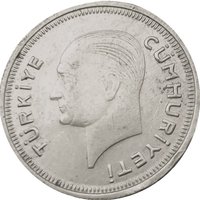
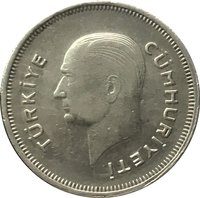
Obverse
Description:
Crescent moon and star.
Inscription:
TÜRKİYE
CUMHURİYETİ
CUMHURİYETİ
Translation:
REPUBLIC OF TURKEY
Script: Latin
Language: Turkish
Engraver: Percy Metcalfe
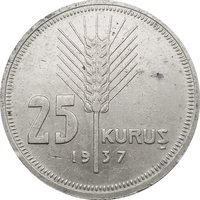
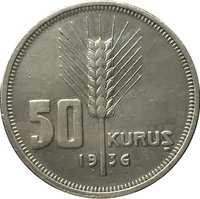
Reverse
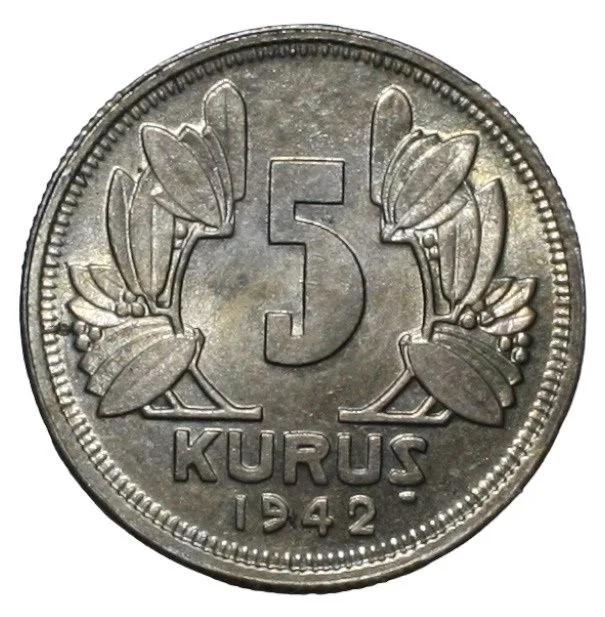
Description:
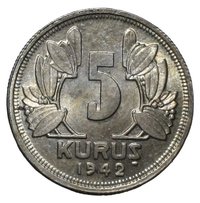
Sprig-patterned value
Inscription:
5
KURUŞ
1939
KURUŞ
1939
Translation:
KURUŞ
1939
1939
Script: Latin
Language: Turkish
Engraver: Percy Metcalfe
Edge
3 reeded segments and 3 smooth segments. "T.C." on the smooth segments.
Legend:
T.C.
Translation:
The Senate and People of Rome.
Language: Latin
Mintings
| Year | Mint Mark | Mintage | Quality | Collection |
|---|---|---|---|---|
| 1935 | — | 100,000 | ||
| 1936 | — | 2,900,000 | ||
| 1937 | — | 4,060,000 | ||
| 1938 | — | 13,380,000 | ||
| 1939 | — | 12,520,000 | ||
| 1940 | — | 4,340,000 | ||
| 1942 | — | 10,160,000 | ||
| 1943 | — | 15,360,000 |
Historical background
In 1935, Turkey's currency situation was defined by the early stability of the newly established Turkish Republic under the leadership of Mustafa Kemal Atatürk. The foundational economic reform had occurred a decade earlier with the 1925 abolition of the Ottoman lira (lira-ı Osmani) and its replacement with the Turkish lira (Türk lirası), symbolizing a decisive break from the empire's economic legacy. This new currency was managed by the freshly chartered Central Bank of the Republic of Turkey (Türkiye Cumhuriyet Merkez Bankası), which began operations in 1931, providing a modern institution to regulate money supply and credit.
The mid-1930s period was characterized by a state-directed, inward-looking economic policy focused on industrialization and self-sufficiency, known as statism (devletçilik). The currency was not freely convertible, and exchange controls were in place to conserve foreign reserves and direct capital toward strategic state-led industrial projects. This insulated the lira from global shocks like the Great Depression but also integrated it into a planned, protectionist system where its value was administratively managed rather than being set by open markets.
Consequently, the Turkish lira in 1935 enjoyed a period of relative stability, but this was an administered stability within a closed economy. The focus was not on international forex markets but on using monetary policy as a tool for national development. The era's legacy was a centralized financial system that prioritized domestic control and industrialization over integration with the global economy, a framework that would define Turkey's monetary approach for decades to come.
The mid-1930s period was characterized by a state-directed, inward-looking economic policy focused on industrialization and self-sufficiency, known as statism (devletçilik). The currency was not freely convertible, and exchange controls were in place to conserve foreign reserves and direct capital toward strategic state-led industrial projects. This insulated the lira from global shocks like the Great Depression but also integrated it into a planned, protectionist system where its value was administratively managed rather than being set by open markets.
Consequently, the Turkish lira in 1935 enjoyed a period of relative stability, but this was an administered stability within a closed economy. The focus was not on international forex markets but on using monetary policy as a tool for national development. The era's legacy was a centralized financial system that prioritized domestic control and industrialization over integration with the global economy, a framework that would define Turkey's monetary approach for decades to come.
Series: 1935 Turkey circulation coins


🌱 Very Common