

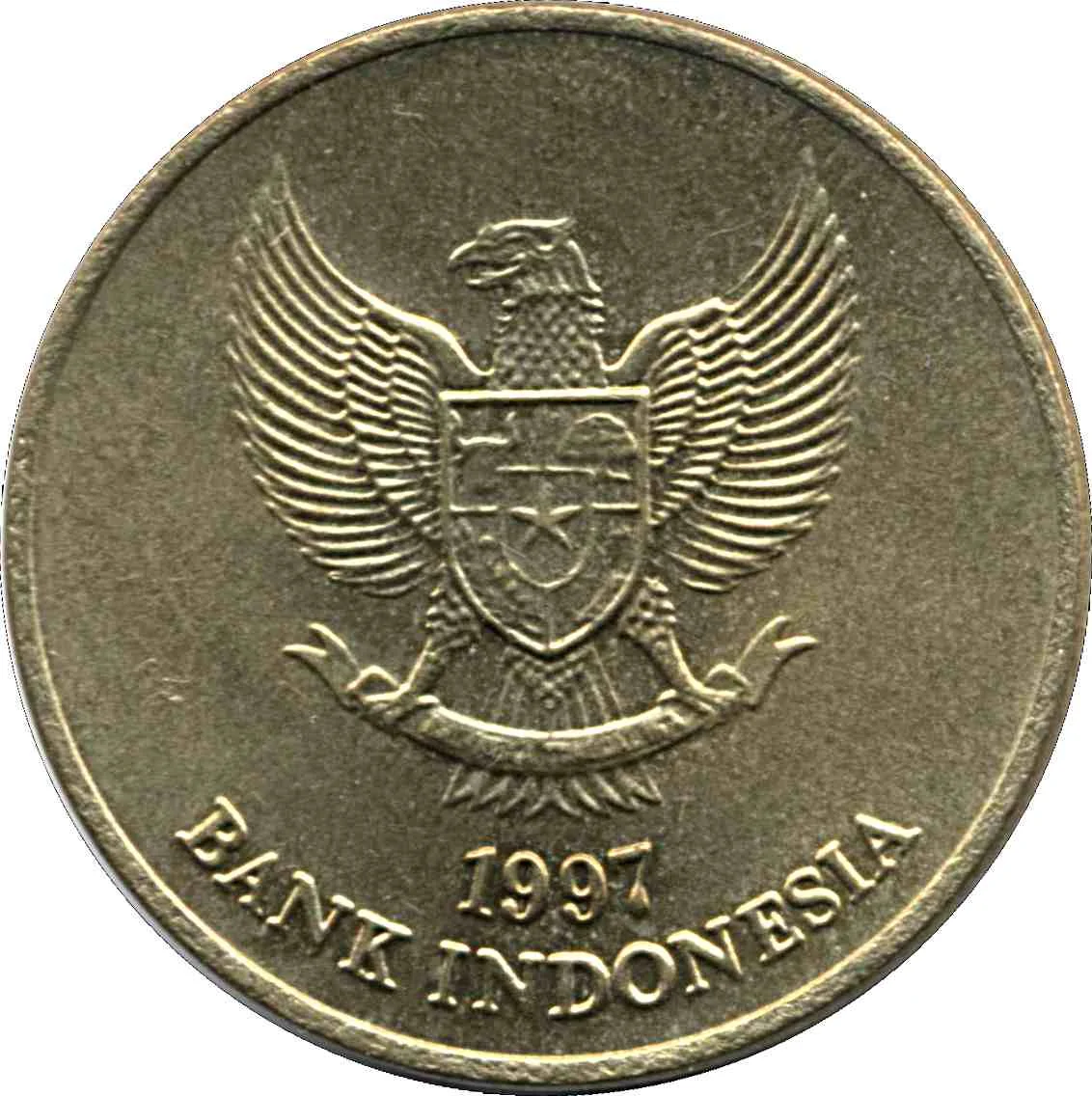

500 rupiah – Indonesia
Add to wishlist
Indonesia
Context
Material
Diameter: 24 mm
Weight: 5.34 g
Thickness: 1.83 mm
Shape: Round
Composition: Aluminium bronze
Magnetic: No
Technique: Milled
Alignment: Medal alignment

flip

References
KM: #
Numista: #6666
Value
Exchange value: 500 IDR
Inflation-adjusted value: 4142.34 IDR
Obverse
Description:
Coat of Arms. Legend and date lettering vary in size.
Inscription:
BHINNEKA TUNGGAL IKA
1997
BANK INDONESIA
1997
BANK INDONESIA
Translation:
BHINNEKA TUNGGAL IKA
1997
BANK INDONESIA
1997
BANK INDONESIA
Script: Latin
Languages: Indonesian, Javanese
Reverse
Description:
Jasmine (Jasminum sambac), the National Flower.
Inscription:
500
RUPIAH
BUNGA MELATI
RUPIAH
BUNGA MELATI
Translation:
Five Hundred Rupiah
Jasmine Flower
Jasmine Flower
Script: Latin
Language: Indonesian
Edge
Plain
Categories
| Symbols> Coat of Arms |
| Plants> Flower |
Mints
| Name | Mark |
|---|---|
| Perum Peruri | — |
Mintings
| Year | Mint Mark | Mintage | Quality | Collection |
|---|---|---|---|---|
| 1997 | — | — | Proof | |
| 1997 | — | — | ||
| 2000 | — | — | ||
| 2001 | — | — | ||
| 2002 | — | — | ||
| 2003 | — | — |
Historical background
In 1997, Indonesia was hailed as a model emerging economy, part of the "Asian Tiger" phenomenon with years of strong GDP growth and macroeconomic stability. The Indonesian rupiah was managed under a controlled, crawling peg system against the US dollar, which had provided predictability for businesses and attracted substantial foreign investment, particularly into massive industrial and infrastructure projects. However, this success masked underlying vulnerabilities, including a fragile banking sector burdened by high levels of short-term corporate debt denominated in US dollars, widespread cronyism, and a current account deficit.
The Asian Financial Crisis, which began with the devaluation of the Thai baht in July 1997, quickly spread to Indonesia. As investor confidence collapsed, the rupiah came under severe speculative attack. Bank Indonesia initially spent billions of dollars in futile defense before widening the currency's trading band and then, in August 1997, allowing it to float freely. The rupiah went into a catastrophic freefall, losing over 80% of its value against the US dollar by early 1998. This collapse devastated Indonesian corporations and banks, which saw their dollar-denominated debts balloon in local currency terms, pushing the financial system toward insolvency.
The currency crisis rapidly spiraled into a full-blown economic, political, and social catastrophe. The government's initial response was inconsistent, and a rescue package from the International Monetary Fund (IMF), with its stringent reform conditions, initially eroded market confidence further. The economic meltdown triggered mass unemployment, soaring inflation, and widespread social unrest, which ultimately led to the fall of President Suharto's 32-year authoritarian regime in May 1998. The 1997-98 crisis thus marked a profound turning point, ending an era of growth and forcing a painful restructuring of Indonesia's economy and political system.
The Asian Financial Crisis, which began with the devaluation of the Thai baht in July 1997, quickly spread to Indonesia. As investor confidence collapsed, the rupiah came under severe speculative attack. Bank Indonesia initially spent billions of dollars in futile defense before widening the currency's trading band and then, in August 1997, allowing it to float freely. The rupiah went into a catastrophic freefall, losing over 80% of its value against the US dollar by early 1998. This collapse devastated Indonesian corporations and banks, which saw their dollar-denominated debts balloon in local currency terms, pushing the financial system toward insolvency.
The currency crisis rapidly spiraled into a full-blown economic, political, and social catastrophe. The government's initial response was inconsistent, and a rescue package from the International Monetary Fund (IMF), with its stringent reform conditions, initially eroded market confidence further. The economic meltdown triggered mass unemployment, soaring inflation, and widespread social unrest, which ultimately led to the fall of President Suharto's 32-year authoritarian regime in May 1998. The 1997-98 crisis thus marked a profound turning point, ending an era of growth and forcing a painful restructuring of Indonesia's economy and political system.

🌱 Very Common