

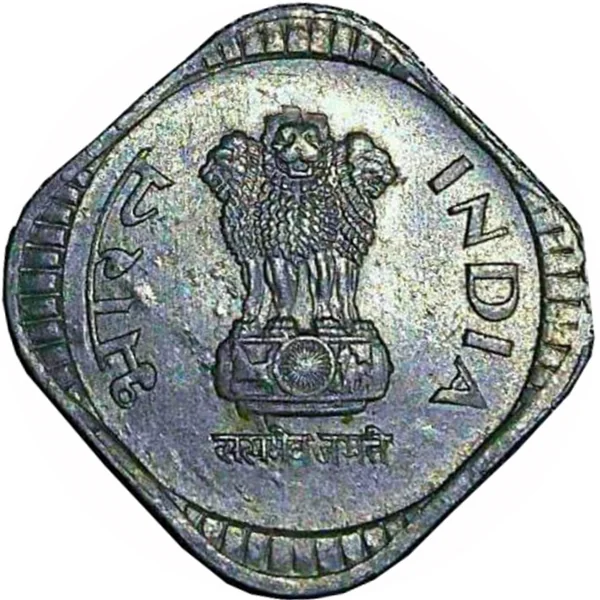
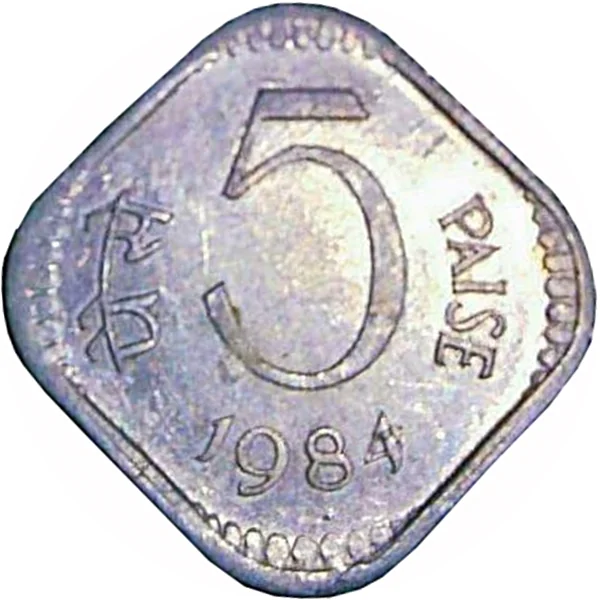
5 paise – India
Add to wishlist
India
Context
Material
Weight: 1.52 g
Thickness: 2.1 mm
Shape: Square with rounded corners
Composition: Aluminium
Magnetic: No
Technique: Milled
Alignment: Medal alignment
flip
References
KM: #
Numista: #66613
Value
Exchange value: 0.05 INR
Inflation-adjusted value: 0.90 INR
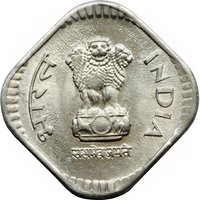
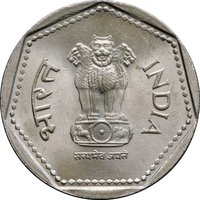
Obverse
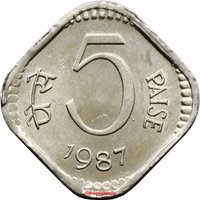
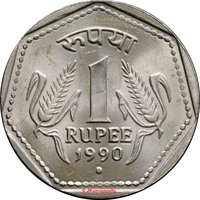
Reverse
Edge
Plain
Mintings
| Year | Mint Mark | Mintage | Quality | Collection |
|---|---|---|---|---|
| 1984 | — | — |
Historical background
In 1984, India’s currency system operated under a tightly controlled and complex framework, characteristic of the Licence Raj era. The Indian Rupee (INR) was not fully convertible; its exchange rate was pegged to a basket of currencies of major trading partners, but effectively managed by the Reserve Bank of India (RBI) with a strong bias towards a fixed parity with the British Pound Sterling. This period was marked by severe foreign exchange shortages, leading to stringent regulations under the Foreign Exchange Regulation Act (FERA), 1973. These rules strictly limited the holding of foreign currency by individuals and businesses, making international transactions cumbersome and fostering a parallel black market for foreign exchange.
The domestic currency landscape was dominated by banknotes issued by the RBI, with the highest denomination being the ₹100 note. However, the economy was significantly cash-based, and the volume of high-value currency in circulation was relatively low compared to the size of the population and economy. This, coupled with the fact that the ₹100 note featured the portrait of Mahatma Gandhi (the series introduced in 1969), meant that counterfeiting was a concern, though not yet at a crisis level. The monetary policy of the time was largely focused on directed credit to priority sectors and controlling inflation, which had moderated from the double-digit peaks of the early 1980s but remained a persistent challenge.
Politically and economically, 1984 was a year of profound transition. The assassination of Prime Minister Indira Gandhi in October and the subsequent accession of Rajiv Gandhi set the stage for a shift in economic thinking. While no major currency reforms were enacted that year, the groundwork was being laid for future liberalization. The pressures of fiscal deficits, a burdensome subsidy regime, and the inefficiencies of the controlled system were becoming increasingly apparent. Thus, 1984 represented the final phase of an old monetary order, with the devaluation of the rupee, gradual liberalization of exchange controls, and the eventual high-denomination currency changes of the late 1980s and 1990s still on the horizon.
The domestic currency landscape was dominated by banknotes issued by the RBI, with the highest denomination being the ₹100 note. However, the economy was significantly cash-based, and the volume of high-value currency in circulation was relatively low compared to the size of the population and economy. This, coupled with the fact that the ₹100 note featured the portrait of Mahatma Gandhi (the series introduced in 1969), meant that counterfeiting was a concern, though not yet at a crisis level. The monetary policy of the time was largely focused on directed credit to priority sectors and controlling inflation, which had moderated from the double-digit peaks of the early 1980s but remained a persistent challenge.
Politically and economically, 1984 was a year of profound transition. The assassination of Prime Minister Indira Gandhi in October and the subsequent accession of Rajiv Gandhi set the stage for a shift in economic thinking. While no major currency reforms were enacted that year, the groundwork was being laid for future liberalization. The pressures of fiscal deficits, a burdensome subsidy regime, and the inefficiencies of the controlled system were becoming increasingly apparent. Thus, 1984 represented the final phase of an old monetary order, with the devaluation of the rupee, gradual liberalization of exchange controls, and the eventual high-denomination currency changes of the late 1980s and 1990s still on the horizon.
⭐ Somewhat Rare