

20 Schilling – Austria
Circulating commemorative coins
Commemoration: Nine states of Austria
Austria
Obverse
Description:
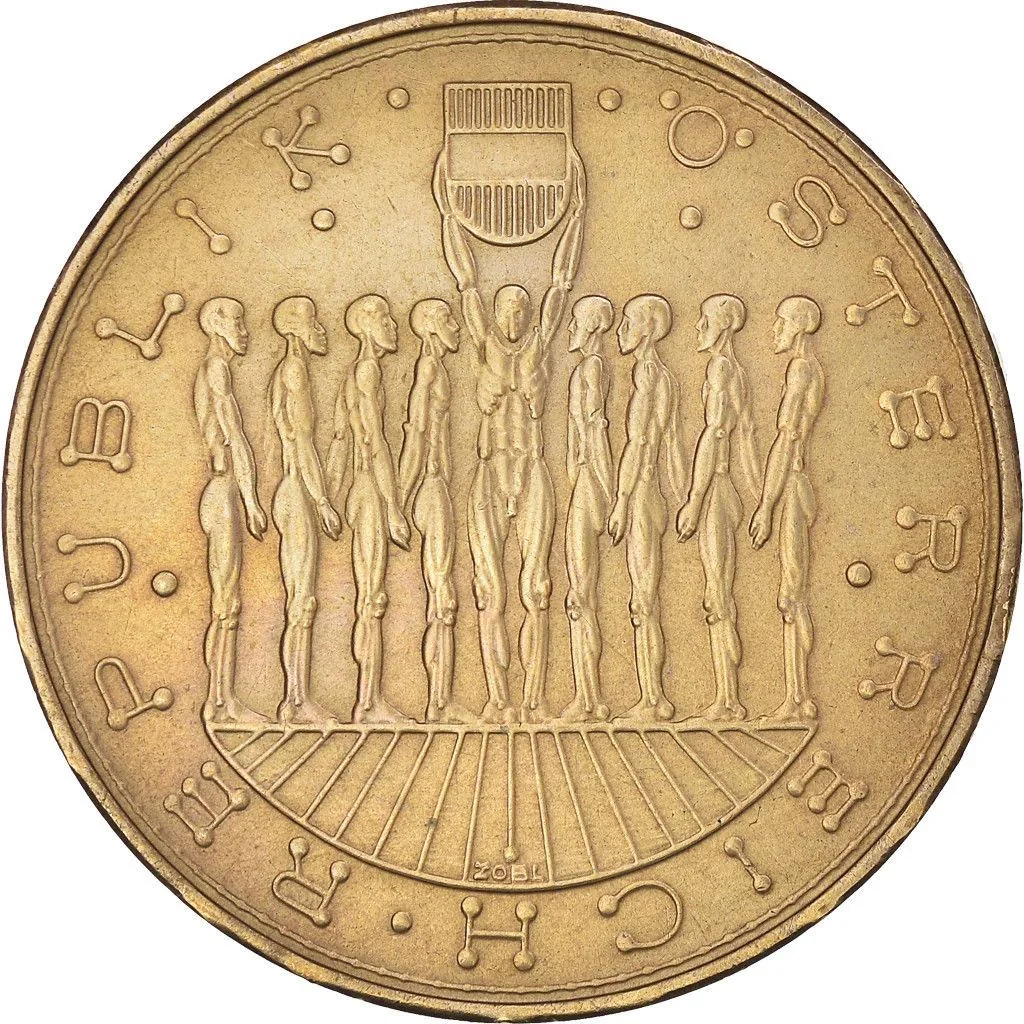
Nine figures, one central holding Austria’s shield, symbolize the nine provinces.
Inscription:
REPUBLIK· ·ÖSTERREICH·
ZOBL
ZOBL
Translation:
REPUBLIC OF AUSTRIA
EAGLE
EAGLE
Script: Latin
Language: German
Engraver: Helmut Zobl
Reverse
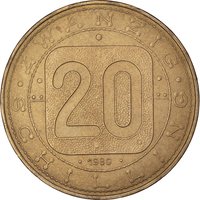
Description:
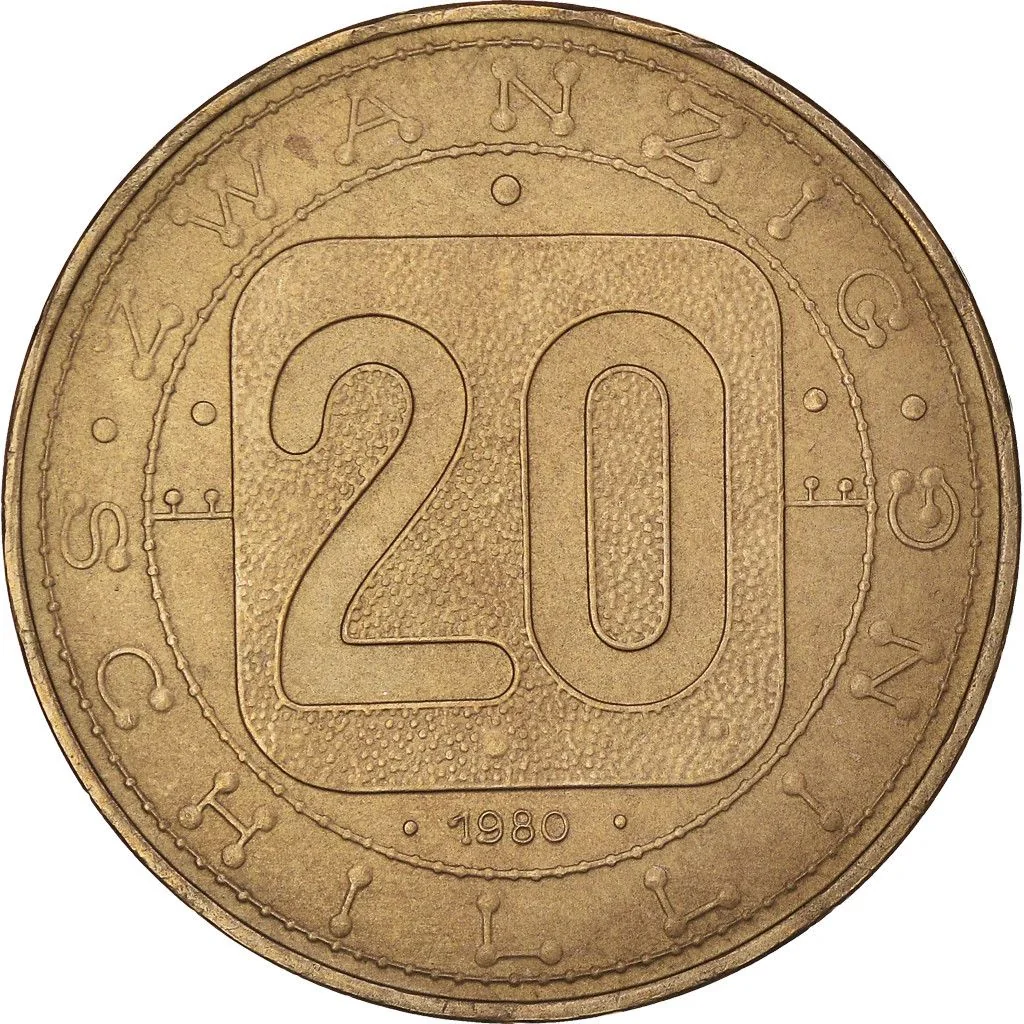
Square dotted field with rounded corners, flanked by stylized trees. Date below.
Inscription:
·ZWANZIG· SCHILLING
20
·1980·
20
·1980·
Translation:
Twenty Schilling
20
1980
20
1980
Script: Latin
Language: German
Engraver: Helmut Zobl
Edge
19 incuse dots in 9 groups of 2 or 3 (KM#2946.1), or smooth edge (KM#2946.2)
Legend:
••• •• •• •• •• •• •• •• ••
Mints
| Name | Mark |
|---|---|
| Münze Österreich | — |
Mintings
| Year | Mint Mark | Mintage | Quality | Collection |
|---|---|---|---|---|
| 1980 | — | 9,851,500 | ||
| 1980 | — | 48,000 | Proof | |
| 1981 | — | 450,500 | ||
| 1981 | — | 49,000 | Proof | |
| 1991 | — | 100,000 | ||
| 1992 | — | 25,000 | ||
| 1993 | — | 28,000 |
Historical background
In 1980, Austria's currency situation was characterized by remarkable stability, a legacy of the country's post-war economic model known as the "Austro-Keynesian" consensus. The Austrian schilling, managed by the highly respected Oesterreichische Nationalbank (OeNB), was a bastion of strength, often referred to as the "hard schilling." This stability was achieved through a policy priority of maintaining low inflation and a stable exchange rate, particularly by pegging the schilling closely to the strong Deutsche Mark of West Germany, Austria's most important trading partner. This de facto peg provided an anchor of credibility and facilitated predictable trade and investment flows.
This monetary stability stood in stark contrast to the turbulent global economic environment of the late 1970s and early 1980s, which was marked by the oil crises, high inflation, and volatile currency markets. While many Western economies struggled with "stagflation," Austria's coordinated approach involving social partnership between government, business, and labor unions helped moderate wage-price pressures. Consequently, Austria maintained lower inflation rates than many of its European neighbors, which in turn bolstered confidence in the schilling. The currency's strength was a point of national pride and a key tool for economic management.
However, this stability was not without its costs and debates. The commitment to a hard currency policy required strict fiscal and monetary discipline, which some argued constrained economic growth and full employment policies at times. Furthermore, the tight linkage to the Deutsche Mark meant that Austria effectively imported the monetary policy decisions of the German Bundesbank, sacrificing a degree of independent monetary control. As the decade progressed, these tensions would subtly increase, setting the stage for future discussions about European monetary integration, which Austria would eventually join by adopting the euro in 1999.
This monetary stability stood in stark contrast to the turbulent global economic environment of the late 1970s and early 1980s, which was marked by the oil crises, high inflation, and volatile currency markets. While many Western economies struggled with "stagflation," Austria's coordinated approach involving social partnership between government, business, and labor unions helped moderate wage-price pressures. Consequently, Austria maintained lower inflation rates than many of its European neighbors, which in turn bolstered confidence in the schilling. The currency's strength was a point of national pride and a key tool for economic management.
However, this stability was not without its costs and debates. The commitment to a hard currency policy required strict fiscal and monetary discipline, which some argued constrained economic growth and full employment policies at times. Furthermore, the tight linkage to the Deutsche Mark meant that Austria effectively imported the monetary policy decisions of the German Bundesbank, sacrificing a degree of independent monetary control. As the decade progressed, these tensions would subtly increase, setting the stage for future discussions about European monetary integration, which Austria would eventually join by adopting the euro in 1999.
🌱 Very Common