

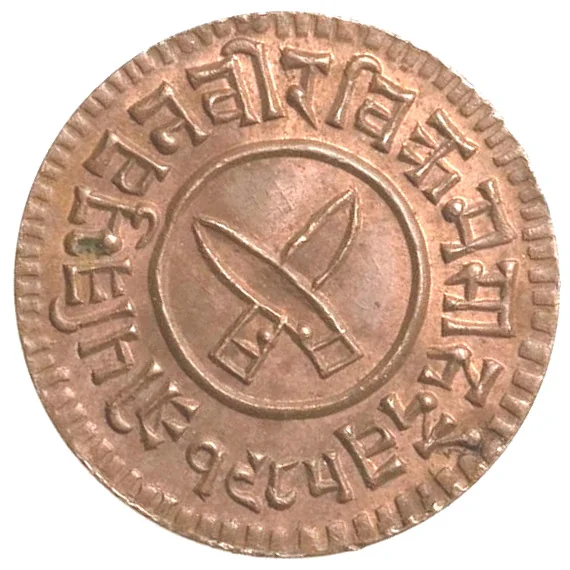
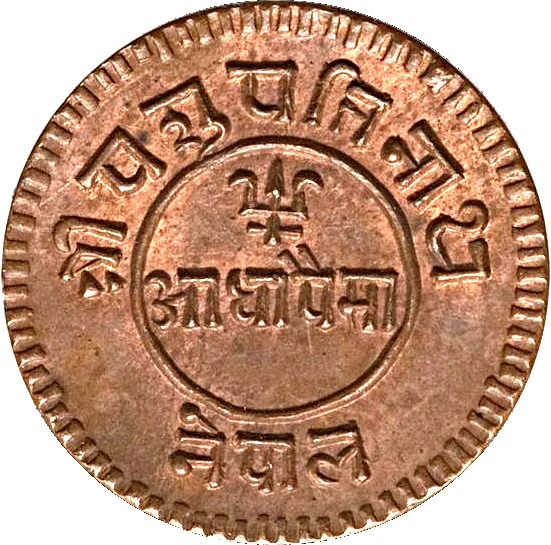
½ Paisa – Nepal
Nepal
Context
Years: 1921–1928
Issuer: Nepal 
Ruler: Tribhuvan Bir Bikram Shah
Currency:
(1546—1932)
Demonetized: Yes
Material
References
KM: #Click to copy to clipboard684
Numista: #66230
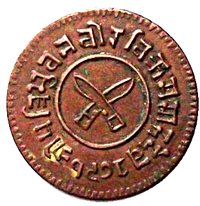
Obverse
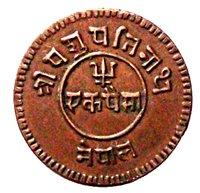
Reverse
Edge
Mintings
| Year | Mint Mark | Mintage | Quality | Collection |
|---|---|---|---|---|
| 1921 | — | — | ||
| 1928 | — | — |
Historical background
In 1921, Nepal's currency situation was characterized by a complex dual system, deeply tied to its political and economic relationship with British India. The primary circulating medium was the Nepali Mohar, but the more dominant and influential currency was the Indian Rupee. The Nepali Rupee (divided into 100 paisa) had been introduced by Prime Minister Chandra Shumsher in 1903, but it struggled for acceptance. The Indian Rupee circulated freely and was often preferred for larger transactions and trade, creating a de facto monetary dependency. This was due to Nepal's open border and immense trade deficit with India, which required settlements in Indian currency.
The system was further complicated by the circulation of older, debased silver coins from the earlier Malla and Shah periods, leading to a confusing multiplicity of coins in daily use. The government's own silver coins were often minted with varying purity and weight, undermining public confidence. This lack of a standardized, trusted national currency hampered internal trade and state revenue collection. Furthermore, Nepal was on a silver standard, but the global decline in the value of silver after World War I caused the Nepali rupee's value to fluctuate against the gold-based Indian Rupee, creating exchange rate instability and economic uncertainty.
Recognizing these problems, the Rana government undertook a significant reform in 1921 by introducing the "Naya Paisa" system. This reform decimalized the currency (1 Rupee = 100 Paisa) and, more importantly, pegged the Nepali Rupee at par with the Indian Rupee. This move effectively placed Nepal on a sterling exchange standard via India, stabilizing the exchange rate and simplifying cross-border trade. While it cemented monetary dependence, it provided the stability needed for commerce and marked a crucial step toward a modern, unified currency system for the kingdom.
The system was further complicated by the circulation of older, debased silver coins from the earlier Malla and Shah periods, leading to a confusing multiplicity of coins in daily use. The government's own silver coins were often minted with varying purity and weight, undermining public confidence. This lack of a standardized, trusted national currency hampered internal trade and state revenue collection. Furthermore, Nepal was on a silver standard, but the global decline in the value of silver after World War I caused the Nepali rupee's value to fluctuate against the gold-based Indian Rupee, creating exchange rate instability and economic uncertainty.
Recognizing these problems, the Rana government undertook a significant reform in 1921 by introducing the "Naya Paisa" system. This reform decimalized the currency (1 Rupee = 100 Paisa) and, more importantly, pegged the Nepali Rupee at par with the Indian Rupee. This move effectively placed Nepal on a sterling exchange standard via India, stabilizing the exchange rate and simplifying cross-border trade. While it cemented monetary dependence, it provided the stability needed for commerce and marked a crucial step toward a modern, unified currency system for the kingdom.
💎 Extremely Rare