

1 Paisa – Nepal
Nepal
Context
Years: 1920–1930
Issuer: Nepal 
Ruler: Tribhuvan Bir Bikram Shah
Currency:
(1546—1932)
Demonetized: Yes
Material
References
KM: #Click to copy to clipboard687
Numista: #22698
Obverse
Description:
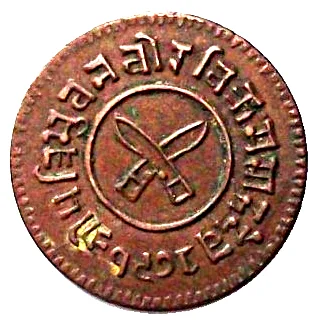
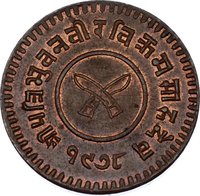
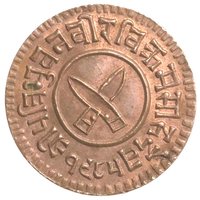
Crossed khukris, 2.6–3.8g.
Reverse
Edge
Mintings
| Year | Mint Mark | Mintage | Quality | Collection |
|---|---|---|---|---|
| 1920 | — | — | ||
| 1921 | — | — | ||
| 1922 | — | — | ||
| 1923 | — | — | ||
| 1924 | — | — | ||
| 1925 | — | — | ||
| 1926 | — | — | ||
| 1927 | — | — | ||
| 1928 | — | — | ||
| 1929 | — | — | ||
| 1930 | — | — |
Historical background
In 1920, Nepal's currency system was a complex and transitional blend of indigenous and foreign influences, operating under the autocratic Rana regime. The primary circulating medium was the Nepalese Mohar, a silver coin minted in Kathmandu. However, the system was not unified; various older and debased coins, including the Dam and the Paisa, remained in circulation, creating confusion in everyday transactions. More significantly, the Indian Rupee, given the open border and extensive trade links with British India, circulated widely and was often preferred for larger commercial dealings, highlighting Nepal's economic dependency.
This monetary landscape was directly managed by the state under Prime Minister Chandra Shumsher Jung Bahadur Rana. The Rana rulers treated coinage as a source of state revenue, periodically recalling and reminting coins with altered silver content, a practice known as "rupees bramha." This led to fluctuations in the value and purity of the Mohar, causing uncertainty. Furthermore, the government maintained an official fixed exchange rate between the Nepalese Mohar and the Indian Rupee, but this official rate often diverged from the market rate, leading to arbitrage and inefficiency.
The year 1920 itself did not see a major reform, but it existed within a period of mounting pressure for modernization. The complexities of the dual-currency system and the administrative burdens of the old coinage were becoming increasingly apparent. This set the stage for the significant monetary reform that would follow in 1932, during the reign of Prime Minister Bhim Shumsher, which introduced the decimal system (Rupees and Paisa) and established a more standardized currency, marking the beginning of the end for the medieval Mohar system.
This monetary landscape was directly managed by the state under Prime Minister Chandra Shumsher Jung Bahadur Rana. The Rana rulers treated coinage as a source of state revenue, periodically recalling and reminting coins with altered silver content, a practice known as "rupees bramha." This led to fluctuations in the value and purity of the Mohar, causing uncertainty. Furthermore, the government maintained an official fixed exchange rate between the Nepalese Mohar and the Indian Rupee, but this official rate often diverged from the market rate, leading to arbitrage and inefficiency.
The year 1920 itself did not see a major reform, but it existed within a period of mounting pressure for modernization. The complexities of the dual-currency system and the administrative burdens of the old coinage were becoming increasingly apparent. This set the stage for the significant monetary reform that would follow in 1932, during the reign of Prime Minister Bhim Shumsher, which introduced the decimal system (Rupees and Paisa) and established a more standardized currency, marking the beginning of the end for the medieval Mohar system.
🌟 Uncommon