

Obverse
Description:
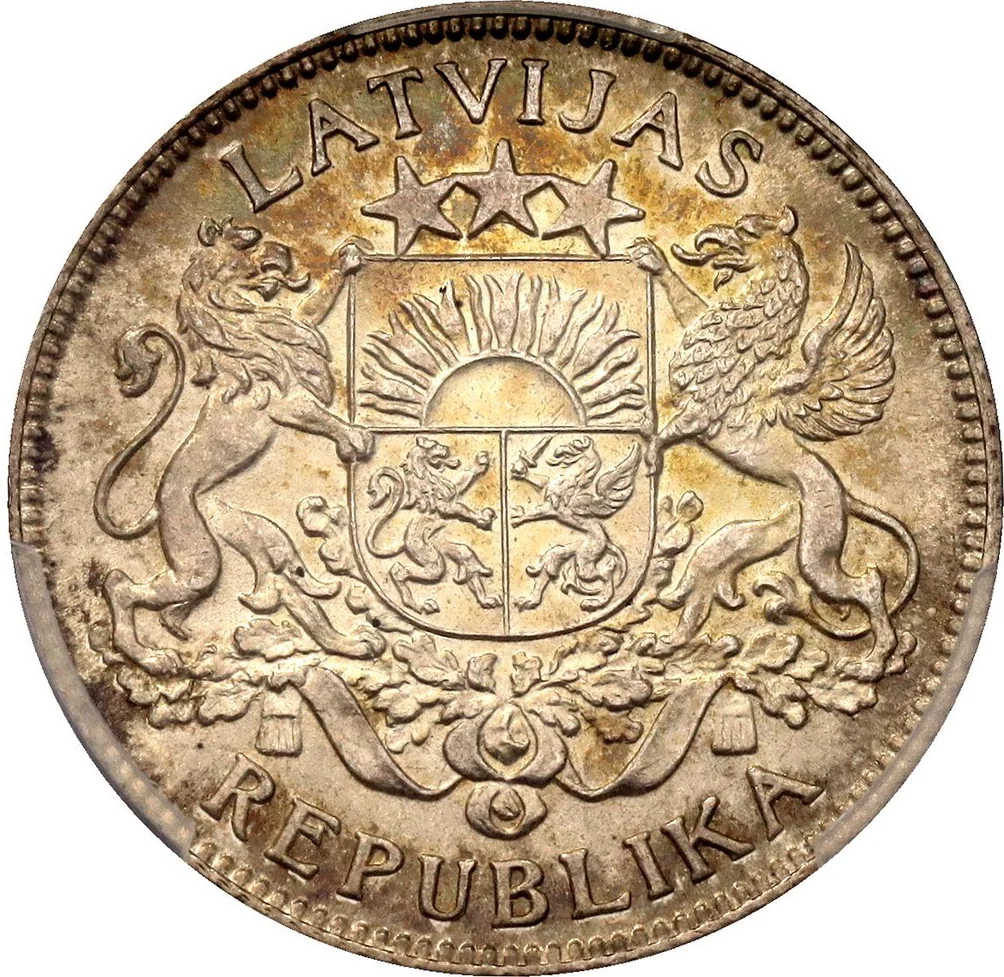
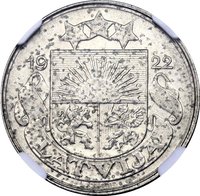
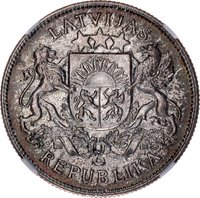
Arms with supporters
Inscription:
LATVIJAS
REPUBLIKA
REPUBLIKA
Translation:
REPUBLIC OF LATVIA
Script: Latin
Language: Latvian
Engraver: Jānis Tilbergs
Reverse
Description:
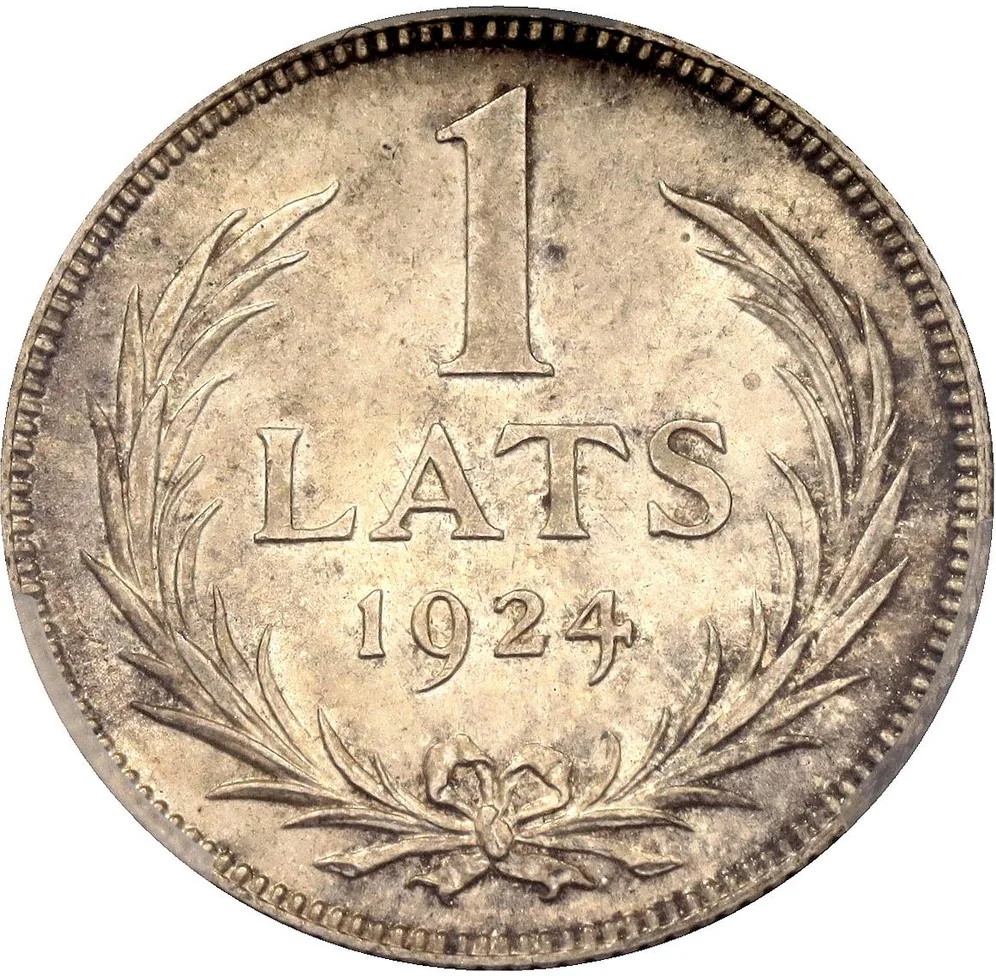
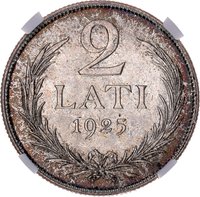
Value and date encircled
Inscription:
1
LATS
1924
LATS
1924
Script: Latin
Engraver: Jānis Tilbergs
Edge
Categories
| Symbols> Coat of Arms |
Mints
| Name | Mark |
|---|---|
| Royal Mint (Tower Hill) | — |
Mintings
| Year | Mint Mark | Mintage | Quality | Collection |
|---|---|---|---|---|
| 1923 | — | — | ||
| 1924 | — | 10,000,000 |
Historical background
In 1923, Latvia was in the midst of a complex and challenging currency situation, a direct legacy of the turmoil of World War I and the subsequent Latvian War of Independence. Following its declaration of independence in 1918, the new state lacked a unified monetary system. Its territory was flooded with a chaotic mix of currencies, including Imperial Russian rubles, German Ostmarks, "Kerensky" rubles from the Russian Provisional Government, and even various local promissory notes. This monetary pluralism led to severe inflation, economic uncertainty, and hindered trade and reconstruction efforts.
Recognizing the critical need for monetary sovereignty, the Latvian government took decisive action. On August 3, 1922, the Bank of Latvia (Latvijas Banka) was founded and granted the exclusive right to issue the national currency. The cornerstone of the reform was the introduction of the Latvian lats (LVL), which was officially instituted by law in March 1923. The lats was conceived as a strong, gold-backed currency, with 1 lats defined as 0.290322 grams of pure gold, mirroring the pre-war gold standard principles to ensure stability and inspire confidence.
Therefore, by the close of 1923, Latvia had successfully transitioned from a period of monetary chaos to one of remarkable stability. The new lats, carefully introduced and backed by substantial gold and foreign exchange reserves, quickly gained public trust and became a symbol of the young nation's economic resilience and sovereignty. This successful currency reform provided the essential foundation for the "Golden Thirties," a decade of significant economic growth and development in interwar Latvia.
Recognizing the critical need for monetary sovereignty, the Latvian government took decisive action. On August 3, 1922, the Bank of Latvia (Latvijas Banka) was founded and granted the exclusive right to issue the national currency. The cornerstone of the reform was the introduction of the Latvian lats (LVL), which was officially instituted by law in March 1923. The lats was conceived as a strong, gold-backed currency, with 1 lats defined as 0.290322 grams of pure gold, mirroring the pre-war gold standard principles to ensure stability and inspire confidence.
Therefore, by the close of 1923, Latvia had successfully transitioned from a period of monetary chaos to one of remarkable stability. The new lats, carefully introduced and backed by substantial gold and foreign exchange reserves, quickly gained public trust and became a symbol of the young nation's economic resilience and sovereignty. This successful currency reform provided the essential foundation for the "Golden Thirties," a decade of significant economic growth and development in interwar Latvia.
🌱 Very Common