

20 Pfennigs – Germany
Germany
Context

Material
References
KM: #Click to copy to clipboard5
Numista: #6586
Value
Bullion value: $2.81
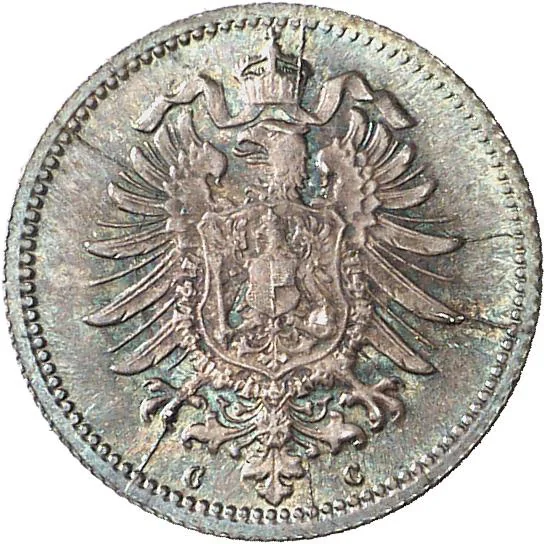
Obverse
Description:
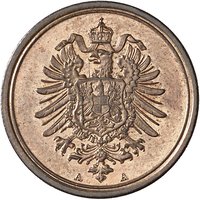
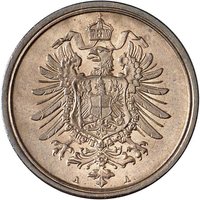
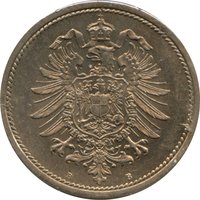
Imperial eagle with mintmarks beneath.
Inscription:
D D
Script: Latin
Engraver: Emil Weigand
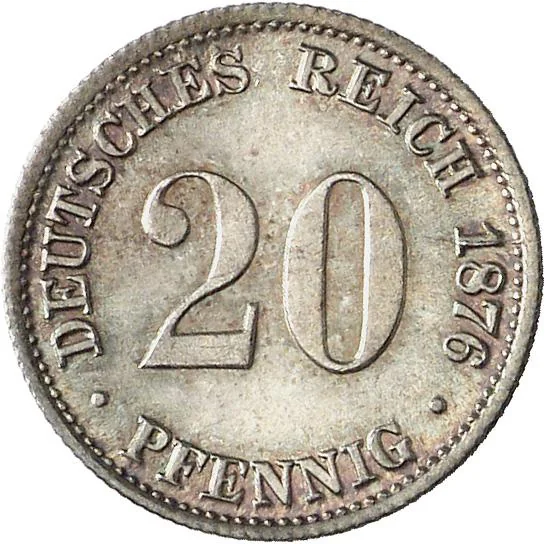
Reverse
Description:
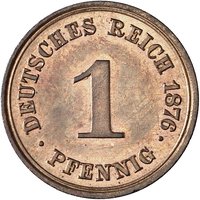
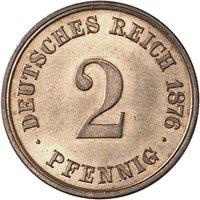
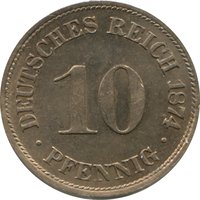
Value, date
Inscription:
DEUTSCHES REICH 1876
20
• PFENNIG •
20
• PFENNIG •
Translation:
German Empire 1876
20
Pfennig
20
Pfennig
Script: Latin
Language: German
Engraver: Friedrich Wilhelm Kullrich
Edge
Reeded
Mints
| Name | Mark |
|---|---|
| Berlin | A |
| Hanover | B |
| Frankfurt am Main | C |
| Munich | D |
| Muldenhütten | E |
| Staatliche Münze Baden-Württemberg | F |
| Staatliche Münze Baden-Württemberg | G |
| Darmstadt | H |
| Hamburgische Münze | J |
Mintings
| Year | Mint Mark | Mintage | Quality | Collection |
|---|---|---|---|---|
| 1873 | A | 2,157,853 | ||
| 1873 | B | 664,010 | ||
| 1873 | C | 903,846 | ||
| 1873 | D | 1,200,977 | ||
| 1873 | G | 763,067 | ||
| 1873 | H | 54,000 | ||
| 1873 | E | 100 | ||
| 1873 | F | 449,552 | ||
| 1874 | C | 1,303,197 | ||
| 1874 | D | 10,086,568 | ||
| 1874 | E | 2,281,041 | ||
| 1874 | A | 8,829,886 | ||
| 1874 | B | 9,222,215 | ||
| 1874 | F | 7,222,398 | ||
| 1874 | G | 3,281,267 | ||
| 1874 | H | 1,841,516 | ||
| 1875 | A | 9,034,131 | ||
| 1875 | B | 2,768,250 | ||
| 1875 | C | 5,938,121 | ||
| 1875 | D | 15,031,539 | ||
| 1875 | E | 1,486,407 | ||
| 1875 | F | 7,667,766 | ||
| 1875 | G | 3,939,809 | ||
| 1875 | H | 1,340,462 | ||
| 1875 | J | 3,501,812 | ||
| 1876 | A | 6,959,008 | ||
| 1876 | B | 5,088,710 | ||
| 1876 | C | 5,911,379 | ||
| 1876 | E | 11,648,242 | ||
| 1876 | F | 13,635,166 | ||
| 1876 | G | 7,820,200 | ||
| 1876 | H | 1,432,797 | ||
| 1876 | J | 10,272,342 | ||
| 1876 | D | 14,151,700 | ||
| 1877 | F | 700,380 |
Historical background
The currency situation in Germany in 1873 was defined by the momentous transition to a unified national monetary system, a direct political consequence of the empire's unification in 1871. Prior to this, the German states used a confusing array of thalers, gulden, kreuzers, and other regional currencies, which hampered commerce and economic integration. The new Reichstag, empowered by the political will to consolidate the nation, passed the Coinage Act of 1873, which established the gold standard and introduced the "Mark" as the sole imperial currency, replacing the old silver-based thalers. This move aligned Germany with the leading industrial power, Great Britain, and signaled its ambition as a modern financial state.
However, the year 1873 itself was marked not by monetary stability but by severe crisis. The Gründerkrise (Founders' Crisis), a major stock market crash and economic depression that began in Vienna and spread to Berlin, erupted just as the new currency was being implemented. While the crash was caused by speculative overinvestment, the end of the French war indemnity, and a broader European financial panic, the concurrent monetary reform contributed to a climate of uncertainty. The shift to gold demonetized silver, causing its value to fall and creating dislocation for those holding silver-based assets, which added deflationary pressure and exacerbated the economic downturn.
Thus, 1873 presents a historical paradox: it was the year Germany successfully created a modern, uniform currency that would underpin its future economic strength, yet it was also the year the new empire faced its first devastating financial crash. The long-term success of the gold Mark was secured, but its introduction was immediately tested by a depression that would shape German economic policy and social tensions for decades to come.
However, the year 1873 itself was marked not by monetary stability but by severe crisis. The Gründerkrise (Founders' Crisis), a major stock market crash and economic depression that began in Vienna and spread to Berlin, erupted just as the new currency was being implemented. While the crash was caused by speculative overinvestment, the end of the French war indemnity, and a broader European financial panic, the concurrent monetary reform contributed to a climate of uncertainty. The shift to gold demonetized silver, causing its value to fall and creating dislocation for those holding silver-based assets, which added deflationary pressure and exacerbated the economic downturn.
Thus, 1873 presents a historical paradox: it was the year Germany successfully created a modern, uniform currency that would underpin its future economic strength, yet it was also the year the new empire faced its first devastating financial crash. The long-term success of the gold Mark was secured, but its introduction was immediately tested by a depression that would shape German economic policy and social tensions for decades to come.
Series: 1873 Germany circulation coins
🌱 Common