

1 Fils – Hashemite Kingdom
Jordan
Context
Years: 1936–1938
Country: Jordan 
Issuer: Hashemite Kingdom
Ruler: Ghazi I
Currency:
(since 1931)
Demonetization: 6 January 1961
Total mintage: 39,000,000
Material
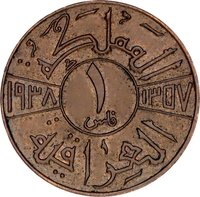
References
KM: #Click to copy to clipboard102
Numista: #6581
Value
Exchange value: 0.001 IQD
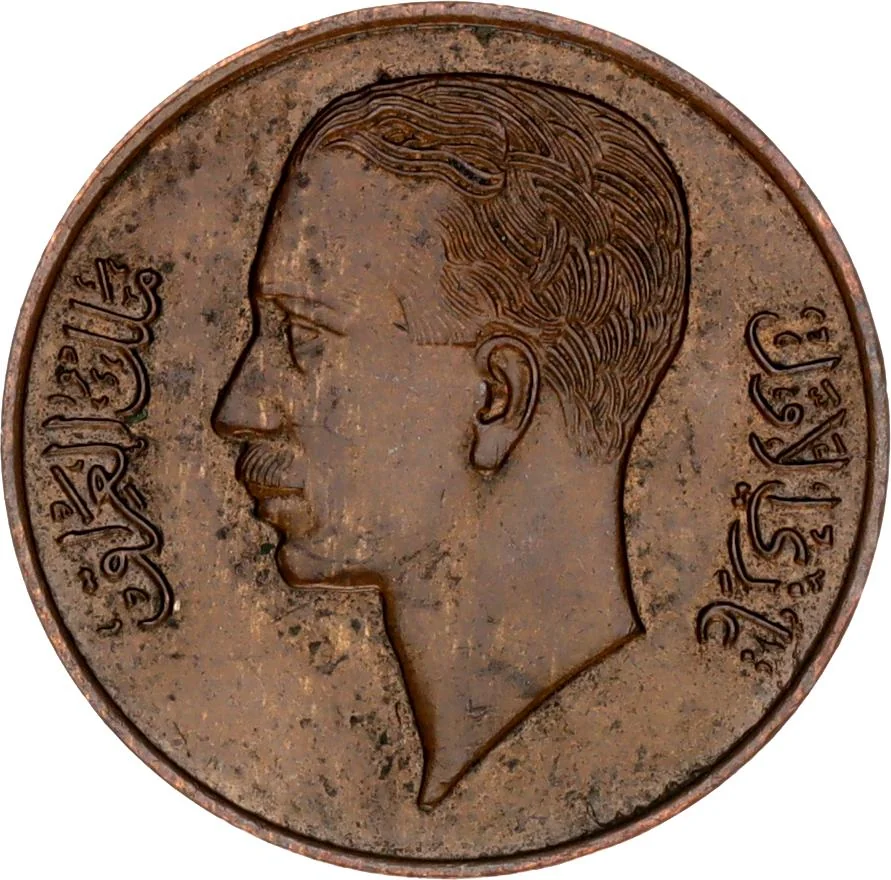
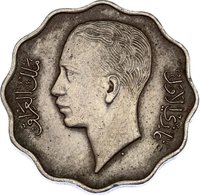
Obverse
Description:
King Ghazi I (1933-1939), left-facing
Inscription:
غازي الأول
ملك العراق
ملك العراق
Translation:
Ghazi the First
King of Iraq
King of Iraq
Script: Arabic
Language: Arabic
Engraver: Percy Metcalfe
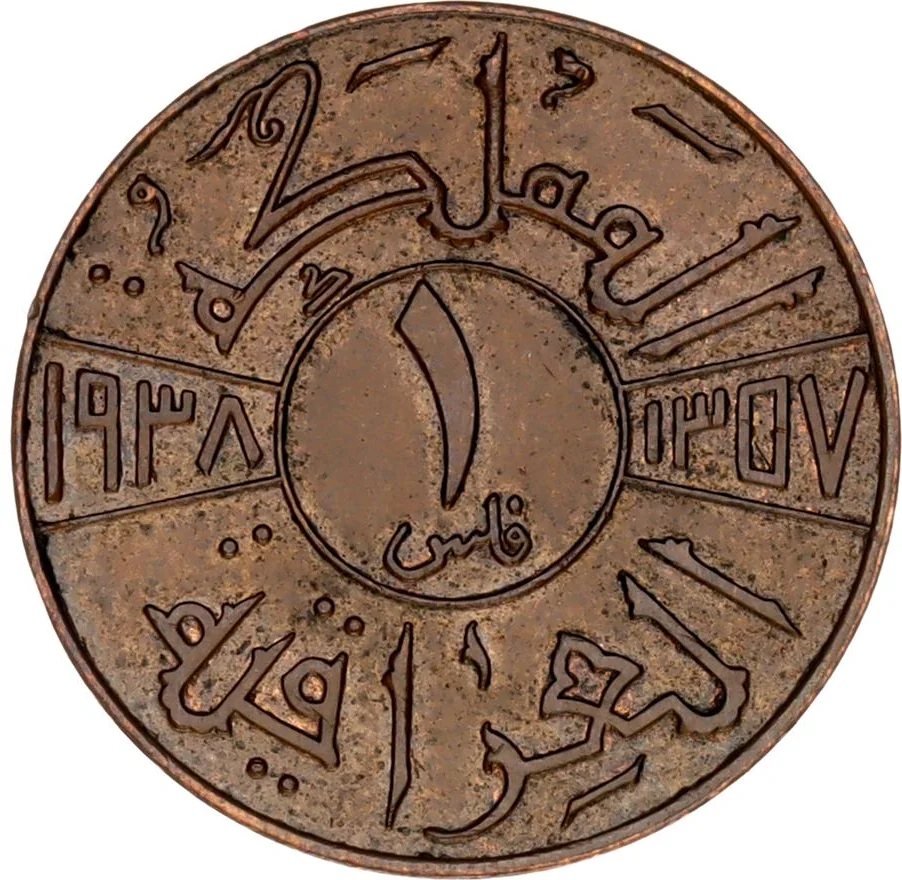
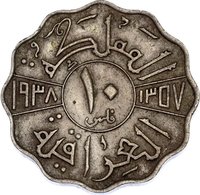
Reverse
Edge
Plain
Mints
| Name | Mark |
|---|---|
| Royal Mint (Tower Hill) | — |
| Mumbai / Bombay | I |
Mintings
| Year | Mint Mark | Mintage | Quality | Collection |
|---|---|---|---|---|
| 1936 | — | 3,000,000 | ||
| 1936 | — | — | Proof | |
| 1938 | — | 36,000,000 | ||
| 1938 | — | — | Proof |
Historical background
In 1936, the currency situation in the Hashemite Kingdom of Jordan (then known as the Emirate of Transjordan under British Mandate) was defined by a lack of a distinct national currency and reliance on external monetary systems. The Ottoman Empire's collapse after World War I left a legacy of various currencies in circulation, but by this period, the region was firmly within the British sterling bloc. The official legal tender was the Palestinian pound, issued by the Palestine Currency Board in London, which was pegged at parity with the British pound sterling. This arrangement meant Transjordan had no independent monetary policy, as its currency was effectively a sterling voucher, backed by sterling securities held in London.
This monetary dependency was a direct reflection of Transjordan's political and economic status under the British Mandate, established in 1922. The use of the Palestinian pound facilitated trade and administrative integration within the mandated territories but underscored Amman's limited financial sovereignty. The currency board system ensured stability and convertibility, which was advantageous for a small, developing economy, but it also meant that the money supply was determined by Transjordan's balance of payments with the sterling area rather than by domestic economic needs.
Consequently, the monetary landscape in 1936 was stable but externally controlled. There were no Jordanian banks issuing notes; circulation consisted of Palestinian pound banknotes and coins, alongside some British gold sovereigns and Turkish coins still used in rural areas. This system would remain essentially unchanged until after Jordan gained full independence in 1946, with the country eventually introducing the Jordanian dinar in 1950 to replace the Palestinian pound. Thus, in 1936, the currency situation was one of colonial-era stability, awaiting the financial instruments of a future sovereign state.
This monetary dependency was a direct reflection of Transjordan's political and economic status under the British Mandate, established in 1922. The use of the Palestinian pound facilitated trade and administrative integration within the mandated territories but underscored Amman's limited financial sovereignty. The currency board system ensured stability and convertibility, which was advantageous for a small, developing economy, but it also meant that the money supply was determined by Transjordan's balance of payments with the sterling area rather than by domestic economic needs.
Consequently, the monetary landscape in 1936 was stable but externally controlled. There were no Jordanian banks issuing notes; circulation consisted of Palestinian pound banknotes and coins, alongside some British gold sovereigns and Turkish coins still used in rural areas. This system would remain essentially unchanged until after Jordan gained full independence in 1946, with the country eventually introducing the Jordanian dinar in 1950 to replace the Palestinian pound. Thus, in 1936, the currency situation was one of colonial-era stability, awaiting the financial instruments of a future sovereign state.
🌱 Very Common