

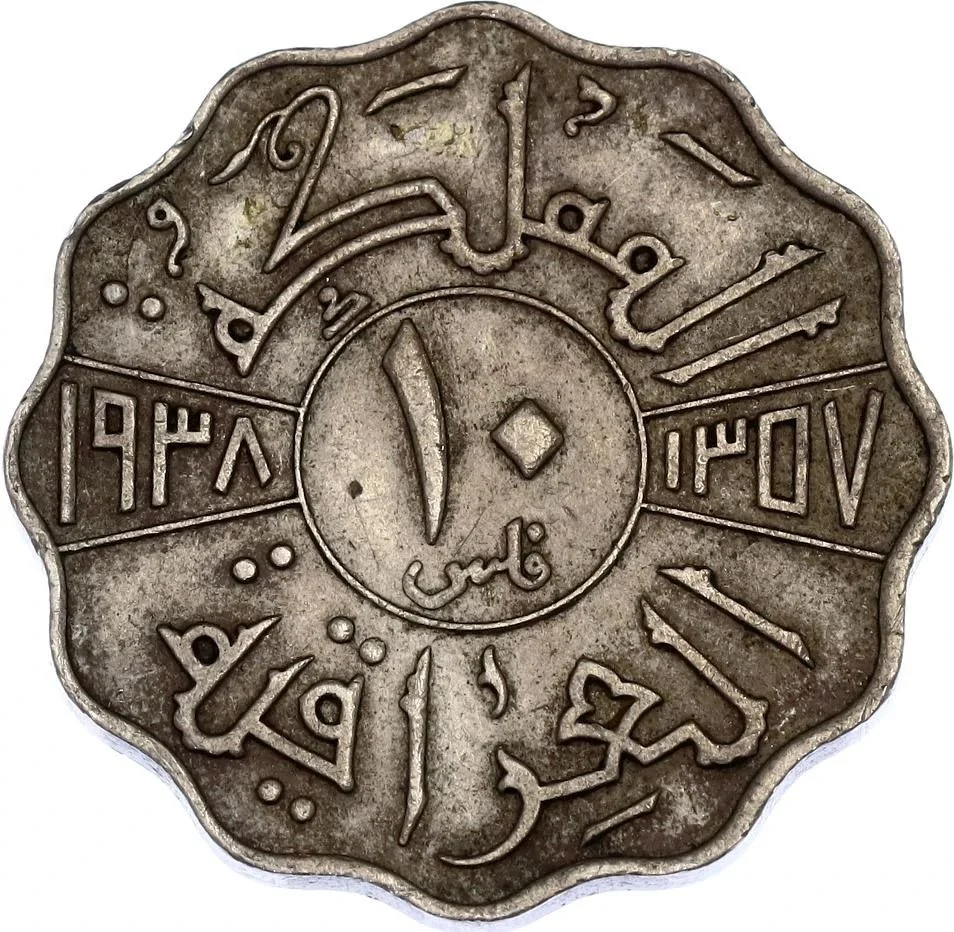
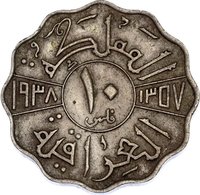
10 Fils – Hashemite Kingdom
Jordan
Context
Years: 1937–1938
Country: Jordan 
Issuer: Hashemite Kingdom
Ruler: Ghazi I
Currency:
(since 1931)
Demonetization: 6 January 1961
Total mintage: 1,000,000
Material
References
KM: #Click to copy to clipboard103
Numista: #12672
Value
Exchange value: 0.010 IQD
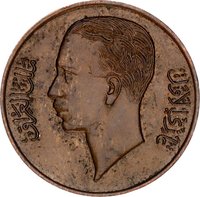
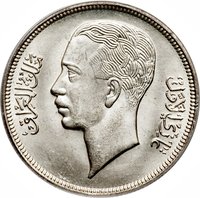
Obverse
Description:
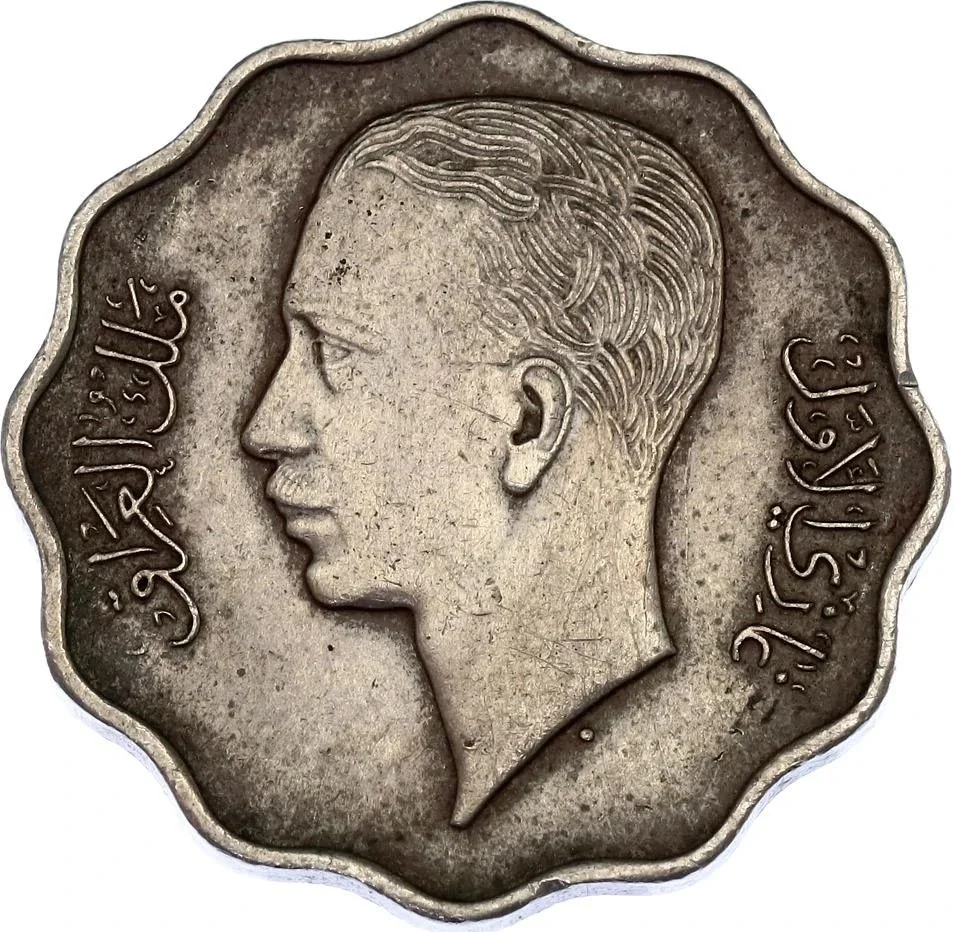
King Ghazi I (1933-1939), left-facing
Inscription:
غازي الأول
ملك العراق
ملك العراق
Translation:
Ghazi the First
King of Iraq
King of Iraq
Script: Arabic
Language: Arabic
Engraver: Percy Metcalfe
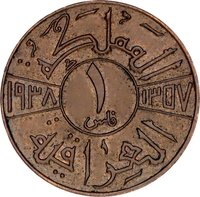
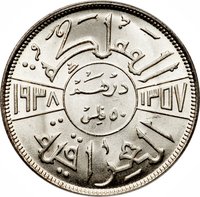
Reverse
Edge
Plain
Mints
| Name | Mark |
|---|---|
| Royal Mint (Tower Hill) | — |
Mintings
| Year | Mint Mark | Mintage | Quality | Collection |
|---|---|---|---|---|
| 1937 | — | 400,000 | ||
| 1937 | — | — | Proof | |
| 1938 | — | 600,000 | ||
| 1938 | — | — | Proof |
Historical background
In 1937, the currency situation in the Hashemite Kingdom of Jordan (then known as the Emirate of Transjordan under British mandate) was characterized by a lack of a distinct national currency and reliance on external monetary systems. The official legal tender was the Palestinian pound, issued by the Palestine Currency Board in Jerusalem. This currency was pegged to and fully backed by the British pound sterling, reflecting Transjordan's economic and administrative ties to the British Mandate over Palestine. In practice, alongside the Palestinian pound, British gold sovereigns, Egyptian pounds, and various Ottoman and European coins also circulated, particularly in rural areas, creating a somewhat fragmented monetary environment.
This arrangement was a direct consequence of Transjordan's political status. Governed by Emir Abdullah I under a British mandate, the territory lacked independent central banking institutions. The use of the Palestinian pound facilitated trade and administrative integration within the Mandate's framework but also meant that Transjordan had no control over its own monetary policy. The currency's stability was entirely dependent on the sterling peg and the reserves held in London, insulating the economy from hyperinflation but leaving it vulnerable to the economic decisions of the British Empire.
The year 1937 fell within a period of relative monetary stability under this system, but it was a stability defined by colonial dependency. Discussions of full independence were growing, yet a national Jordanian currency would not be realized until a decade later, with the introduction of the Jordanian dinar in 1949 following the kingdom's independence in 1946. Thus, the 1937 currency situation underscores a transitional phase where Transjordan’s economy was integrated into a broader imperial system, awaiting the financial instruments of sovereign statehood.
This arrangement was a direct consequence of Transjordan's political status. Governed by Emir Abdullah I under a British mandate, the territory lacked independent central banking institutions. The use of the Palestinian pound facilitated trade and administrative integration within the Mandate's framework but also meant that Transjordan had no control over its own monetary policy. The currency's stability was entirely dependent on the sterling peg and the reserves held in London, insulating the economy from hyperinflation but leaving it vulnerable to the economic decisions of the British Empire.
The year 1937 fell within a period of relative monetary stability under this system, but it was a stability defined by colonial dependency. Discussions of full independence were growing, yet a national Jordanian currency would not be realized until a decade later, with the introduction of the Jordanian dinar in 1949 following the kingdom's independence in 1946. Thus, the 1937 currency situation underscores a transitional phase where Transjordan’s economy was integrated into a broader imperial system, awaiting the financial instruments of sovereign statehood.
🌱 Fairly Common