

¼ dollar – Hawaii
Add to wishlist
United States
Context
Year: 1883
Country: United States
Issuer: Hawaii
Ruler: Kalākaua
Currency:
(1847—1898)
Demonetization: 1 January 1904
Total mintage: 26
Material
References
KM: #
Numista: #6577
Value
Bullion value: $13.87
Obverse
Description:
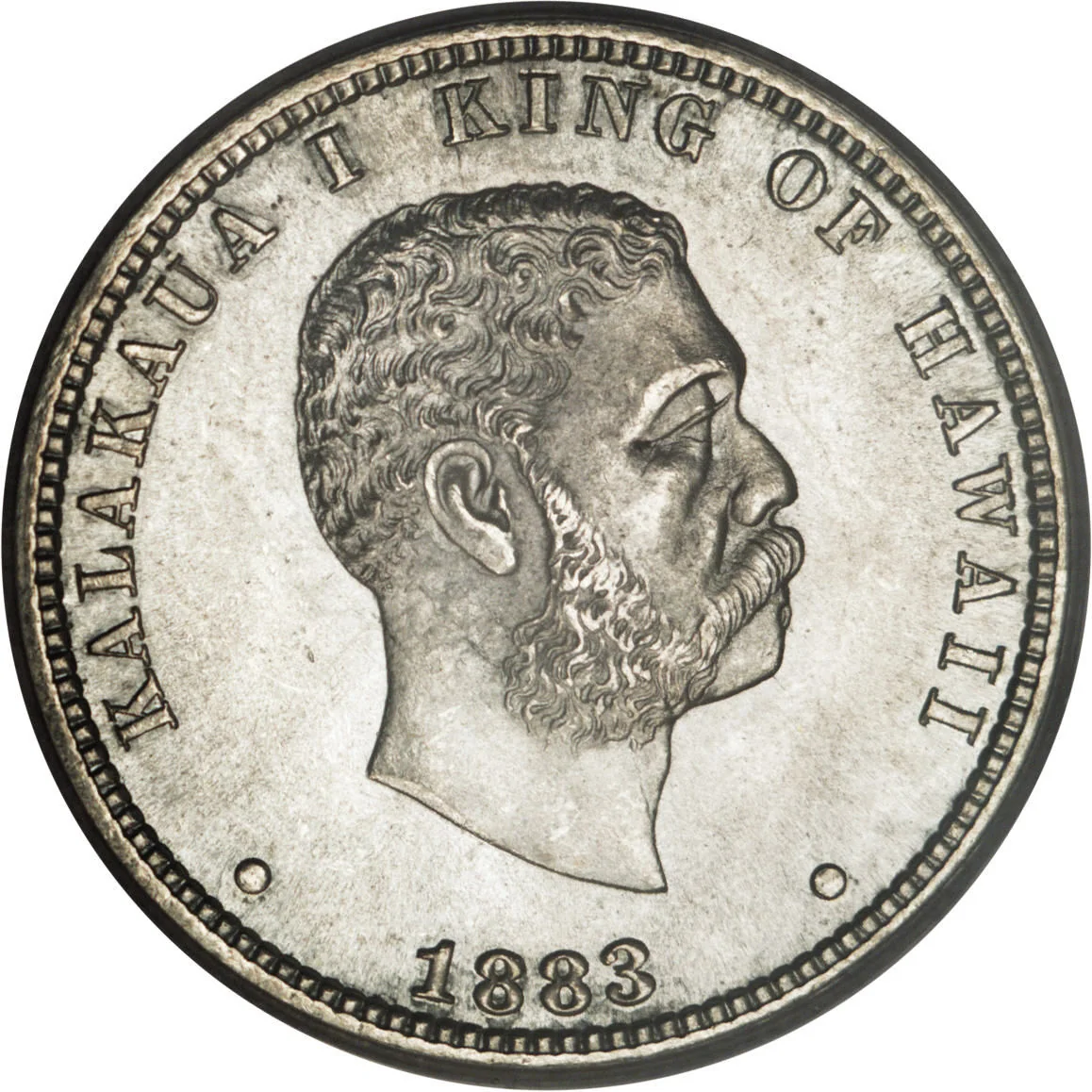
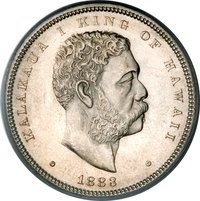
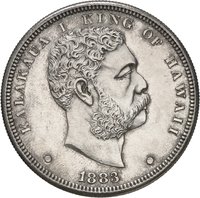
King Kalākaua I bust right, date below.
Inscription:
KALAKAUA I KING OF HAWAII
· 1883 ·
· 1883 ·
Translation:
KALAKAUA I KING OF HAWAII
· 1883 ·
· 1883 ·
Script: Latin
Engraver: Charles Edward Barber
Reverse
Description:
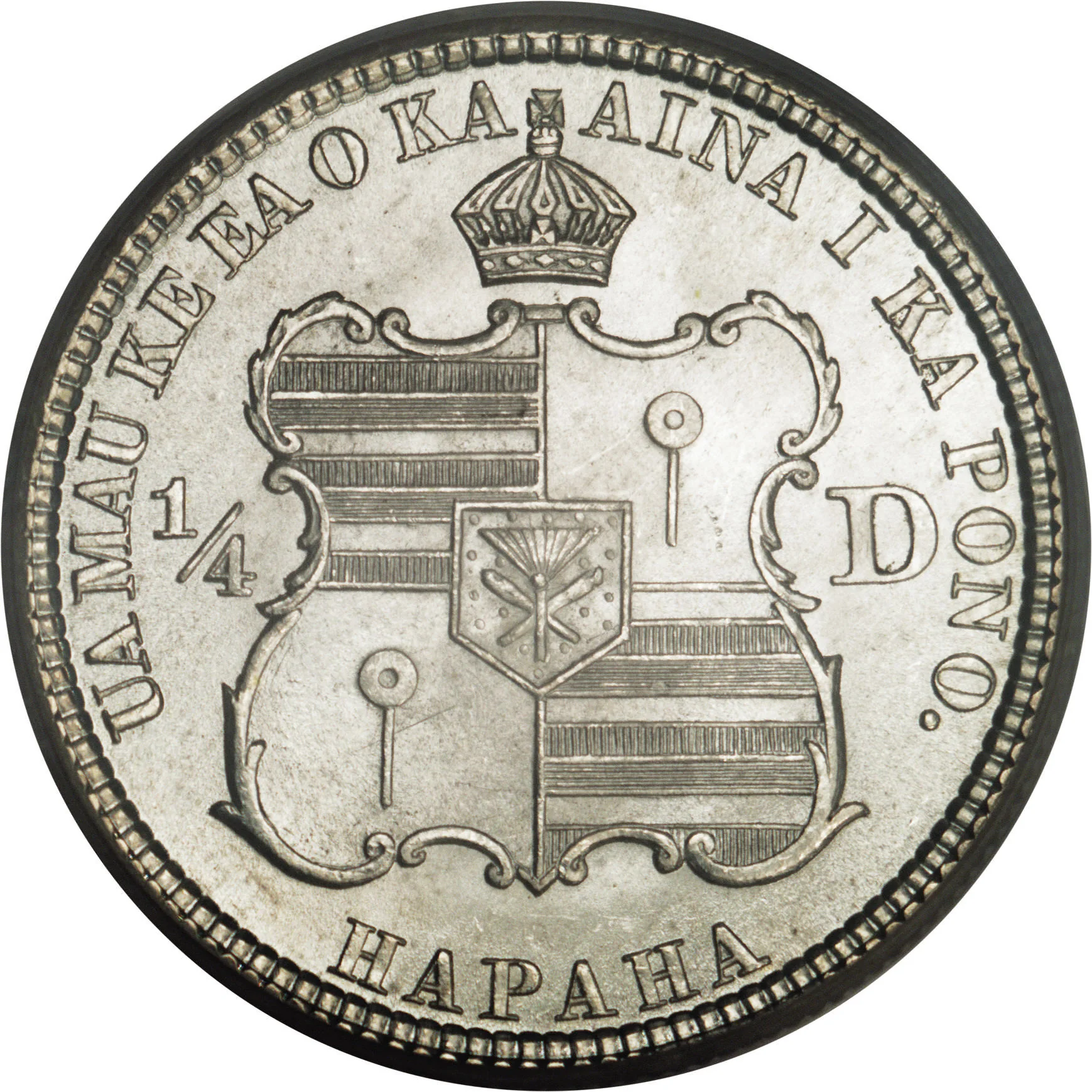
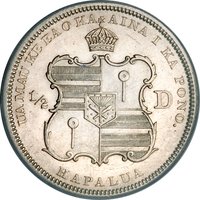
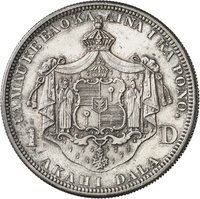
The shield is quartered: the 1st and 4th quarters show stripes for the Hawaiian islands, the 2nd and 3rd display taboo emblems. An inner escutcheon features crossed spears, and the shield is topped by the Crown of Hawaii.
Inscription:
UA MAU KE EA O KA AINA I KA PONO.
¼ D
HAPAHA
¼ D
HAPAHA
Translation:
The life of the land is perpetuated in righteousness.
Quarter Dollar
Quarter Dollar
Script: Latin
Language: Hawaiian
Engraver: Charles Edward Barber
Edge
Reeded
Categories
| Person> Monarch |
| Mustache/Beard |
| Symbols> Coat of Arms |
| Symbol> Crown |
Mints
| Name | Mark |
|---|---|
| United States Mint of San Francisco | — |
Mintings
| Year | Mint Mark | Mintage | Quality | Collection |
|---|---|---|---|---|
| 1883 | — | — | ||
| 1883 | — | 26 | Proof |
Historical background
In 1883, Hawaii existed in a complex monetary landscape, caught between its indigenous traditions, the practical needs of a booming sugar economy, and the gravitational pull of foreign powers. Officially, the Kingdom of Hawaii had its own decimal currency, pegged to the U.S. dollar at par. Coins and paper notes bearing the portrait of King Kalākaua circulated, symbolizing national sovereignty. However, this system was perpetually strained and did not operate in isolation.
The reality on the ground was one of significant monetary chaos and competition. U.S. gold and silver coins, British sovereigns, and even Chilean and Mexican pesos circulated widely alongside Hawaiian issues, driven by international trade and plantation labor contracts. This created constant confusion over exchange rates and values. Furthermore, a chronic shortage of hard currency, especially small change for daily transactions, plagued the islands. To fill this void, private entities—including sugar plantations, merchants, and even newspapers—issued their own low-denomination scrip or tokens, which workers and residents were forced to use locally, creating a fragmented and often exploitative economic environment.
This unstable situation was a direct reflection of Hawaii's precarious political position. The sugar industry, dominated by American businessmen, pushed for closer ties with the United States, and monetary integration was a key step. The 1875 Reciprocity Treaty, which allowed duty-free Hawaiian sugar into the U.S., had already bound the economies tightly. The currency chaos of 1883 thus underscored a broader narrative: the weakening of the Kingdom's independent financial control and the increasing alignment with the U.S. monetary system, a trend that would culminate in Hawaii officially adopting the U.S. dollar in 1900 after annexation.
The reality on the ground was one of significant monetary chaos and competition. U.S. gold and silver coins, British sovereigns, and even Chilean and Mexican pesos circulated widely alongside Hawaiian issues, driven by international trade and plantation labor contracts. This created constant confusion over exchange rates and values. Furthermore, a chronic shortage of hard currency, especially small change for daily transactions, plagued the islands. To fill this void, private entities—including sugar plantations, merchants, and even newspapers—issued their own low-denomination scrip or tokens, which workers and residents were forced to use locally, creating a fragmented and often exploitative economic environment.
This unstable situation was a direct reflection of Hawaii's precarious political position. The sugar industry, dominated by American businessmen, pushed for closer ties with the United States, and monetary integration was a key step. The 1875 Reciprocity Treaty, which allowed duty-free Hawaiian sugar into the U.S., had already bound the economies tightly. The currency chaos of 1883 thus underscored a broader narrative: the weakening of the Kingdom's independent financial control and the increasing alignment with the U.S. monetary system, a trend that would culminate in Hawaii officially adopting the U.S. dollar in 1900 after annexation.
🌱 Fairly Common