

100 escudos – Cape Verde
Add to wishlist
Non-circulating coins
Commemoration: Papal Visit
Cape Verde
Context
Material
References
KM: #
Numista: #65760
Value
Exchange value: 100 CVE
Bullion value: $46.44
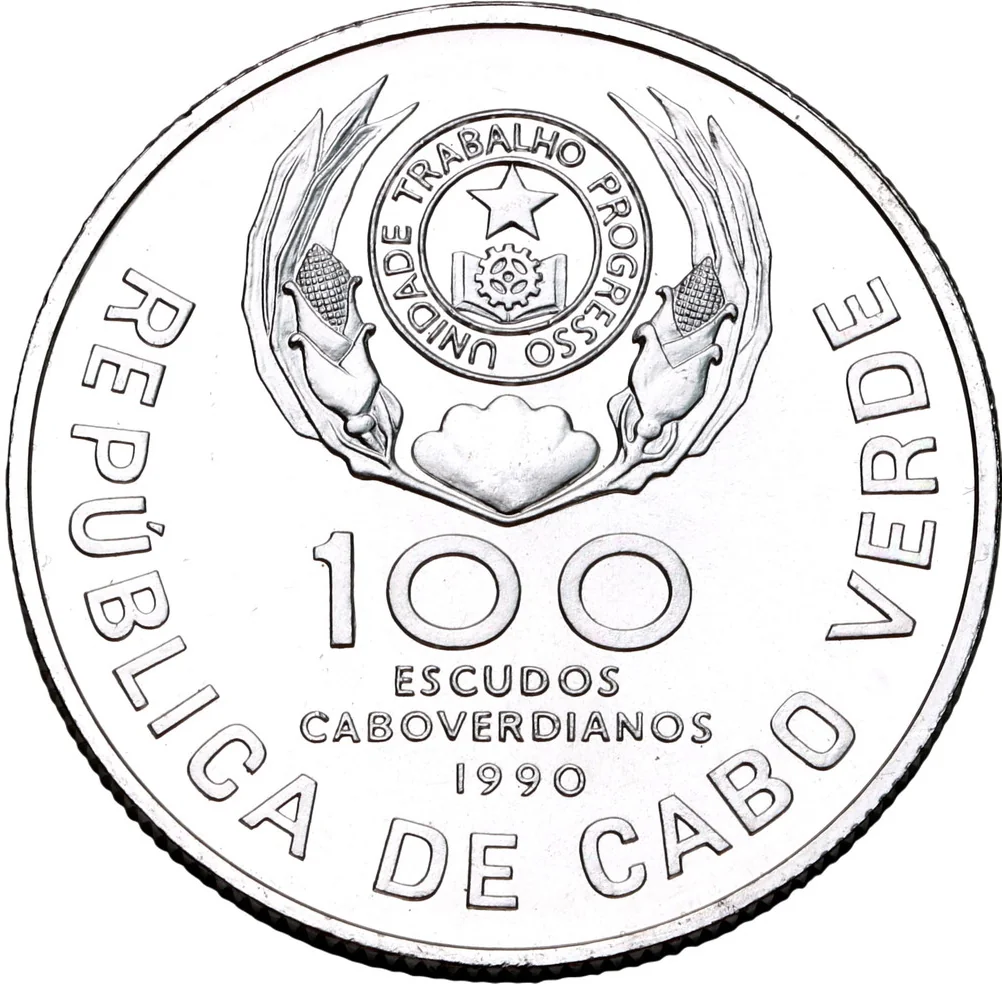
Obverse
Description:
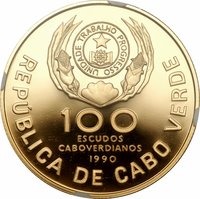
Emblem in wreath above value and year.
Inscription:
100 ESCUDOS CABOVERDIANOS 1990
REPÚBLICA DE CABO VERDE
UNIDADE TRABALHO PROGRESSO
REPÚBLICA DE CABO VERDE
UNIDADE TRABALHO PROGRESSO
Translation:
100 Cape Verdean Escudos 1990
Republic of Cape Verde
Unity Work Progress
Republic of Cape Verde
Unity Work Progress
Script: Latin
Language: Portuguese
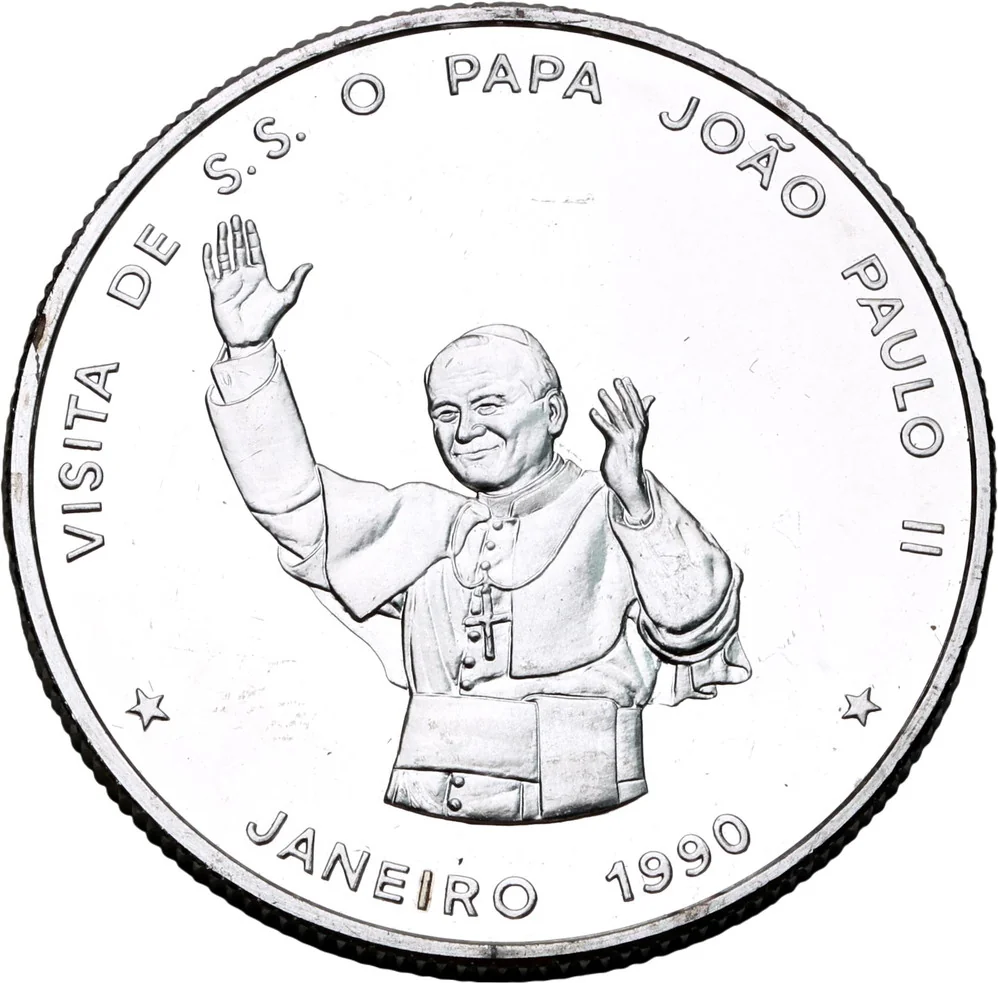
Reverse
Description:
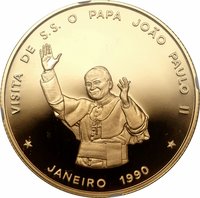
Pope John Paul II, born Karol Wojtyła, led the Catholic Church from 1978 to 2005.
Inscription:
VISITA DE S.S. O PAPA JOÃO PAULO II
JANEIRO 1990
JANEIRO 1990
Translation:
Visit of His Holiness Pope John Paul II
January 1990
January 1990
Script: Latin
Language: Portuguese
Edge
Reeded
Mintings
| Year | Mint Mark | Mintage | Quality | Collection |
|---|---|---|---|---|
| 1990 | — | — | Proof |
Historical background
In 1990, the currency situation in Cape Verde was defined by the Escudo (CVE), which had been the nation's currency since independence from Portugal in 1975. The currency was managed by the Bank of Cape Verde (Banco de Cabo Verde), established in 1975, and was pegged to a basket of currencies. However, for practical purposes, it maintained a strong and stable fixed exchange rate with the Portuguese Escudo (PTE), a legacy of colonial ties and a crucial linkage for an economy heavily dependent on imports, remittances from a large diaspora in Portugal, and foreign aid.
This peg provided essential stability for the small, insular, and developing economy, which had limited natural resources and relied on services like tourism, shipping, and fisheries. The fixed exchange rate helped control inflation and facilitated predictable transactions for key sectors. However, it also meant Cape Verde's monetary policy was largely dictated by the need to maintain the peg, limiting the central bank's ability to use interest rates or money supply as independent tools for domestic economic management.
The year 1990 fell within a period of significant economic and political transition. Domestically, the one-party state was moving toward multiparty democracy (achieved in 1991), and economically, the government was beginning to implement structural adjustment programs in collaboration with the IMF and World Bank. While the currency peg remained firmly in place in 1990, these reforms would set the stage for future monetary policy shifts, including a later formal change in the peg from the Portuguese Escudo to the Euro in 1999, ensuring continued monetary stability within a changing geopolitical and economic landscape.
This peg provided essential stability for the small, insular, and developing economy, which had limited natural resources and relied on services like tourism, shipping, and fisheries. The fixed exchange rate helped control inflation and facilitated predictable transactions for key sectors. However, it also meant Cape Verde's monetary policy was largely dictated by the need to maintain the peg, limiting the central bank's ability to use interest rates or money supply as independent tools for domestic economic management.
The year 1990 fell within a period of significant economic and political transition. Domestically, the one-party state was moving toward multiparty democracy (achieved in 1991), and economically, the government was beginning to implement structural adjustment programs in collaboration with the IMF and World Bank. While the currency peg remained firmly in place in 1990, these reforms would set the stage for future monetary policy shifts, including a later formal change in the peg from the Portuguese Escudo to the Euro in 1999, ensuring continued monetary stability within a changing geopolitical and economic landscape.
💎 Very Rare