

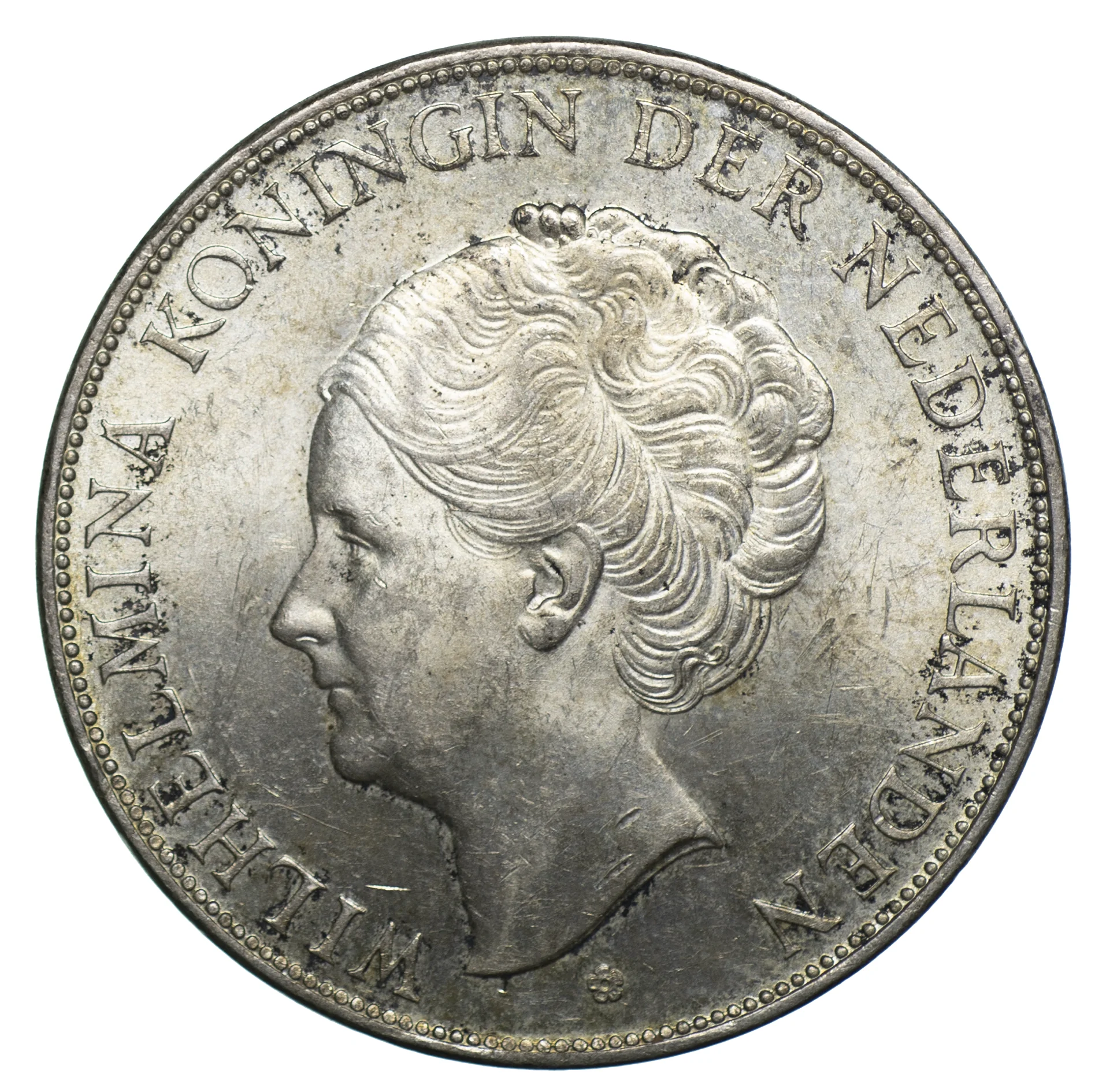
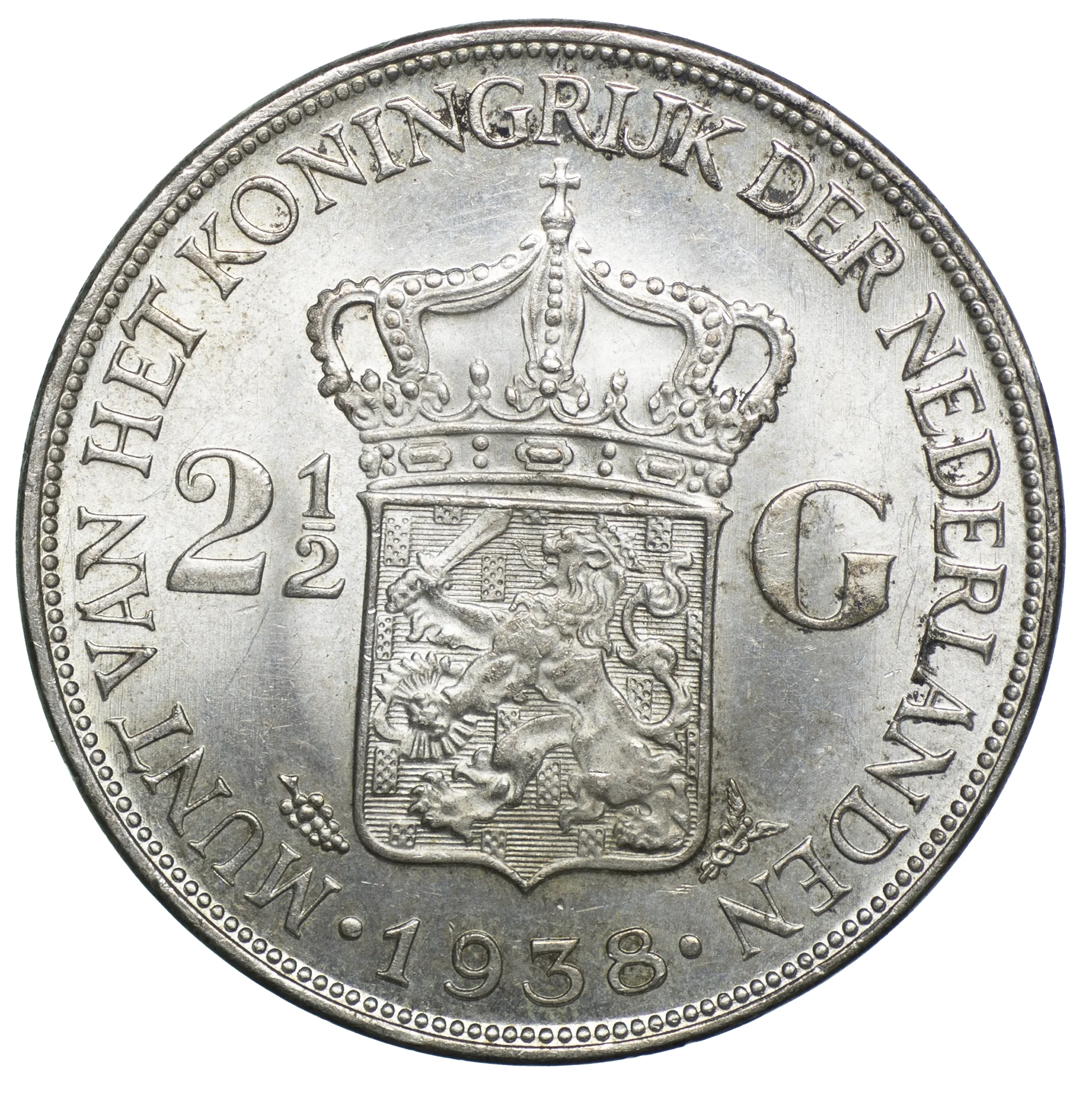
2½ Gulden – Netherlands
Netherlands
Context
Years: 1929–1940
Issuer: Netherlands 
Ruler: Wilhelmina
Currency:
(1817—2001)
Demonetized: Yes
Total mintage: 41,120,000
Material
References
KM: #Click to copy to clipboard165
Numista: #6551
Value
Exchange value: 2.5 NLG
Bullion value: $51.17
Obverse
Reverse
Edge
Smooth with inscriptions
Legend:
★ GOD ★ ZIJ ★ MET ★ ONS
Translation:
God be with us
Language: Dutch
Categories
| Symbol> Crown |
| Symbols> Coat of Arms |
Mints
| Name | Mark |
|---|---|
| Royal Dutch Mint | — |
Mintings
| Year | Mint Mark | Mintage | Quality | Collection |
|---|---|---|---|---|
| 1929 | — | 4,400,000 | ||
| 1930 | — | 11,600,000 | ||
| 1931 | — | 4,720,000 | ||
| 1932 | — | 6,000,000 | ||
| 1933 | — | — | ||
| 1937 | — | 4,000,000 | ||
| 1938 | — | 2,000,000 | ||
| 1939 | — | 3,760,000 | ||
| 1940 | — | 4,640,000 |
Historical background
In 1929, the Netherlands was operating under the gold standard, a system it had returned to in 1925 after the disruptions of World War I. This move, championed by the central bank (De Nederlandsche Bank) and its president, Dr. Gerard Vissering, was intended to restore monetary stability and international credibility. The guilder was pegged to gold at its pre-war parity, a deliberately strong valuation that aimed to signal the nation's financial prudence and economic recovery. However, this "high-guilder" policy came at a significant cost, making Dutch exports more expensive on the global market and contributing to higher domestic unemployment compared to its neighbours even before the global crisis hit.
The Wall Street Crash of October 1929 and the ensuing Great Depression placed immense strain on this rigid system. As global trade collapsed and capital flows seized up, the Netherlands' export-oriented economy suffered severely. The commitment to maintaining the gold parity forced the government and central bank to pursue a harshly deflationary policy. To protect gold reserves, interest rates were kept high, government spending was cut, and wages were pushed downward, deepening the domestic economic slump in an effort to preserve the currency's fixed value above all else.
Consequently, by the end of 1929, the Netherlands found itself in a precarious position: officially stable with a strong, gold-backed currency, but economically vulnerable. The policy choice prioritized monetary orthodoxy and long-term confidence over short-term economic relief, setting the stage for a prolonged and severe depression in the early 1930s. The country would stubbornly cling to the gold standard until 1936, far longer than most other European nations, with the social and economic consequences of this rigid adherence defining the era.
The Wall Street Crash of October 1929 and the ensuing Great Depression placed immense strain on this rigid system. As global trade collapsed and capital flows seized up, the Netherlands' export-oriented economy suffered severely. The commitment to maintaining the gold parity forced the government and central bank to pursue a harshly deflationary policy. To protect gold reserves, interest rates were kept high, government spending was cut, and wages were pushed downward, deepening the domestic economic slump in an effort to preserve the currency's fixed value above all else.
Consequently, by the end of 1929, the Netherlands found itself in a precarious position: officially stable with a strong, gold-backed currency, but economically vulnerable. The policy choice prioritized monetary orthodoxy and long-term confidence over short-term economic relief, setting the stage for a prolonged and severe depression in the early 1930s. The country would stubbornly cling to the gold standard until 1936, far longer than most other European nations, with the social and economic consequences of this rigid adherence defining the era.
🌱 Very Common