

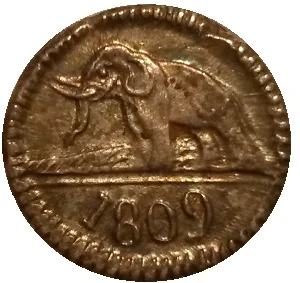
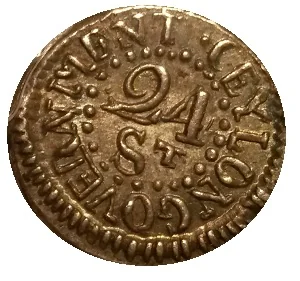
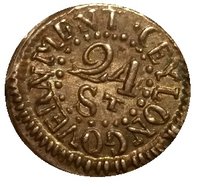
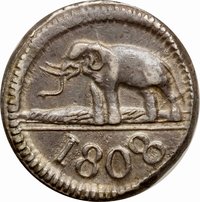
24 Stivers – Ceylon
Sri Lanka
Context
Years: 1803–1809
Country: Sri Lanka 
Issuer: Ceylon
Ruler: George III
Currency:
(1796—1828)
Demonetized: Yes
Material
References
KM: #Click to copy to clipboard76
Numista: #65481
Value
Bullion value: $12.86
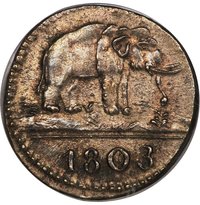
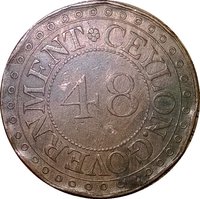
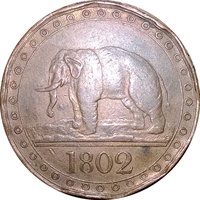
Obverse
Reverse
Edge
Plain
Mintings
| Year | Mint Mark | Mintage | Quality | Collection |
|---|---|---|---|---|
| 1803 | — | — | ||
| 1804 | — | — | ||
| 1805 | — | — | ||
| 1808 | — | — | ||
| 1809 | — | — |
Historical background
In 1803, Ceylon (modern-day Sri Lanka) was a British Crown Colony, having been seized from the Dutch in 1796. The currency situation was chaotic and transitional, reflecting the island's recent change of colonial power. Multiple currencies circulated simultaneously, creating a complex and inefficient monetary environment. The official British sterling (pounds, shillings, and pence) was used for government accounts and major trade, but the older Dutch rixdollar and its subunits remained deeply embedded in local commerce. Alongside these, a variety of Indian silver rupees (particularly from Madras and Bengal), Portuguese coins, and even unofficial "coin tokens" issued by local merchants were all in common use, leading to confusion and frequent disputes over exchange rates.
This monetary pluralism was a significant hindrance to trade and administration. The British authorities, recognizing the problem, had begun to formally regulate the system. In 1801, a Proclamation attempted to fix the exchange rates between the dominant currencies: the British sterling, the Dutch rixdollar, and the Indian rupee. However, these fixed rates often conflicted with market values, leading to arbitrage and instability. The situation was further complicated by a chronic shortage of small change, which hampered everyday transactions and prompted the continued use of cut or defaced foreign coins and private tokens.
Ultimately, the currency landscape of 1803 Ceylon was one of imposed order struggling against entrenched practice. The British colonial government was in the early stages of asserting monetary sovereignty, but had not yet succeeded in creating a unified system. The coexistence of multiple coinages symbolized the island's layered colonial history and the practical challenges of integrating a strategically important colony into the economic orbit of the British Empire, a process that would take decades to complete.
This monetary pluralism was a significant hindrance to trade and administration. The British authorities, recognizing the problem, had begun to formally regulate the system. In 1801, a Proclamation attempted to fix the exchange rates between the dominant currencies: the British sterling, the Dutch rixdollar, and the Indian rupee. However, these fixed rates often conflicted with market values, leading to arbitrage and instability. The situation was further complicated by a chronic shortage of small change, which hampered everyday transactions and prompted the continued use of cut or defaced foreign coins and private tokens.
Ultimately, the currency landscape of 1803 Ceylon was one of imposed order struggling against entrenched practice. The British colonial government was in the early stages of asserting monetary sovereignty, but had not yet succeeded in creating a unified system. The coexistence of multiple coinages symbolized the island's layered colonial history and the practical challenges of integrating a strategically important colony into the economic orbit of the British Empire, a process that would take decades to complete.
✨ Legendary