

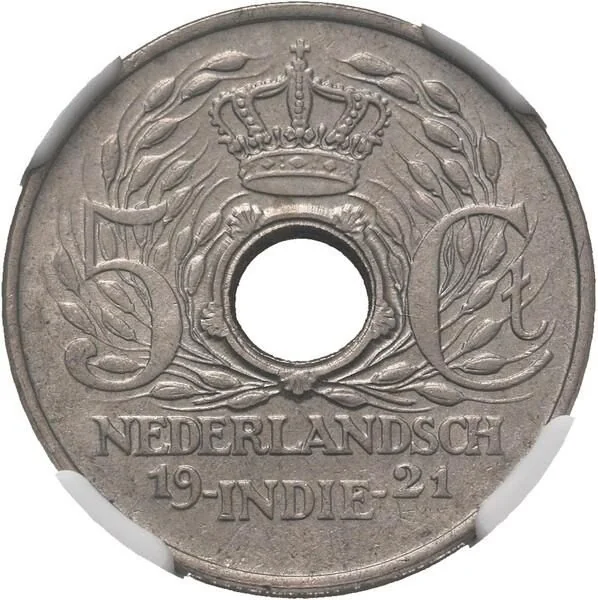
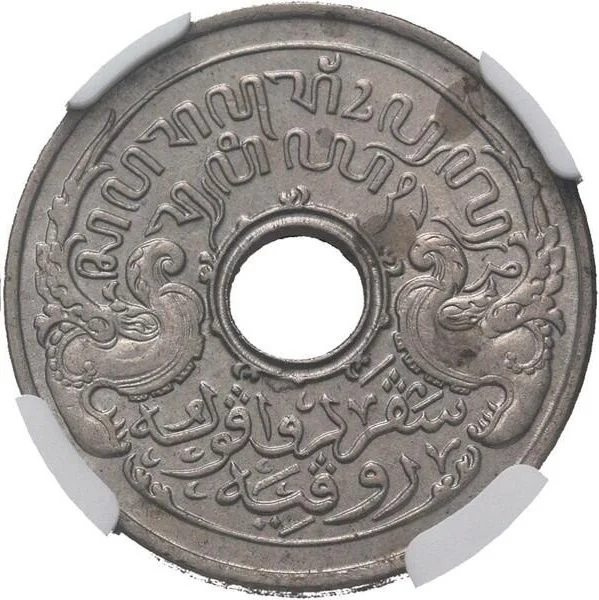
5 cents – Netherlands East Indies
Add to wishlist
Indonesia
Context
Years: 1913–1922
Country: Indonesia
Issuer: Netherlands East Indies
Ruler: Wilhelmina
Currency:
(1854—1948)
Demonetization: 1 January 1952
Total mintage: 120,000,000
Material
Diameter: 21 mm
Weight: 5 g
Thickness: 1.83 mm
Shape: Round with a round hole
Technique: Milled
Alignment: Medal alignment
flip
References
KM: #
Numista: #6544
Obverse
Reverse
Edge
Plain
Mintings
| Year | Mint Mark | Mintage | Quality | Collection |
|---|---|---|---|---|
| 1913 | — | 60,000,000 | ||
| 1913 | — | — | Proof | |
| 1921 | — | — | Proof | |
| 1921 | — | 40,000,000 | ||
| 1922 | — | 20,000,000 |
Historical background
In 1913, the currency situation in the Netherlands East Indies (NEI) was defined by the operation of the Java Bank (De Javasche Bank) as the colony's central bank of issue, operating under a state-guaranteed monopoly. The monetary system was firmly anchored to the gold standard, with the official unit of account being the Netherlands Indies guilder (gulden), which maintained a fixed parity with the Dutch guilder. This link provided stability for international trade, crucially for the export of commodities like sugar, rubber, tobacco, and petroleum, which were the backbone of the colonial economy.
The currency in circulation was a dual system of metal and paper. Silver and copper coins were used for everyday transactions, while the Java Bank issued paper banknotes. However, a persistent shortage of small change, especially in the Outer Islands beyond Java, was a chronic issue. This often led to the use of foreign coins, particularly Mexican and Spanish silver dollars, in remote trading ports, despite official efforts to suppress them. The Java Bank's conservative note-issuing policy, tied strictly to its metal reserves, sometimes constrained credit availability.
Overall, the 1913 system was designed primarily to serve Dutch commercial and fiscal interests, ensuring smooth financial transfers to the Netherlands and stability for European enterprises. It was a modern, gold-backed system at the center, yet its effectiveness diminished in the archipelago's vast periphery, where traditional and foreign currencies still played a practical role. This centralized and export-oriented framework would soon be severely tested by the economic disruptions of the First World War, which began the following year.
The currency in circulation was a dual system of metal and paper. Silver and copper coins were used for everyday transactions, while the Java Bank issued paper banknotes. However, a persistent shortage of small change, especially in the Outer Islands beyond Java, was a chronic issue. This often led to the use of foreign coins, particularly Mexican and Spanish silver dollars, in remote trading ports, despite official efforts to suppress them. The Java Bank's conservative note-issuing policy, tied strictly to its metal reserves, sometimes constrained credit availability.
Overall, the 1913 system was designed primarily to serve Dutch commercial and fiscal interests, ensuring smooth financial transfers to the Netherlands and stability for European enterprises. It was a modern, gold-backed system at the center, yet its effectiveness diminished in the archipelago's vast periphery, where traditional and foreign currencies still played a practical role. This centralized and export-oriented framework would soon be severely tested by the economic disruptions of the First World War, which began the following year.
🌱 Very Common