

200 escudos – Portugal
Add to wishlist
Circulating commemorative coins
Commemoration: Enviados Daimios Kiushu
Portugal
Context
Year: 1993
Issuer: Portugal
Period:
(since 1974)
Currency:
(1911—2001)
Demonetized: Yes
Total mintage: 1,000,000
Material
Diameter: 36 mm
Weight: 21.4 g
Thickness: 2.8 mm
Shape: Round
Composition: Copper-nickel
Technique: Milled
Alignment: Coin alignment
flip
References
KM: #
Numista: #6500
Value
Exchange value: 200 PTE
Inflation-adjusted value: 437.02 PTE
Obverse
Description:
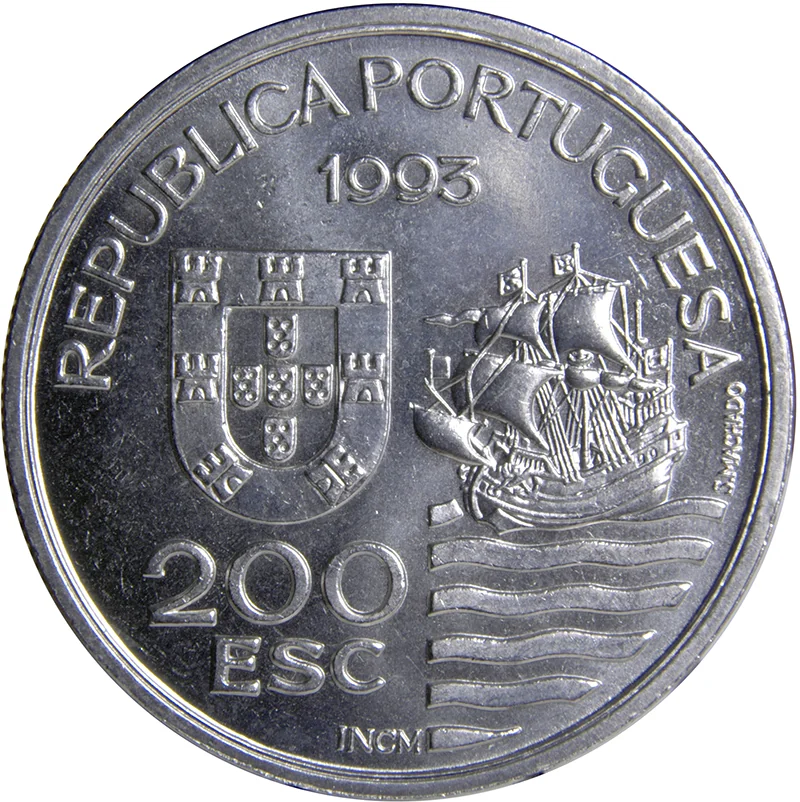
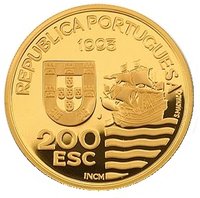
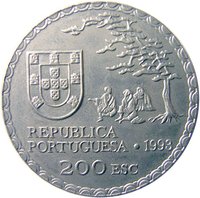
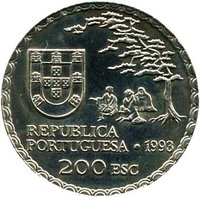
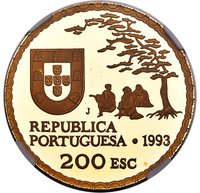
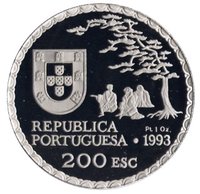
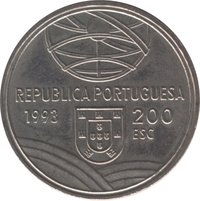
Portuguese coat of arms (left) with value and date; a 16th-century ship (right) sailing from Japan to Europe.
Inscription:
REPUBLICA PORTUGUESA
1993
200 ESC
S.MACHADO
INCM
1993
200 ESC
S.MACHADO
INCM
Translation:
PORTUGUESE REPUBLIC
1993
200 ESCUDOS
S.MACHADO
INCM
1993
200 ESCUDOS
S.MACHADO
INCM
Script: Latin
Language: Portuguese
Reverse
Description:
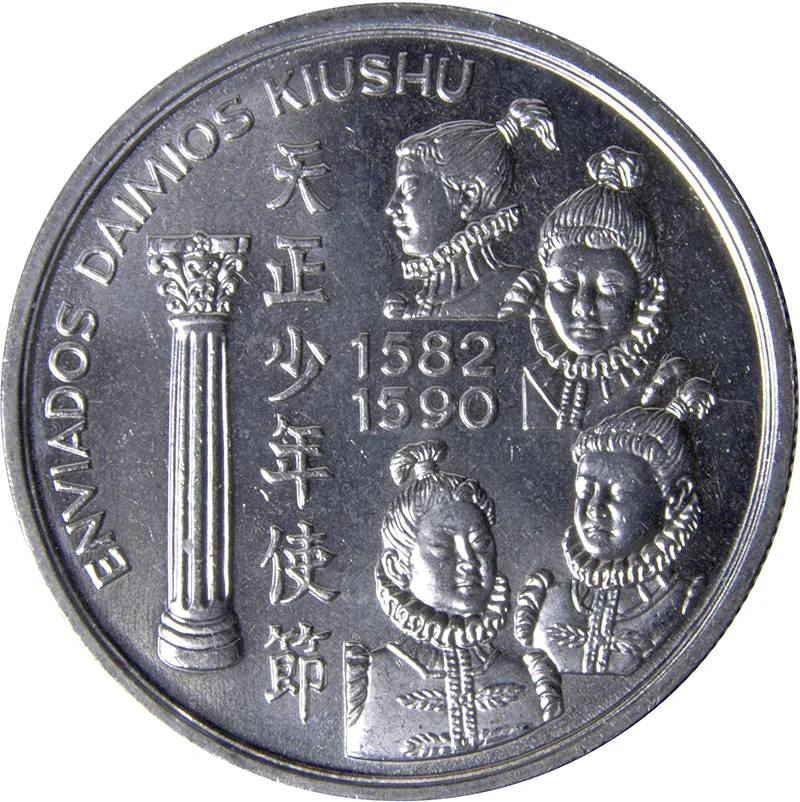
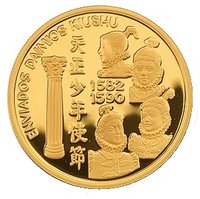
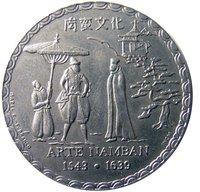
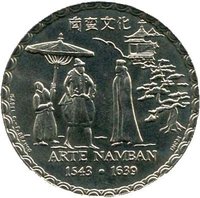
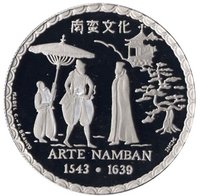
Right: busts of four young men sent to Europe (1582–1590) as representatives of Christian daimyos from Kyushu. Left: a legend beside a Roman column, repeated in Japanese.
Inscription:
ENVIADOS DAIMIOS KIUSHU
天
正
少 1582
年 1590
使
節
天
正
少 1582
年 1590
使
節
Translation:
Enviados Daimios Kiushu
Tensho
Boy 1582
Year 1590
Mission
Tensho
Boy 1582
Year 1590
Mission
Script: Latin
Languages: Portuguese, Japanese
Edge
Reeded
Categories
| Symbols> Coat of Arms |
| Transportation> Watercraft |
Mints
| Name | Mark |
|---|---|
| Imprensa Nacional - Casa da Moeda | incm |
Mintings
| Year | Mint Mark | Mintage | Quality | Collection |
|---|---|---|---|---|
| 1993 | incm | 1,000,000 |
Historical background
In 1993, Portugal's currency situation was defined by its pivotal role within the European Monetary System (EMS) and the intense national effort to meet the strict convergence criteria for European Economic and Monetary Union (EMU). The Portuguese escudo (PTE) was a member of the EMS Exchange Rate Mechanism (ERM), which required it to maintain its value within a narrow band of fluctuation against other member currencies, most importantly the German Deutsche Mark. This commitment served as a key anchor for monetary policy, aimed at curbing Portugal's historically high inflation and fostering economic stability in the wake of the country's rapid modernization and integration into the European Community.
Domestically, this period was characterized by a challenging but determined policy of desinflação (disinflation). The Banco de Portugal, under this ERM discipline, pursued tight monetary policies to bring down inflation, which had been in double digits for much of the 1980s. Success was evident, as inflation fell to approximately 6.4% in 1993, down from over 13% just three years earlier. However, this came at a short-term economic cost, with the country experiencing a mild recession in 1993, highlighting the tension between achieving convergence targets and maintaining domestic growth.
The broader context was the Maastricht Treaty, which had been ratified in 1992 and set the roadmap for the single currency. Therefore, every monetary decision in 1993 was viewed through the lens of qualifying for the Euro. While the escudo faced pressures within the ERM during the 1992-93 crisis that forced several currencies to devalue or exit, Portugal successfully maintained its parity, demonstrating political and economic resolve. The year 1993 thus represented a critical consolidation phase, solidifying the escudo's stability and setting the stage for Portugal's eventual entry into the Eurozone at its inception in 1999.
Domestically, this period was characterized by a challenging but determined policy of desinflação (disinflation). The Banco de Portugal, under this ERM discipline, pursued tight monetary policies to bring down inflation, which had been in double digits for much of the 1980s. Success was evident, as inflation fell to approximately 6.4% in 1993, down from over 13% just three years earlier. However, this came at a short-term economic cost, with the country experiencing a mild recession in 1993, highlighting the tension between achieving convergence targets and maintaining domestic growth.
The broader context was the Maastricht Treaty, which had been ratified in 1992 and set the roadmap for the single currency. Therefore, every monetary decision in 1993 was viewed through the lens of qualifying for the Euro. While the escudo faced pressures within the ERM during the 1992-93 crisis that forced several currencies to devalue or exit, Portugal successfully maintained its parity, demonstrating political and economic resolve. The year 1993 thus represented a critical consolidation phase, solidifying the escudo's stability and setting the stage for Portugal's eventual entry into the Eurozone at its inception in 1999.

🌱 Very Common