

5 pengos (Admiral Miklós Horthy) – Hungary
Add to wishlist
Circulating commemorative coins
Commemoration: 75th Birthday of Admiral Miklós Horthy
Hungary
Context
Year: 1943
Issuer: Hungary
Ruler: Nicolas Horthy
Currency:
(1927—1946)
Demonetization: 31 October 1945
Total mintage: 2,000,000
Material
References
KM: #
Numista: #6489
Obverse
Description:
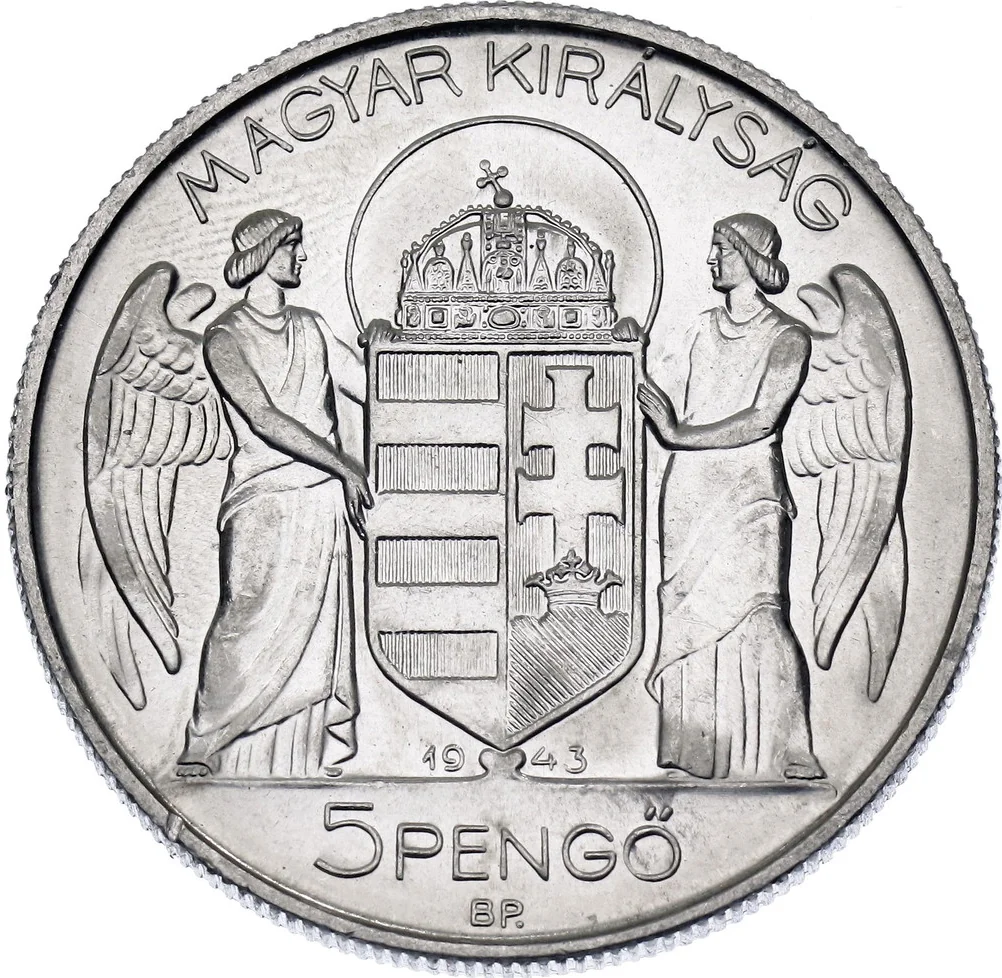
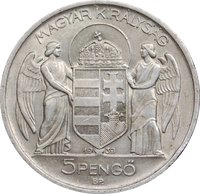
Angels supporting Hungary's crowned shield.
Inscription:
MAGYAR KIRÁLYSÁG
19 43
5 PENGŐ
BP.
19 43
5 PENGŐ
BP.
Translation:
HUNGARIAN KINGDOM
19 43
5 PENGO
BP.
19 43
5 PENGO
BP.
Script: Latin
Language: Hungarian
Engraver: Lajos Berán
Reverse
Description:
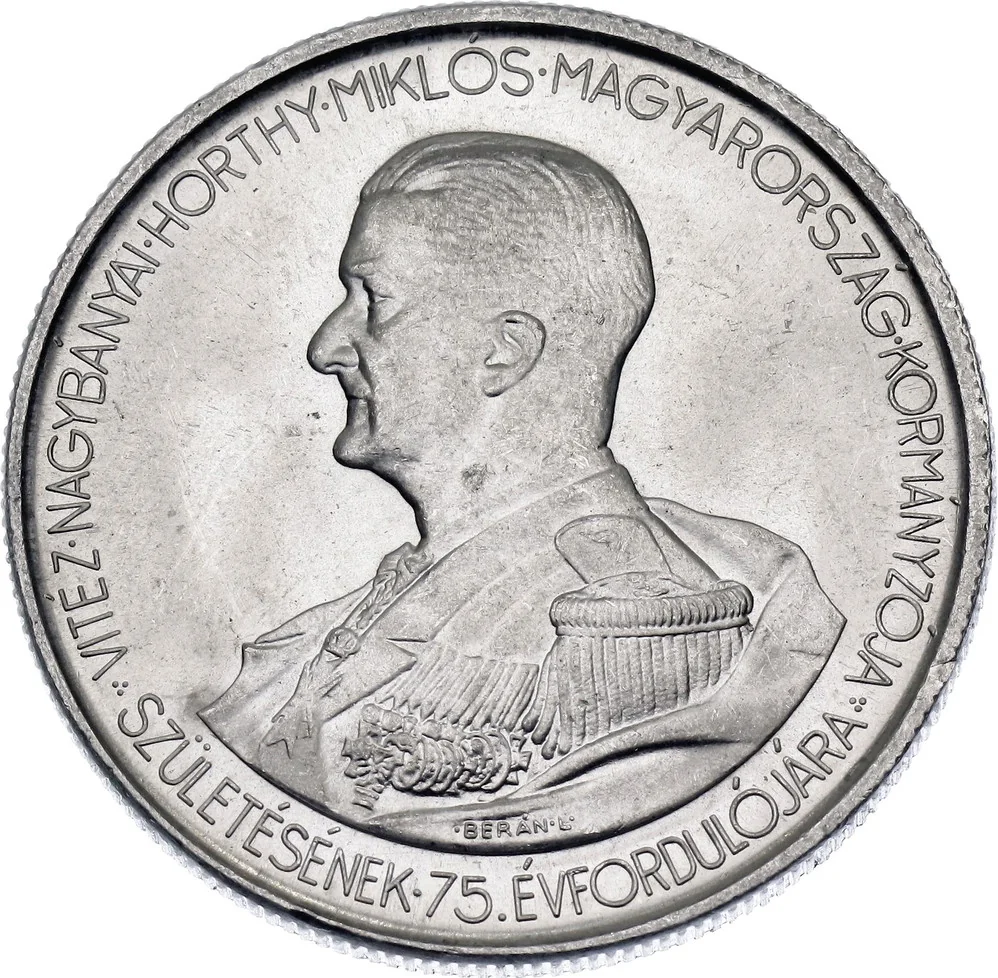
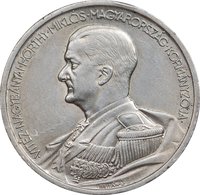
Admiral Miklós Horthy, portrait engraver's name below.
Inscription:
VITÉZ·NAGYBÁNYAI·HORTHY·MIKLÓS·MAGYARORSZÁG·KORMÁNYZÓJA
· BERÁN · L ·
SZÜLETÉSÉNEK·75.ÉVFORDULÓJÁRA
· BERÁN · L ·
SZÜLETÉSÉNEK·75.ÉVFORDULÓJÁRA
Translation:
Vitéz Nagybányai Horthy Miklós Magyarország Kormányzója
Berán L.
Születésének 75. évfordulójára
---
Vitéz Miklós Horthy of Nagybánya, Governor of Hungary
L. Berán
On the 75th anniversary of his birth
Berán L.
Születésének 75. évfordulójára
---
Vitéz Miklós Horthy of Nagybánya, Governor of Hungary
L. Berán
On the 75th anniversary of his birth
Script: Latin
Language: Hungarian
Engraver: Lajos Berán
Edge
Reeded
Categories
| Event> Birth anniversary |
| Person> Military leader |
Mints
| Name | Mark |
|---|---|
| Hungarian mint | — |
Mintings
| Year | Mint Mark | Mintage | Quality | Collection |
|---|---|---|---|---|
| 1943 | BP | 2,000,000 | ||
| 1943 | BP | — | Proof |
Historical background
By 1943, Hungary's currency situation was one of severe and accelerating inflation, directly tied to its deepening economic and political crisis within the Second World War. As a key ally of Nazi Germany, the Hungarian economy was harnessed entirely for the German war effort. This involved massive spending on armaments and the maintenance of a large army on the Eastern Front, financed not by taxes but by the unrestrained printing of money by the Hungarian National Bank. The pengő, introduced in 1927 as a stable currency, was now being produced in ever-increasing quantities to cover the government's deficits, flooding the economy with paper money without corresponding economic output.
The consequences were classic symptoms of wartime inflation: prices began to rise sharply as the money supply ballooned. While price controls and rationing on essential goods were officially in place to suppress the visible effects, they created a thriving black market where the real value of the pengő plummeted. The government's attempts to finance the war through loans from the central bank and forced purchases of war bonds further eroded public confidence in the currency. By this point, the inflationary spiral was well-established, though it had not yet reached the catastrophic hyperinflation that would characterize the final year of the war and its immediate aftermath.
This deteriorating monetary environment reflected Hungary's precarious position. The costly war effort was draining the national treasury, while the tide of the war was turning decisively against the Axis after Stalingrad. The economic subservience to Germany meant Hungary was exporting goods and resources for increasingly worthless Reichsmarks, deepening its own financial hole. Thus, in 1943, the currency situation was a clear indicator of an economy under extreme duress, setting the stage for the complete monetary collapse that would follow in 1945-46, when the pengő would become the most hyperinflated currency in economic history.
The consequences were classic symptoms of wartime inflation: prices began to rise sharply as the money supply ballooned. While price controls and rationing on essential goods were officially in place to suppress the visible effects, they created a thriving black market where the real value of the pengő plummeted. The government's attempts to finance the war through loans from the central bank and forced purchases of war bonds further eroded public confidence in the currency. By this point, the inflationary spiral was well-established, though it had not yet reached the catastrophic hyperinflation that would characterize the final year of the war and its immediate aftermath.
This deteriorating monetary environment reflected Hungary's precarious position. The costly war effort was draining the national treasury, while the tide of the war was turning decisively against the Axis after Stalingrad. The economic subservience to Germany meant Hungary was exporting goods and resources for increasingly worthless Reichsmarks, deepening its own financial hole. Thus, in 1943, the currency situation was a clear indicator of an economy under extreme duress, setting the stage for the complete monetary collapse that would follow in 1945-46, when the pengő would become the most hyperinflated currency in economic history.
🌱 Common