

20 korún – Slovakia
Add to wishlist
Circulating commemorative coins
Commemoration: St. Cyril and St. Methodius
Slovakia
Obverse
Description:
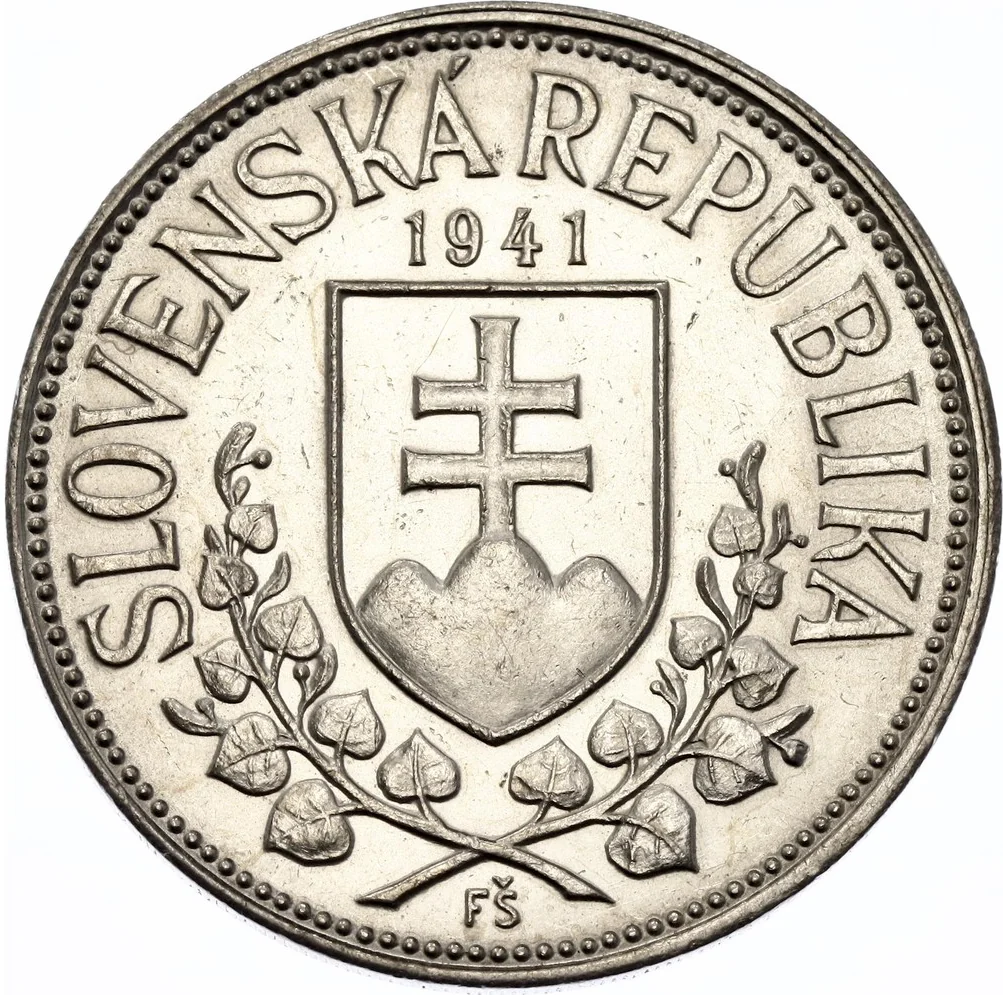
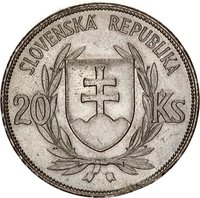
Slovak shield, linden spring beneath.
Inscription:
SLOVENSKÁ REPUBLIKA
1941
F Š
1941
F Š
Translation:
SLOVAK REPUBLIC
1941
F Š
1941
F Š
Script: Latin
Language: Slovak
Engraver: František Štefunko
Reverse
Description:
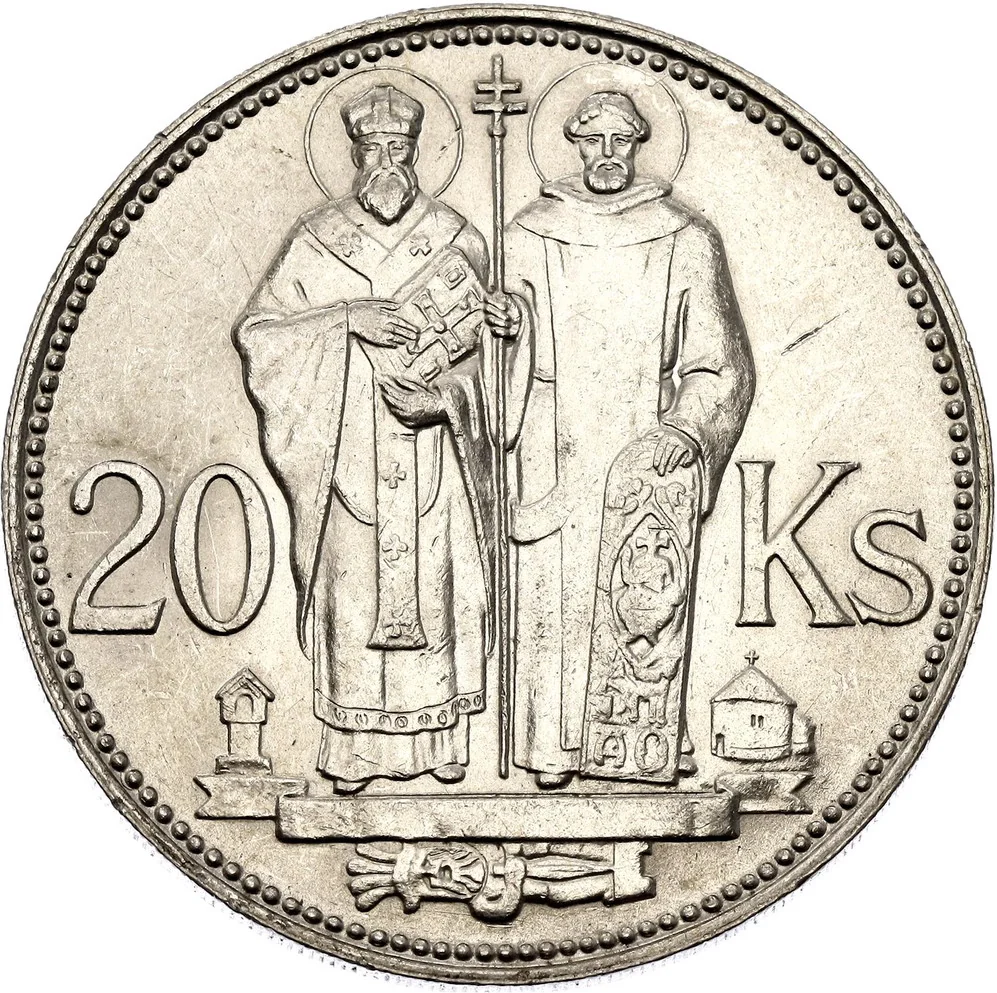
Saints Kyrill and Methodius; church cross at lower right.
Inscription:
20 Ks
Script: Latin
Engraver: František Štefunko
Edge
Milled
Categories
| Building> Religious building |
| Person> Religious figure |
| Symbols> Coat of Arms |
| Symbol> Cross |
Mints
| Name | Mark |
|---|---|
| Kremnica | — |
Mintings
| Year | Mint Mark | Mintage | Quality | Collection |
|---|---|---|---|---|
| 1941 | — | — |
Historical background
In 1941, Slovakia existed as the Slovak Republic, a nominally independent client state of Nazi Germany established in 1939 following the dissolution of Czechoslovakia. Its currency situation was a direct reflection of this political subordination. The official currency was the Slovak koruna (Sk), which had replaced the Czechoslovak koruna and was initially pegged to the German Reichsmark at a fixed rate of 1 Reichsmark = 11.62 Slovak koruna. This peg was not based on economic parity but was a political tool, ensuring Slovakia's economy was tightly bound to and financially exploitable by the Greater German Reich.
Economically, the currency regime served German war interests. Slovakia was compelled to provide enormous "loans" and cover the costs of occupying German troops, leading to significant budget deficits financed by money printing. This, combined with wartime shortages and strict state control of prices and distribution, created severe inflationary pressures. While open inflation was partially suppressed by rationing and fixed prices, a thriving black market emerged where goods were traded at much higher real values, effectively creating a dual currency system where the official koruna's purchasing power eroded.
Furthermore, the Slovak koruna's circulation was geographically and politically constrained. It was not an internationally traded currency, and its value was entirely dependent on the German relationship. Within the disrupted Central European economy, the Slovak state, under the authoritarian leadership of Jozef Tiso, used currency controls to manage its limited sovereignty, but ultimate financial authority lay with Berlin. The currency situation of 1941 was thus one of controlled instability, masking the deeper realities of wartime exploitation and the gradual erosion of economic stability in service to the Nazi war machine.
Economically, the currency regime served German war interests. Slovakia was compelled to provide enormous "loans" and cover the costs of occupying German troops, leading to significant budget deficits financed by money printing. This, combined with wartime shortages and strict state control of prices and distribution, created severe inflationary pressures. While open inflation was partially suppressed by rationing and fixed prices, a thriving black market emerged where goods were traded at much higher real values, effectively creating a dual currency system where the official koruna's purchasing power eroded.
Furthermore, the Slovak koruna's circulation was geographically and politically constrained. It was not an internationally traded currency, and its value was entirely dependent on the German relationship. Within the disrupted Central European economy, the Slovak state, under the authoritarian leadership of Jozef Tiso, used currency controls to manage its limited sovereignty, but ultimate financial authority lay with Berlin. The currency situation of 1941 was thus one of controlled instability, masking the deeper realities of wartime exploitation and the gradual erosion of economic stability in service to the Nazi war machine.
🌱 Common