

20 korún – Slovakia
Add to wishlist
Circulating commemorative coins
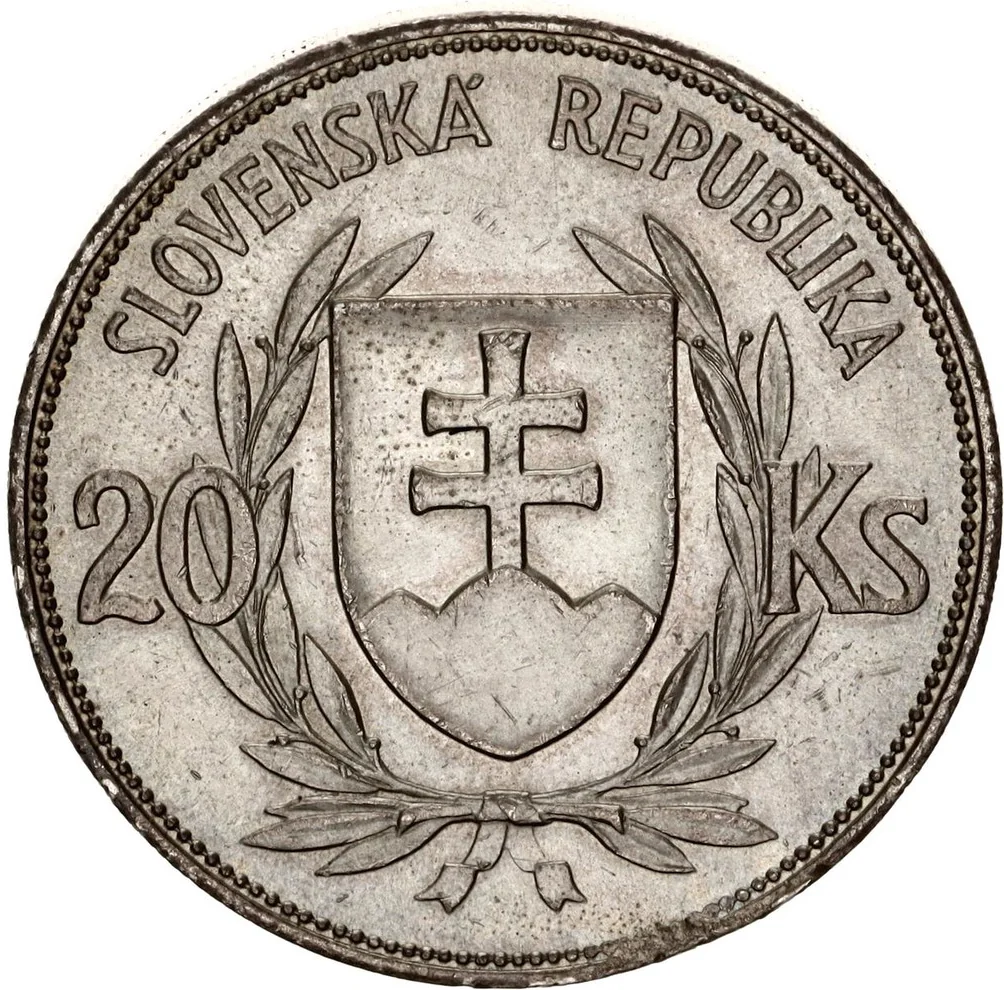
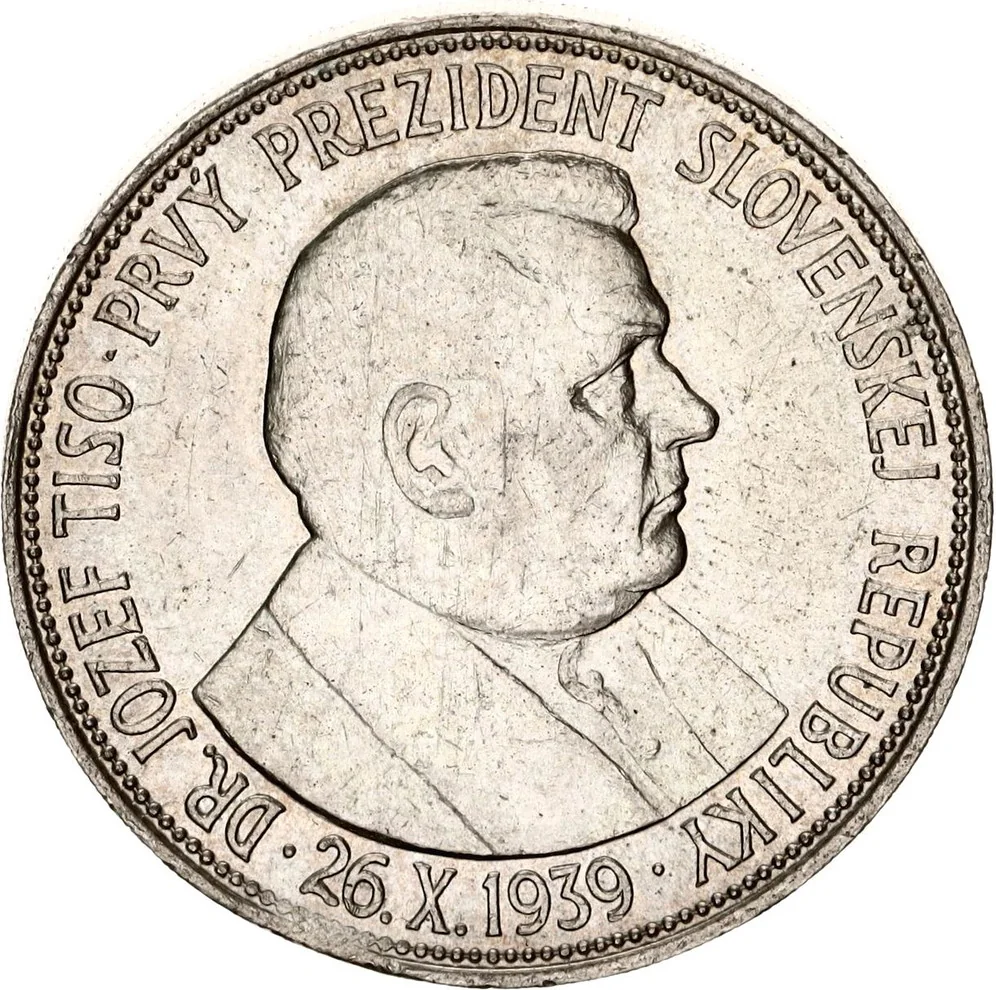
Commemoration: The first president of Slovak Republic 1939
Slovakia
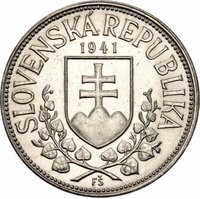
Obverse
Description:
Slovakian crest
Inscription:
SLOVENSKÁ REPUBLIKA
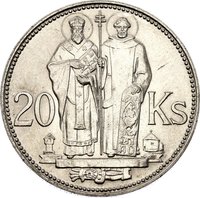
20 Ks
20 Ks
Translation:
SLOVAK REPUBLIC
20 Korunas
20 Korunas
Script: Latin
Language: Slovak
Engraver: Andrej Peter
Reverse
Edge
Milled
Categories
| Symbol> Wreath |
| Person> Politician |
| Symbols> Coat of Arms |
| Symbol> Cross |
Mintings
| Year | Mint Mark | Mintage | Quality | Collection |
|---|---|---|---|---|
| 1939 | — | 200,000 |
Historical background
Following the dissolution of Czechoslovakia in March 1939, the newly declared Slovak Republic, a client state of Nazi Germany, faced immediate monetary instability. The country remained within the currency union with the Protectorate of Bohemia and Moravia, continuing to use the Czechoslovak koruna. However, this arrangement quickly proved untenable as both entities began printing money independently to finance their regimes, leading to inflationary pressures and a loss of confidence. The need for a distinct symbol of sovereignty and greater economic control, albeit within the constraints of German dominance, necessitated the creation of a separate Slovak currency.
On October 4, 1939, the Slovak koruna (Koruna slovenská) was officially introduced, replacing the Czechoslovak koruna at par. The new currency was initially pegged to the German Reichsmark at a rate of 1 Reichsmark to 11.62 Slovak korunas, firmly anchoring Slovakia's economy to the Nazi war effort. While this move provided a temporary facade of stability and facilitated trade with Germany, it fundamentally subordinated Slovak financial policy to Berlin's needs, ensuring the economy served as a supplier for the German military.
The wartime economy, coupled with this dependent monetary framework, led to growing inflation and scarcity. As the conflict progressed, Slovakia was compelled to provide increasing "loans" to Germany, effectively financing its own occupation and draining resources. By the latter stages of the war, particularly after the Slovak National Uprising in 1944, the currency experienced significant devaluation and loss of public trust, mirroring the collapsing fortunes of the regime itself. The Slovak koruna was ultimately abolished after the war's end and the restoration of Czechoslovakia, being replaced by a reconstituted Czechoslovak koruna in 1945.
On October 4, 1939, the Slovak koruna (Koruna slovenská) was officially introduced, replacing the Czechoslovak koruna at par. The new currency was initially pegged to the German Reichsmark at a rate of 1 Reichsmark to 11.62 Slovak korunas, firmly anchoring Slovakia's economy to the Nazi war effort. While this move provided a temporary facade of stability and facilitated trade with Germany, it fundamentally subordinated Slovak financial policy to Berlin's needs, ensuring the economy served as a supplier for the German military.
The wartime economy, coupled with this dependent monetary framework, led to growing inflation and scarcity. As the conflict progressed, Slovakia was compelled to provide increasing "loans" to Germany, effectively financing its own occupation and draining resources. By the latter stages of the war, particularly after the Slovak National Uprising in 1944, the currency experienced significant devaluation and loss of public trust, mirroring the collapsing fortunes of the regime itself. The Slovak koruna was ultimately abolished after the war's end and the restoration of Czechoslovakia, being replaced by a reconstituted Czechoslovak koruna in 1945.
🌱 Fairly Common