

1 Dollar – Guyana
Guyana
Context
Years: 1996–2015
Issuer: Guyana 
Issuing organization: Bank of Guyana
Period:
(since 1970)
Currency:
(since 1965)
Material
References
KM: #Click to copy to clipboard50
Numista: #6473
Value
Exchange value: 1 GYD
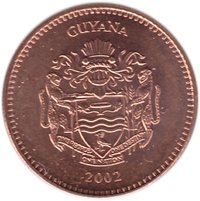
Obverse
Reverse
Description:
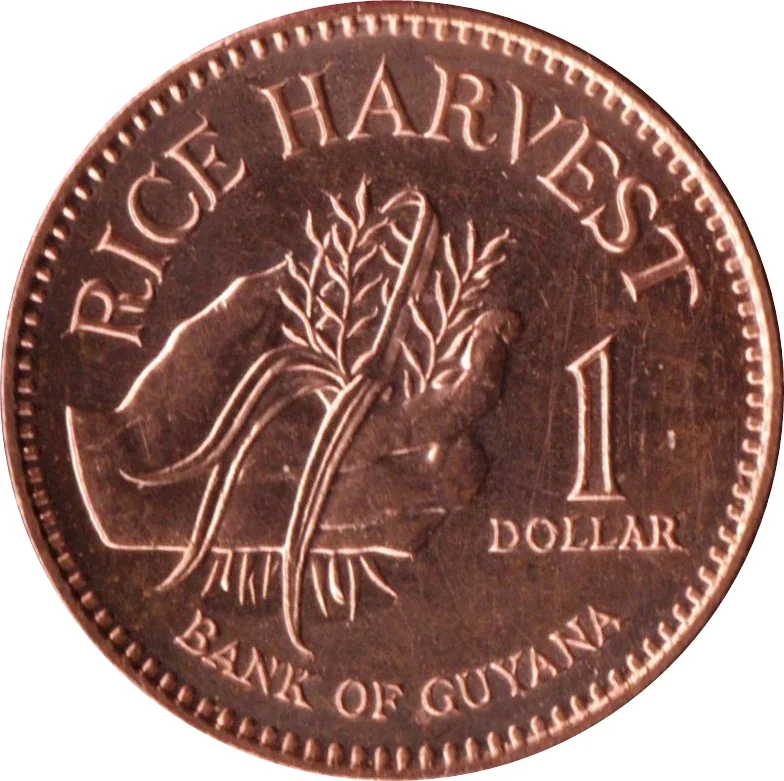
Hand-harvesting rice.
Inscription:
RICE HARVEST
1
DOLLAR
BANK OF GUYANA
1
DOLLAR
BANK OF GUYANA
Script: Latin
Engraver: Sean Thomas
Edge
Reeded
Categories
| Agriculture |
| Animal> Feline |
| Symbol> Hand |
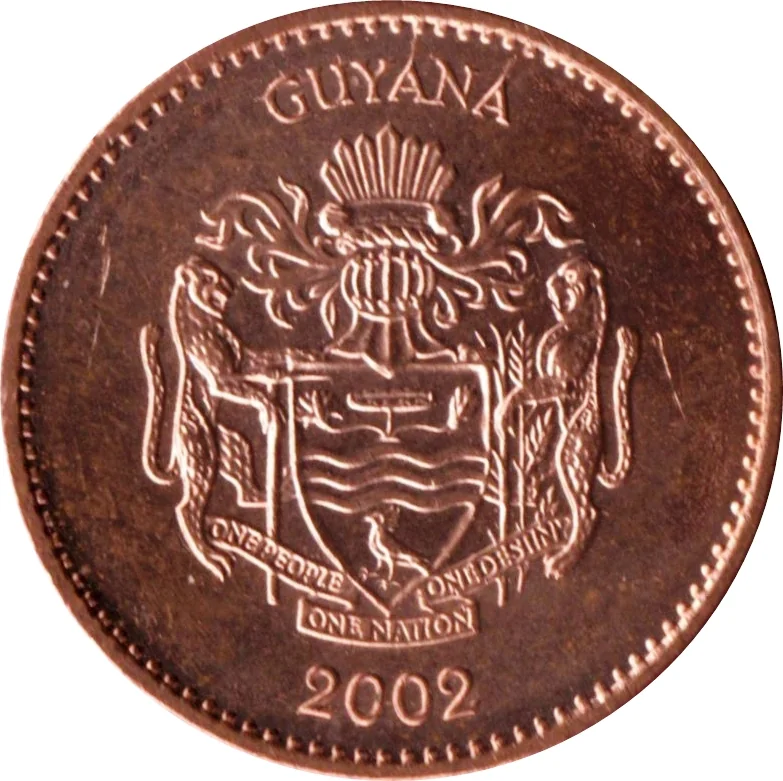
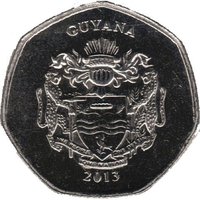
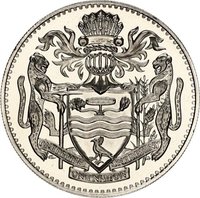
| Symbols> Coat of Arms |
Mints
| Name | Mark |
|---|---|
| Royal Mint | — |
Mintings
| Year | Mint Mark | Mintage | Quality | Collection |
|---|---|---|---|---|
| 1996 | — | — | ||
| 2001 | — | — | ||
| 2002 | — | — | ||
| 2005 | — | — | ||
| 2008 | — | — | ||
| 2011 | — | — | ||
| 2012 | — | — | ||
| 2015 | — | — |
Historical background
In 1996, Guyana's currency situation was characterized by a period of relative stability and cautious optimism under a managed float system, a significant improvement from the severe economic turmoil of the previous decades. Following a disastrous period of state control and a virtual economic collapse in the 1980s, a series of IMF-supported Economic Recovery Programs (ERPs) initiated after 1988 had begun to bear fruit. These reforms included the liberalization of the exchange rate, moving away from a fixed, overvalued official rate that had fueled a rampant black market. By 1996, the Guyana dollar (GYD) was finding its market value, with inflation being brought under control and foreign exchange reserves slowly rebuilding.
This stability was underpinned by the continued implementation of structural adjustment policies and the growing performance of key export sectors, notably sugar, gold, and rice. The government of President Cheddi Jagan, while historically socialist, pragmatically maintained the reform course, which helped secure continued international financial support. The managed float allowed for periodic adjustments by the Bank of Guyana, which intervened to smooth out excessive volatility rather than to defend a specific parity. Consequently, the parallel market premium—the gap between the official and black-market rates—had narrowed considerably compared to the crisis years, though it had not been fully eliminated.
However, the situation remained fragile and exposed to external shocks. The economy was still heavily indebted and dependent on a narrow range of primary commodity exports, whose prices on the global market directly impacted foreign exchange inflows. Furthermore, political tensions and social challenges posed risks to the continuity of economic policy. Thus, while 1996 represented a year of consolidated progress within a multi-year stabilization phase, the Guyanese currency system was not yet considered robust, with its health intrinsically linked to sustained fiscal discipline and the volatile fortunes of its export sectors.
This stability was underpinned by the continued implementation of structural adjustment policies and the growing performance of key export sectors, notably sugar, gold, and rice. The government of President Cheddi Jagan, while historically socialist, pragmatically maintained the reform course, which helped secure continued international financial support. The managed float allowed for periodic adjustments by the Bank of Guyana, which intervened to smooth out excessive volatility rather than to defend a specific parity. Consequently, the parallel market premium—the gap between the official and black-market rates—had narrowed considerably compared to the crisis years, though it had not been fully eliminated.
However, the situation remained fragile and exposed to external shocks. The economy was still heavily indebted and dependent on a narrow range of primary commodity exports, whose prices on the global market directly impacted foreign exchange inflows. Furthermore, political tensions and social challenges posed risks to the continuity of economic policy. Thus, while 1996 represented a year of consolidated progress within a multi-year stabilization phase, the Guyanese currency system was not yet considered robust, with its health intrinsically linked to sustained fiscal discipline and the volatile fortunes of its export sectors.
🌱 Very Common