

50 Cents – East Africa
Context
Years: 1937–1944
Issuer: East Africa
Ruler: George VI
Currency:
(1921—1967)
Demonetized: Yes
Total mintage: 12,000,000
Material
References
KM: #Click to copy to clipboard27
Numista: #11172
Obverse
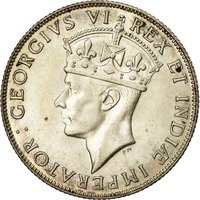
Description:
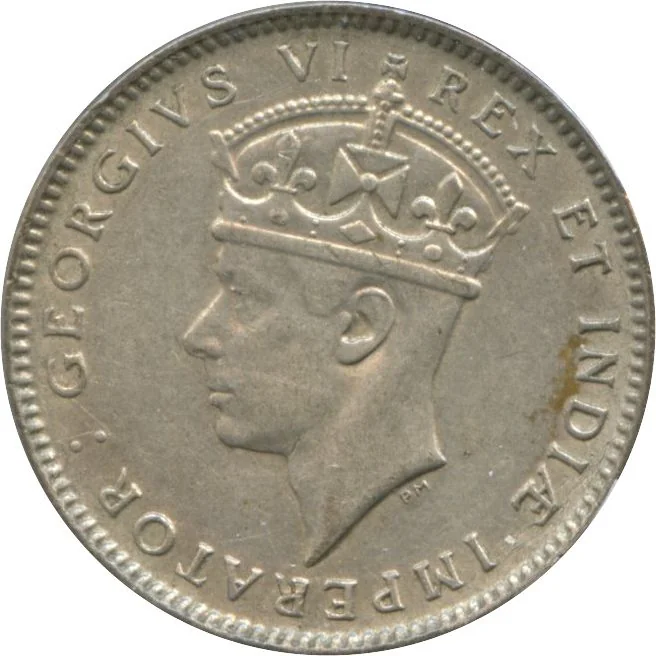
King George VI facing left.
Inscription:
GEORGIVS VI REX ET INDIÆ IMPERATOR:
PM
PM
Translation:
GEORGE VI KING AND EMPEROR OF INDIA:
PM
PM
Script: Latin
Language: Latin
Engraver: Percy Metcalfe
Reverse
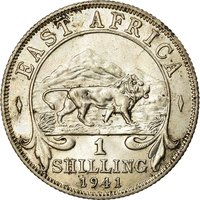
Description:
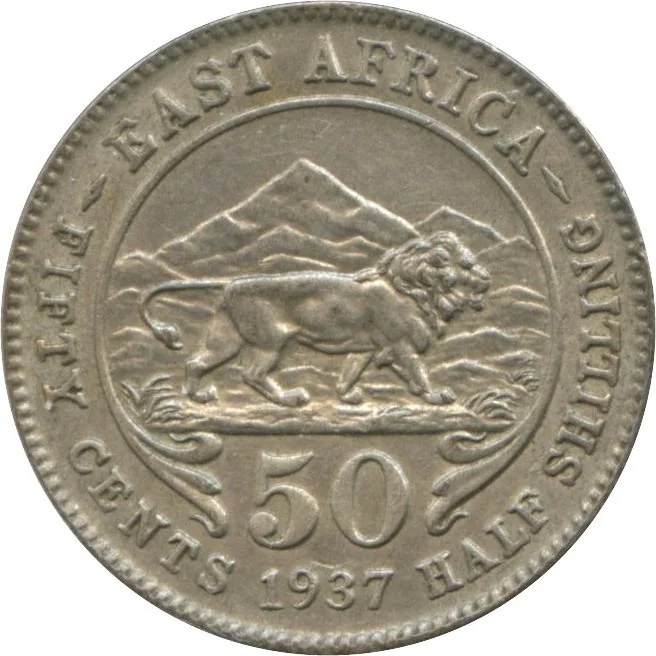
Lion and mountains in a 3/4 circle with fleur ends. Date divides denominations below and right.
Inscription:
-EAST AFRICA-
H
50
FIFTY CENTS HALF SHILLING
H
50
FIFTY CENTS HALF SHILLING
Script: Latin
Edge
Reeded
Mints
| Name | Mark |
|---|---|
| Heaton and Sons / The Mint Birmingham | H |
| Mumbai / Bombay | I |
| Pretoria | SA |
Mintings
Historical background
In 1937, the currency situation in East Africa was defined by the dominance of colonial monetary systems, primarily under British control. The region was served by the East African Currency Board (EACB), established in 1919 and headquartered in London. This board issued a common currency—the East African shilling—for the territories of Kenya, Uganda, Tanganyika (a British mandate), and Zanzibar. The system was a classic colonial currency board arrangement, where the local currency was fully backed by sterling reserves held in London, ensuring a fixed and stable exchange rate with the British pound. This facilitated imperial trade and administrative efficiency, firmly tethering the East African economies to the financial and economic priorities of the United Kingdom.
Beyond the British sphere, other colonial powers imposed their own currencies. Italian-occupied Ethiopia (following its invasion in 1935-36) saw the attempted introduction of the Italian East African lira, while the Belgian Franc circulated in Rwanda and Burundi (administered as part of Ruanda-Urundi under a League of Nations mandate). French territories like Djibouti used the French franc. These distinct monetary zones fragmented regional commerce, as trade across colonial borders required currency exchange and was often subject to strict imperial trade policies that discouraged intra-African exchange in favor of export to European metropoles.
For the African population, this imposed monetary economy coexisted with, and often disrupted, traditional systems of barter and commodity wealth (like livestock). The primary function of the currency was to facilitate the colonial export economy—cash crops like coffee, cotton, and sisal—and to pay taxes and wages. The EACB system provided monetary stability but offered no local control over credit or monetary policy, limiting the ability to respond to local economic needs. Consequently, the currency landscape of 1937 was one of external imposition, designed for extraction and administrative convenience, laying a foundation of monetary integration within specific colonial blocks that would later influence post-independence financial policies.
Beyond the British sphere, other colonial powers imposed their own currencies. Italian-occupied Ethiopia (following its invasion in 1935-36) saw the attempted introduction of the Italian East African lira, while the Belgian Franc circulated in Rwanda and Burundi (administered as part of Ruanda-Urundi under a League of Nations mandate). French territories like Djibouti used the French franc. These distinct monetary zones fragmented regional commerce, as trade across colonial borders required currency exchange and was often subject to strict imperial trade policies that discouraged intra-African exchange in favor of export to European metropoles.
For the African population, this imposed monetary economy coexisted with, and often disrupted, traditional systems of barter and commodity wealth (like livestock). The primary function of the currency was to facilitate the colonial export economy—cash crops like coffee, cotton, and sisal—and to pay taxes and wages. The EACB system provided monetary stability but offered no local control over credit or monetary policy, limiting the ability to respond to local economic needs. Consequently, the currency landscape of 1937 was one of external imposition, designed for extraction and administrative convenience, laying a foundation of monetary integration within specific colonial blocks that would later influence post-independence financial policies.
🌱 Common