

5 euro (Baltic Way) – Latvia
Add to wishlist
Non-circulating coins
Commemoration: 25th anniversary of the Baltic Way
Latvia
Context
Material
References
KM: #
Numista: #64048
Value
Exchange value: 5 EUR
Bullion value: $50.79
Inflation-adjusted value: 7.38 EUR
Obverse
Description:
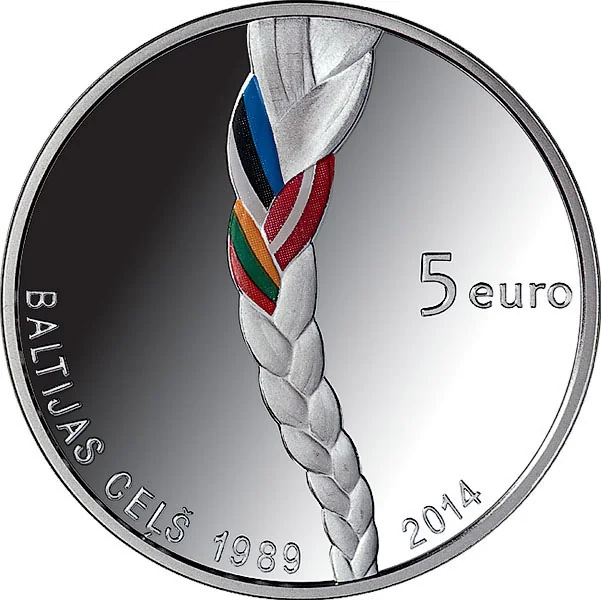
The obverse features a braid woven with the seven colors of the three Baltic nations' flags. To the right is "5 euro" and the year 2014. The semicircular inscription "BALTIJAS CEĻŠ 1989" is at the lower left.
Inscription:
5 euro
BALTIJAS CEĻŠ 1989 2014
BALTIJAS CEĻŠ 1989 2014
Translation:
The Baltic Way 1989 2014
Script: Latin
Language: Latvian
Engraver: Ligita Franckeviča
Designer: Visvaldis Asaris
Reverse
Description:
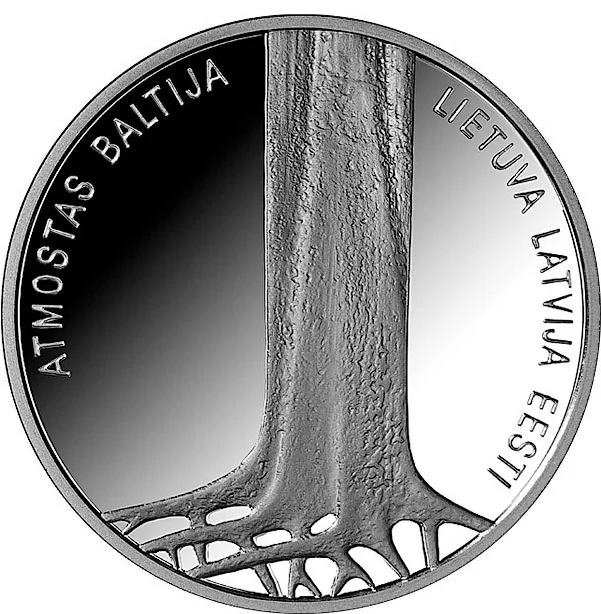
The reverse depicts a tree trunk with exposed roots, flanked by the inscriptions ATMOSTAS BALTIJA and LIETUVA LATVIJA EESTI.
Inscription:
ATMOSTAS BALTIJA
LIETUVA LATVIJA EESTI
LIETUVA LATVIJA EESTI
Translation:
Eternal Baltic
Lithuania Latvia Estonia
Lithuania Latvia Estonia
Script: Latin
Engraver: Ligita Franckeviča
Designer: Visvaldis Asaris
Edge
The edge features two inscriptions LATVIJAS BANKA and LATVIJAS REPUBLIKA, separated by rhombic dots.
Legend:
LATVIJAS BANKA ◊ LATVIJAS REPUBLIKA ◊
Translation:
LATVIJAS BANKA ◊ LATVIJAS REPUBLIKA ◊
Language: Latvian
Mints
| Name | Mark |
|---|---|
| Royal Dutch Mint | — |
Mintings
| Year | Mint Mark | Mintage | Quality | Collection |
|---|---|---|---|---|
| 2014 | — | 10,000 | Proof |
Historical background
In 2014, Latvia was in a unique and transitional currency situation, having just adopted the euro on January 1st of that year. This marked the culmination of a long-stated strategic goal following its accession to the European Union in 2004 and recovery from a severe financial crisis in 2008-2009. The country replaced its previous currency, the Latvian lats (LVL), which had been a strong symbol of national identity since its reintroduction after independence from the Soviet Union. The switch was driven by a desire for deeper economic integration with the Eurozone core, aiming to secure greater financial stability, attract foreign investment, and lower borrowing costs for the state and businesses.
The transition itself was technically smooth, with a two-week dual-circulation period. However, it was met with significant public ambivalence. Polls consistently showed a majority of Latvians opposed the change, driven by concerns over a loss of sovereignty, fears of hidden price increases (despite strict conversion rules), and sentimental attachment to the lats. The political elite, however, remained overwhelmingly in favor, viewing euro adoption as a final step in Latvia's "return to Europe" and a strategic move to distance itself from the economic and political influence of Russia—a consideration that gained immense urgency later in 2014 with the annexation of Crimea.
Thus, Latvia's 2014 currency situation was defined by its first full year operating within the Eurozone. The macroeconomic rationale was clear: it locked in the fiscal discipline of the post-crisis years and provided a stable currency platform. Yet, the year also highlighted the complex blend of economic pragmatism and geopolitical calculation behind the move, set against a backdrop of lingering public skepticism. The timing proved historically significant, as the geopolitical shocks later that year underscored the importance of Latvia's anchored position within the core European monetary and political bloc.
The transition itself was technically smooth, with a two-week dual-circulation period. However, it was met with significant public ambivalence. Polls consistently showed a majority of Latvians opposed the change, driven by concerns over a loss of sovereignty, fears of hidden price increases (despite strict conversion rules), and sentimental attachment to the lats. The political elite, however, remained overwhelmingly in favor, viewing euro adoption as a final step in Latvia's "return to Europe" and a strategic move to distance itself from the economic and political influence of Russia—a consideration that gained immense urgency later in 2014 with the annexation of Crimea.
Thus, Latvia's 2014 currency situation was defined by its first full year operating within the Eurozone. The macroeconomic rationale was clear: it locked in the fiscal discipline of the post-crisis years and provided a stable currency platform. Yet, the year also highlighted the complex blend of economic pragmatism and geopolitical calculation behind the move, set against a backdrop of lingering public skepticism. The timing proved historically significant, as the geopolitical shocks later that year underscored the importance of Latvia's anchored position within the core European monetary and political bloc.

⭐ Rare