

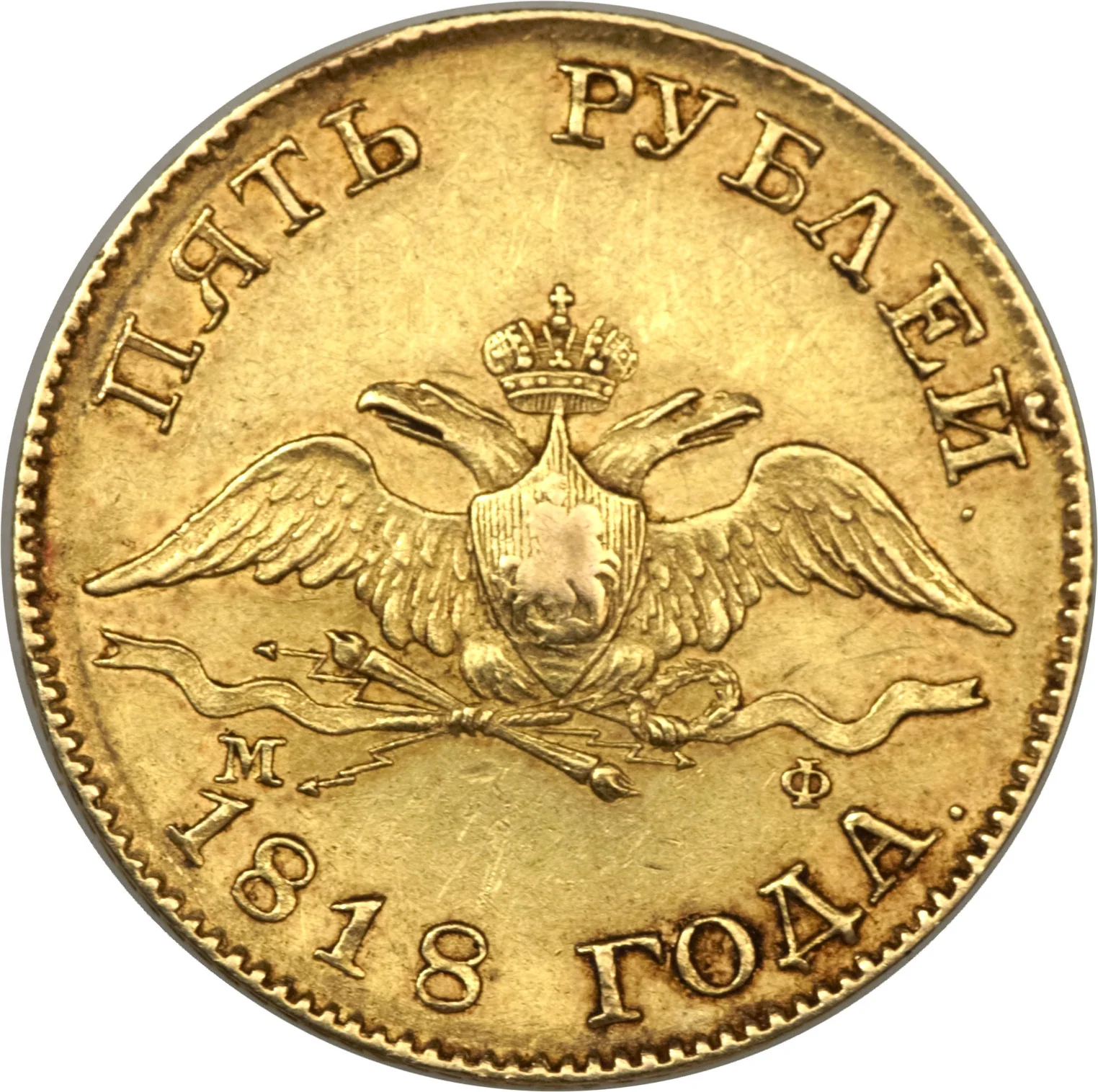
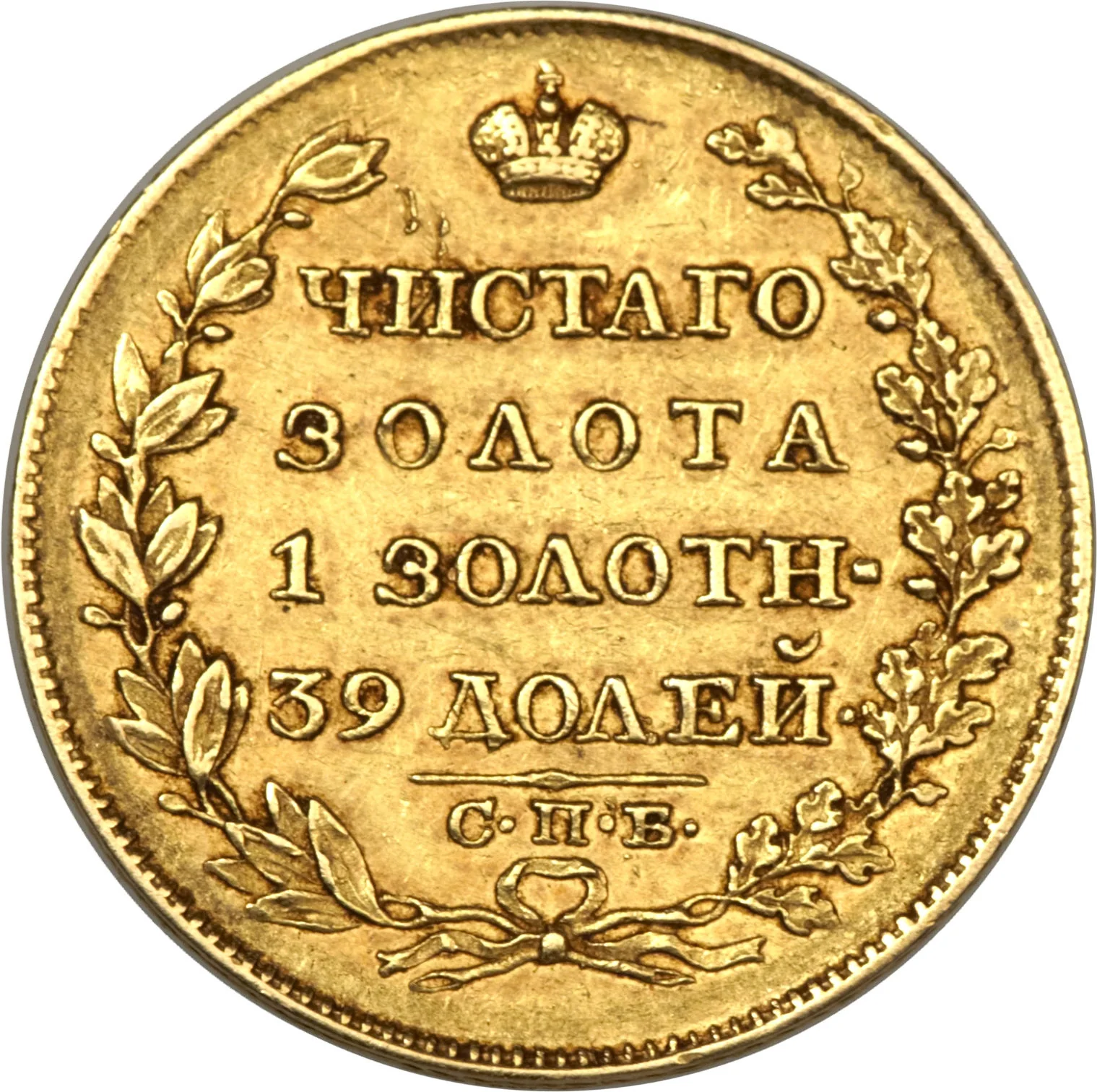
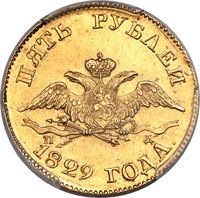
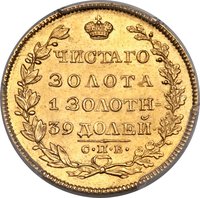
5 rubles – Russian Empire
Add to wishlist
Russia
Context
Years: 1817–1825
Country: Russia
Issuer: Russian Empire
Ruler: Alexander I
Currency:
(1700—1917)
Demonetized: Yes
Total mintage: 3,949,156
Material
References
KM: #
Numista: #63986
Value
Bullion value: $925.08
Obverse
Reverse
Edge
Dotted
Mintings
| Year | Mint Mark | Mintage | Quality | Collection |
|---|---|---|---|---|
| 1817 | СПБ | 710,008 | BU | |
| 1818 | СПБ | 1,520,000 | BU | |
| 1819 | СПБ | 963,145 | BU | |
| 1822 | СПБ | 40,003 | BU | |
| 1823 | СПБ | 440,000 | BU | |
| 1824 | СПБ | 276,000 | BU | |
| 1825 | СПБ | — | BU | |
| 1825 | СПБ | — | Proof |
Historical background
By 1817, the Russian Empire's currency system was in a state of profound disarray, a direct legacy of the Napoleonic Wars. To finance the massive military campaigns of 1812-1815, the government of Alexander I had resorted to printing vast quantities of paper money, known as assignatsii. This led to severe inflation and a catastrophic divergence between the paper assignat ruble and the silver ruble. By 1817, the assignat had lost roughly three-quarters of its face value, with the exchange rate stabilising around 4 assignat rubles to 1 silver ruble. This created a chaotic dual-currency economy where state accounts and international trade were conducted in silver, while most domestic commerce used the depreciated paper.
Recognising the crisis, Tsar Alexander I and his Finance Minister, Count Dmitry Guryev, initiated a major monetary reform in 1817. The cornerstone of this effort was the establishment of a new State Commercial Bank, endowed with 30 million silver rubles from a large war indemnity paid by France. The bank's primary mission was to facilitate the gradual withdrawal of the depreciated assignats from circulation and to restore public confidence in paper currency by guaranteeing its convertibility into hard coin. This period marked a deliberate, if cautious, shift toward stabilisation and the backing of paper money with precious metal reserves.
However, the reform of 1817 was more a foundation for future stability than an immediate solution. The government, wary of social unrest, did not pursue the aggressive retirement of assignats that some advisors recommended. Instead, it aimed for a slow, managed process to avoid deflationary shock. Consequently, the dual-currency system and the gap between silver and paper rubles persisted for decades, not being fully resolved until the more comprehensive reform of Count Yegor Kankrin in 1839-1843. Thus, 1817 represents a pivotal but intermediate chapter in Imperial Russia's long struggle to establish a sound and unified monetary system.
Recognising the crisis, Tsar Alexander I and his Finance Minister, Count Dmitry Guryev, initiated a major monetary reform in 1817. The cornerstone of this effort was the establishment of a new State Commercial Bank, endowed with 30 million silver rubles from a large war indemnity paid by France. The bank's primary mission was to facilitate the gradual withdrawal of the depreciated assignats from circulation and to restore public confidence in paper currency by guaranteeing its convertibility into hard coin. This period marked a deliberate, if cautious, shift toward stabilisation and the backing of paper money with precious metal reserves.
However, the reform of 1817 was more a foundation for future stability than an immediate solution. The government, wary of social unrest, did not pursue the aggressive retirement of assignats that some advisors recommended. Instead, it aimed for a slow, managed process to avoid deflationary shock. Consequently, the dual-currency system and the gap between silver and paper rubles persisted for decades, not being fully resolved until the more comprehensive reform of Count Yegor Kankrin in 1839-1843. Thus, 1817 represents a pivotal but intermediate chapter in Imperial Russia's long struggle to establish a sound and unified monetary system.
✨ Legendary