

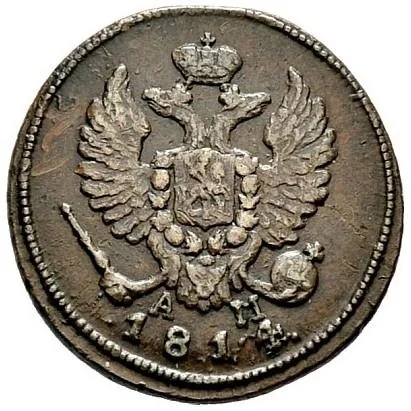
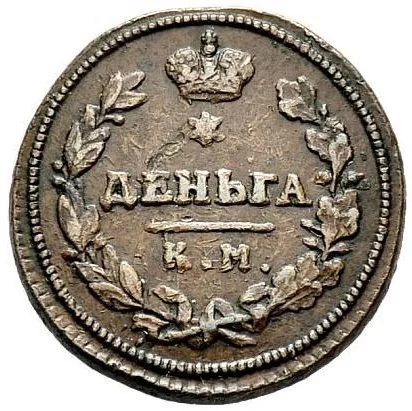
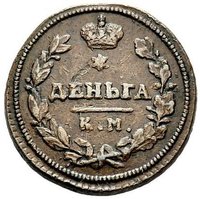
1 Denga – Russian Empire
Russia
Context
Years: 1812–1817
Country: Russia 
Issuer: Russian Empire
Ruler: Alexander I
Currency:
(1700—1917)
Demonetized: Yes
Total mintage: 1,500,000
Material
References
Numista: #101915
Obverse
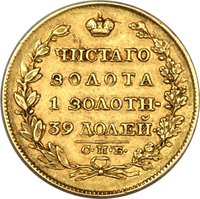
Reverse
Edge
Plain
Mintings
| Year | Mint Mark | Mintage | Quality | Collection |
|---|---|---|---|---|
| 1812 | КМ | 250,000 | ||
| 1813 | КМ | 250,000 | ||
| 1814 | КМ | 250,000 | ||
| 1815 | КМ | 250,000 | ||
| 1816 | КМ | 250,000 | ||
| 1817 | КМ | 250,000 |
Historical background
In 1812, the Russian Empire's currency system was a complex and strained mixture of metallism and paper money, a legacy of decades of warfare. The primary monetary units were the silver ruble and the paper assignat ruble, which existed in parallel but were not equal in value. The state-issued assignatsiya, introduced under Catherine the Great in 1769 to finance wars, had no precious metal backing and were produced in large quantities. Consequently, by 1812, the paper assignat ruble had depreciated significantly, trading at only about a quarter of the value of a silver ruble. This created a de facto dual-currency economy where foreign trade and state contracts were often calculated in silver, while daily domestic transactions used the depreciated paper notes.
The financial situation was acutely pressured by the Napoleonic Wars. In the years leading up to 1812, and especially following the French invasion, the imperial government under Alexander I faced enormous military expenditures. To cover these costs, the state resorted to the accelerated printing of assignats, a classic wartime fiscal measure. This dramatic increase in the money supply, without a corresponding increase in economic output, led to severe inflation and a further loss of public confidence in the paper currency. The economic disruption caused by the invasion itself—including the scorched-earth tactics, the loss of territory, and the destruction of Moscow—exacerbated the monetary chaos, making it difficult for the treasury to stabilize finances.
Despite these challenges, the assignat system proved functionally crucial for the war effort. It provided the flexible, if inflationary, means to mobilize resources, pay troops, and sustain the army across vast distances. The system's very fragility underscored the state's absolute priority: military victory over financial stability. In the aftermath of 1812, the legacy of this monetary expansion would burden the Russian economy for years, contributing to a state debt crisis and eventually leading to the monetary reform of 1839-1843, which finally abolished the assignats and established a silver-backed ruble.
The financial situation was acutely pressured by the Napoleonic Wars. In the years leading up to 1812, and especially following the French invasion, the imperial government under Alexander I faced enormous military expenditures. To cover these costs, the state resorted to the accelerated printing of assignats, a classic wartime fiscal measure. This dramatic increase in the money supply, without a corresponding increase in economic output, led to severe inflation and a further loss of public confidence in the paper currency. The economic disruption caused by the invasion itself—including the scorched-earth tactics, the loss of territory, and the destruction of Moscow—exacerbated the monetary chaos, making it difficult for the treasury to stabilize finances.
Despite these challenges, the assignat system proved functionally crucial for the war effort. It provided the flexible, if inflationary, means to mobilize resources, pay troops, and sustain the army across vast distances. The system's very fragility underscored the state's absolute priority: military victory over financial stability. In the aftermath of 1812, the legacy of this monetary expansion would burden the Russian economy for years, contributing to a state debt crisis and eventually leading to the monetary reform of 1839-1843, which finally abolished the assignats and established a silver-backed ruble.
✨ Legendary