

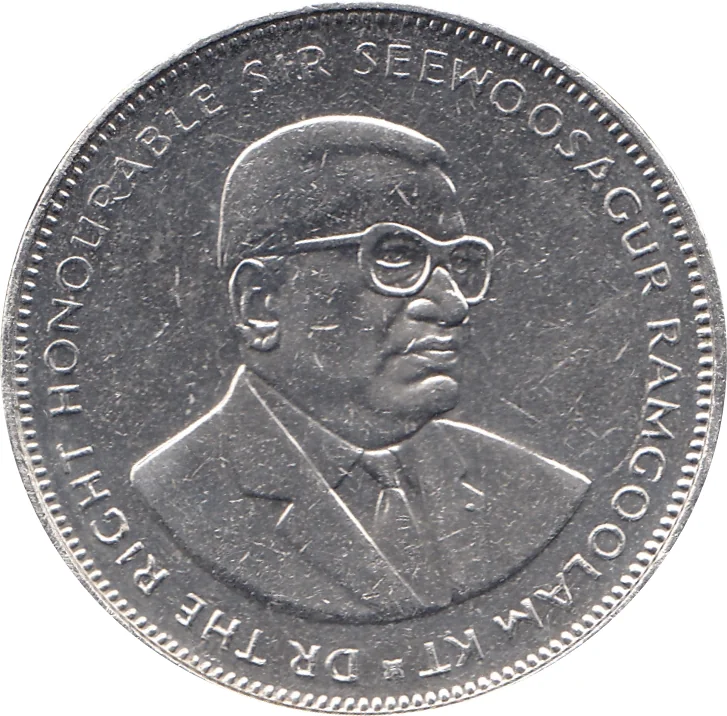
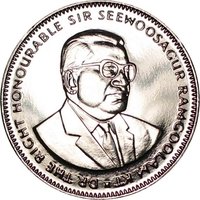
Obverse
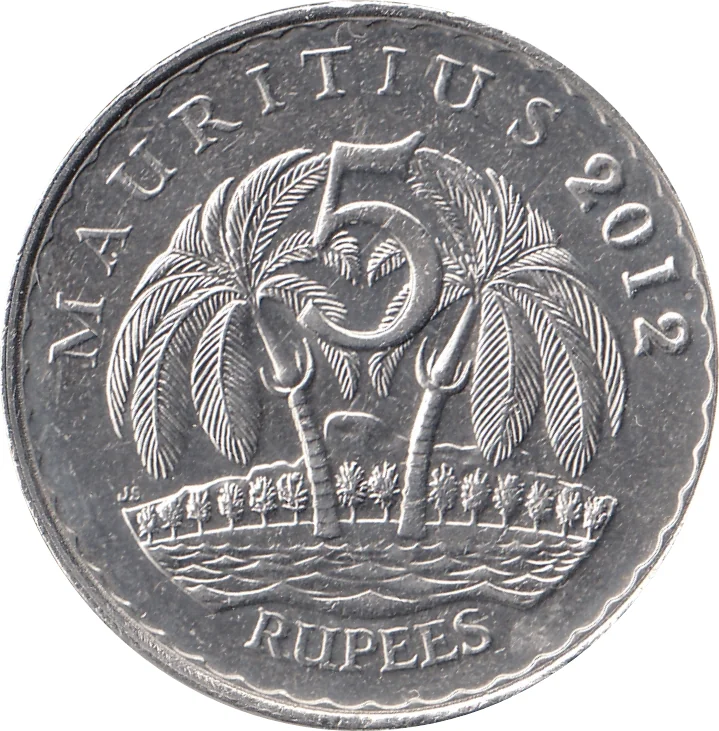
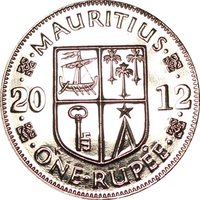
Reverse
Edge
Security Edge (Milled)
Categories
| Person> Politician |
| Plant> Tree |
Mintings
| Year | Mint Mark | Mintage | Quality | Collection |
|---|---|---|---|---|
| 2012 | — | — | ||
| 2018 | — | — |
Historical background
In 2012, Mauritius faced a challenging currency situation characterized by significant depreciation of the Mauritian Rupee (MUR) against major trading currencies, particularly the US Dollar. The rupee, which had traded around 28-29 against the USD in early 2011, weakened to approximately 30.5 by mid-2012 and continued to slide, breaching the 31.0 mark by year-end. This depreciation was driven by a combination of a widening current account deficit, strong import demand (especially for capital goods and energy), and weaker export performance in key sectors like textiles. The global economic uncertainty from the Eurozone debt crisis also contributed to volatility, prompting capital outflows from emerging markets like Mauritius.
The depreciation placed the Bank of Mauritius (BoM) in a difficult policy dilemma. On one hand, a weaker rupee benefited the crucial tourism and export-oriented sectors by making their services and goods cheaper for foreign buyers. On the other hand, it stoked imported inflation, increasing the cost of fuel, food, and other essentials, which squeezed household budgets. The central bank intervened intermittently in the foreign exchange market to smooth out excessive volatility and build reserves, but it largely allowed the currency to reflect market fundamentals, adhering to a managed float regime.
Ultimately, the currency pressures in 2012 highlighted the structural vulnerabilities of Mauritius's small, open economy. The situation underscored the country's heavy dependence on imports and its sensitivity to global financial flows. The government and central bank responses focused on medium-term measures to improve the trade balance and attract stable foreign investment, rather than imposing strict capital controls, setting the stage for subsequent economic adjustments in the following years.
The depreciation placed the Bank of Mauritius (BoM) in a difficult policy dilemma. On one hand, a weaker rupee benefited the crucial tourism and export-oriented sectors by making their services and goods cheaper for foreign buyers. On the other hand, it stoked imported inflation, increasing the cost of fuel, food, and other essentials, which squeezed household budgets. The central bank intervened intermittently in the foreign exchange market to smooth out excessive volatility and build reserves, but it largely allowed the currency to reflect market fundamentals, adhering to a managed float regime.
Ultimately, the currency pressures in 2012 highlighted the structural vulnerabilities of Mauritius's small, open economy. The situation underscored the country's heavy dependence on imports and its sensitivity to global financial flows. The government and central bank responses focused on medium-term measures to improve the trade balance and attract stable foreign investment, rather than imposing strict capital controls, setting the stage for subsequent economic adjustments in the following years.
🌱 Very Common