

50 Centimes – French Cameroon
Cameroon
Context
Years: 1924–1926
Country: Cameroon 
Issuer: French Cameroon
Period:
(1919—1940)
Currency:
(1922—1945)
Demonetized: Yes
Total mintage: 14,300,000
Material
Diameter: 17.5 mm
Weight: 2.53 g
Thickness: 1.54 mm
Shape: Round
Composition: Aluminium bronze
Magnetic: No
Technique: Milled
Alignment: Coin alignment
flip
References
KM: #Click to copy to clipboard1
Numista: #6377
Obverse
Description:
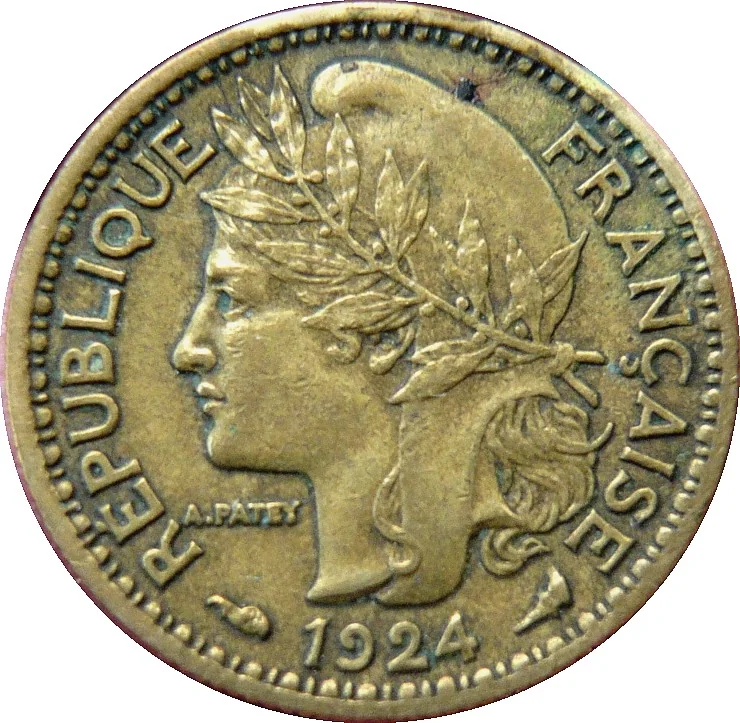
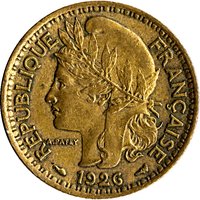
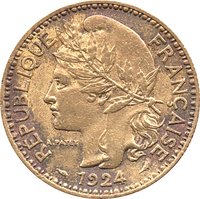
Laureate left, date beneath.
Inscription:
REPUBLIQUE FRANCAISE
A.PATEY
1924
A.PATEY
1924
Translation:
FRENCH REPUBLIC
A. PATEY
1924
A. PATEY
1924
Script: Latin
Language: French
Engraver: Henri-Auguste Patey
Reverse
Description:
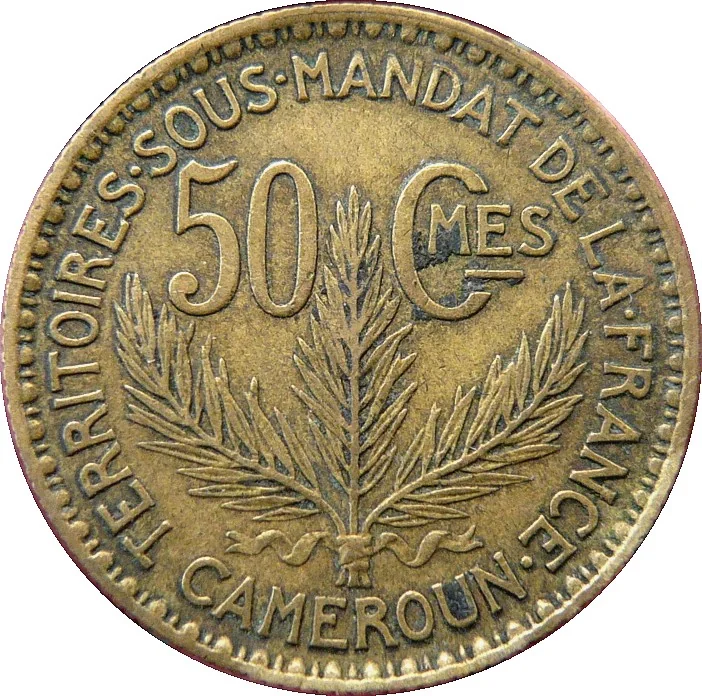
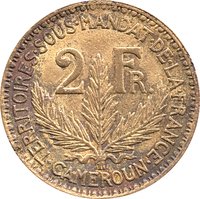
Branch spray
Inscription:
TERRITOIRES SOUS MANDAT DE LA FRANCE
50 Cmes
CAMEROUN
50 Cmes
CAMEROUN
Translation:
TERRITORIES UNDER MANDATE OF FRANCE
50 Centimes
CAMEROON
50 Centimes
CAMEROON
Script: Latin
Language: French
Engraver: Henri-Auguste Patey
Edge
Reeded
Mints
| Name | Mark |
|---|---|
| Monnaie de Paris | — |
Mintings
| Year | Mint Mark | Mintage | Quality | Collection |
|---|---|---|---|---|
| 1924 | — | 4,000,000 | ||
| 1925 | — | 2,500,000 | ||
| 1926 | — | 7,800,000 |
Historical background
In 1924, the currency situation in French Cameroon was defined by its integration into the monetary system of French Equatorial Africa (AEF), under the authority of the Banque de l'Afrique Occidentale (BAO). The territory had fully transitioned from the earlier, diverse mix of commodity monies, such as brass rods and cowries, and German marks from the colonial period prior to World War I, to the French franc system. The legal tender was the French franc, with the BAO issuing distinct banknotes for circulation in the AEF region, which were pegged at par with the metropolitan French franc. This created a stable, centrally managed currency aligned with France's economic interests.
The primary function of this monetary arrangement was to facilitate the colony's export economy and administrative integration. The franc-based system streamlined the taxation of the local population, who were compelled to use the currency to pay head taxes (impôt de capitation), thereby driving them into the cash crop economy, particularly for cocoa, coffee, and palm products. It also ensured that trade and profits flowed efficiently to French commercial firms and the metropole, as there were no exchange controls or differential rates between the colonial and metropolitan francs.
However, this imposed stability came with significant constraints. The money supply and credit were tightly controlled by the BAO, primarily serving the needs of French administrators and large trading companies, with little credit available for African farmers or entrepreneurs. The economy was fundamentally cash-scarce outside major administrative centers, and the sudden requirement to earn francs for tax payments created hardship and deepened dependency on European commercial networks. Thus, in 1924, the currency situation was one of consolidated colonial control, acting as a key tool for economic extraction and the forced modernization of the local economy within the framework of the French imperial franc zone.
The primary function of this monetary arrangement was to facilitate the colony's export economy and administrative integration. The franc-based system streamlined the taxation of the local population, who were compelled to use the currency to pay head taxes (impôt de capitation), thereby driving them into the cash crop economy, particularly for cocoa, coffee, and palm products. It also ensured that trade and profits flowed efficiently to French commercial firms and the metropole, as there were no exchange controls or differential rates between the colonial and metropolitan francs.
However, this imposed stability came with significant constraints. The money supply and credit were tightly controlled by the BAO, primarily serving the needs of French administrators and large trading companies, with little credit available for African farmers or entrepreneurs. The economy was fundamentally cash-scarce outside major administrative centers, and the sudden requirement to earn francs for tax payments created hardship and deepened dependency on European commercial networks. Thus, in 1924, the currency situation was one of consolidated colonial control, acting as a key tool for economic extraction and the forced modernization of the local economy within the framework of the French imperial franc zone.

🌱 Common