

50 francs (Reign of Prince Rainier III) – Monaco
Add to wishlist
Non-circulating coins
Commemoration: 25th Anniversary of the Reign of Prince Rainier III
Monaco
Context
Years: 1974–1976
Issuer: Monaco
Ruler: Rainier III
Currency:
(1960—2001)
Demonetized: Yes
Total mintage: 20,500
Material
References
KM: #
Numista: #6372
Value
Exchange value: 50 MCF
Bullion value: $65.71
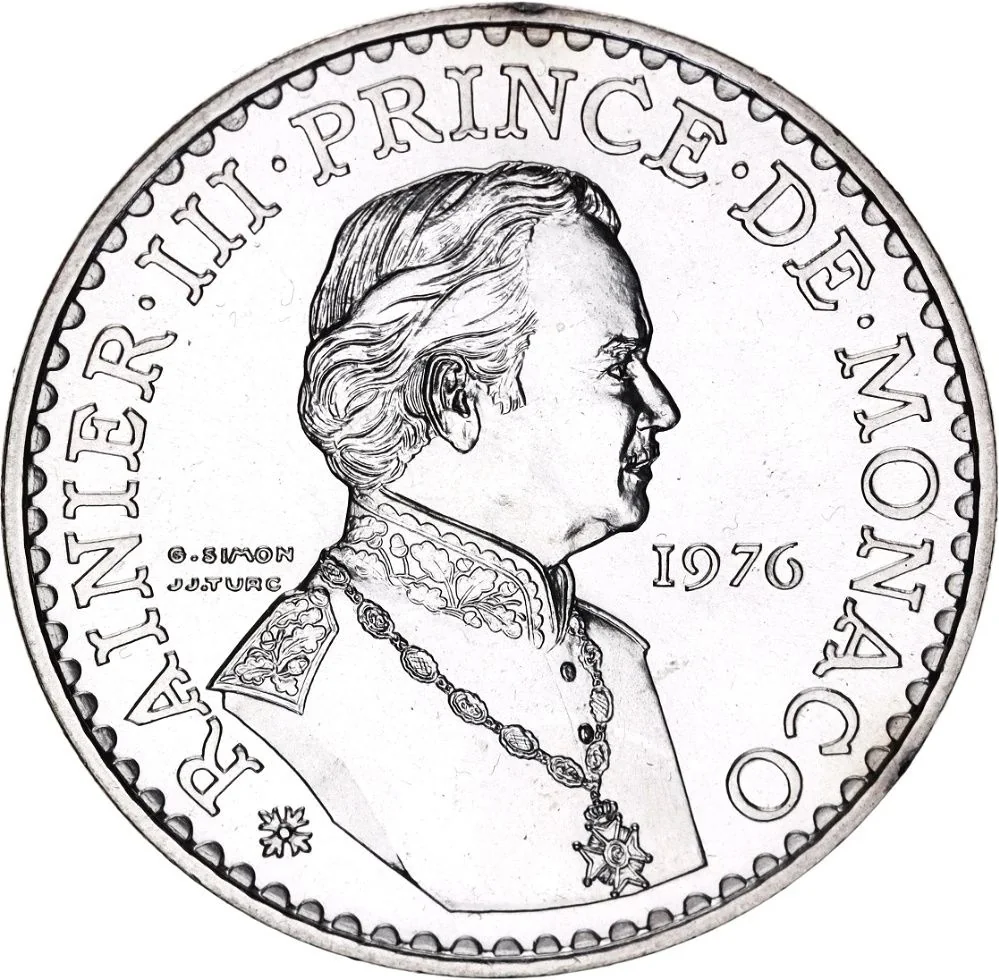
Obverse
Description:
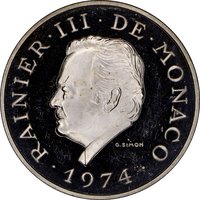
Prince Rainier III in uniform, wearing the Order of Saint Charles collar.
Inscription:
RAINIER · III · PRINCE · DE · MONACO
G.SIMON
J.J.TURC
1976
G.SIMON
J.J.TURC
1976
Script: Latin
Engraver: Georges Simon
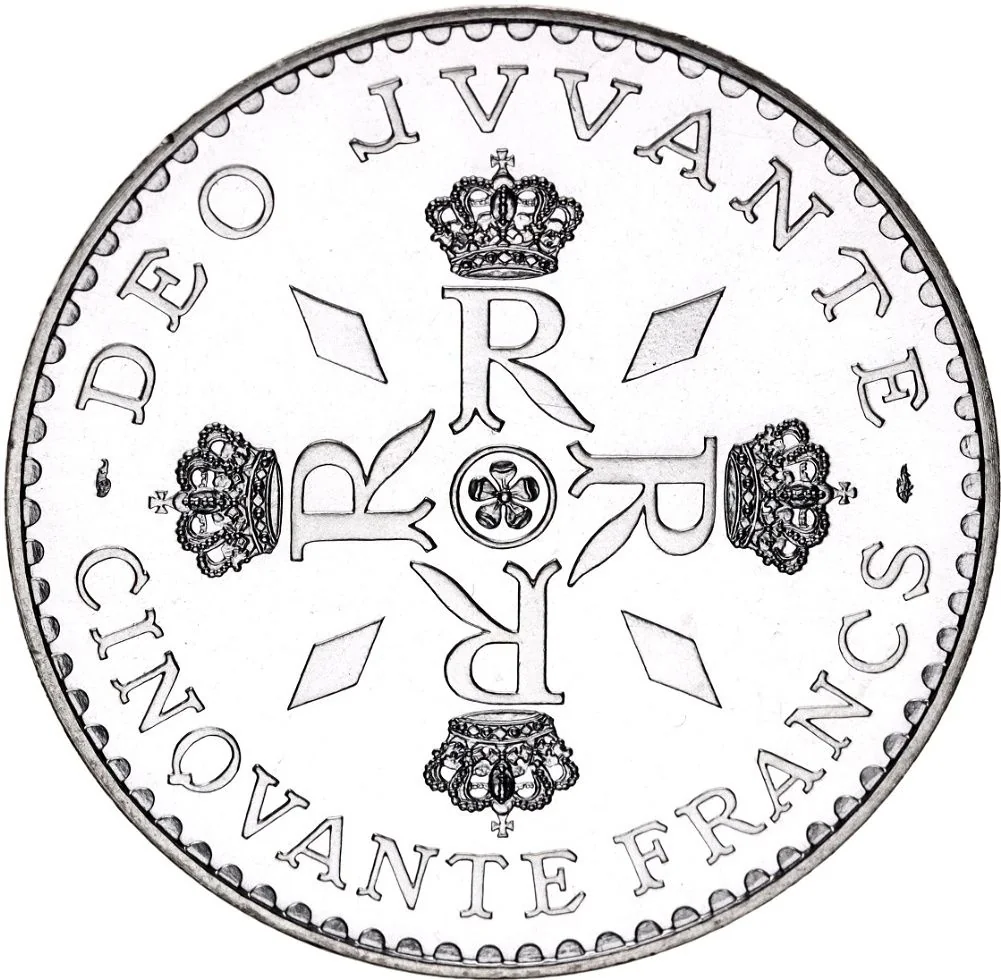
Reverse
Description:
Four crowned R's and rockets alternate around a central flower.
Inscription:
DEO JVVANTE
CINQVANTE FRANCS
CINQVANTE FRANCS
Script: Latin
Engraver: Georges Simon
Edge
Inscripted or smooth without inscription
Legend:
VINGT-CINQ ANNÉES DE REGNE 1949 - 1974
Translation:
Twenty-Five Years of Reign 1949 - 1974
Language: French
Mints
| Name | Mark |
|---|---|
| Monnaie de Paris | — |
Mintings
| Year | Mint Mark | Mintage | Quality | Collection |
|---|---|---|---|---|
| 1974 | — | 7,000 | ||
| 1975 | — | 7,500 | ||
| 1976 | — | 6,000 | In sets |
Historical background
In 1974, Monaco's currency situation was fundamentally defined by its unique political and monetary relationship with France, governed by the 1963 Monetary Convention. This treaty solidified the Principality's use of the French franc (FRF) as its sole official legal tender. Monaco minted its own franc coins, which were identical in value, size, and composition to their French counterparts and circulated interchangeably throughout France. However, the right of note issuance was exclusively held by the French Treasury, meaning all paper banknotes in Monaco were French.
The year 1974 fell within a period of relative monetary stability for the Franc Zone, but it was also a time of broader economic uncertainty. The first oil shock of 1973 had triggered inflation and economic slowdown across Europe, pressures which inevitably affected the French franc and, by extension, Monaco. Domestically, Monaco's economy, heavily reliant on tourism, banking, and commerce, remained robust, insulated by its wealthy demographic and status as a tax haven. The fixed, one-to-one parity with the French franc provided crucial stability for its financial sector and international business interests.
Therefore, the background for Monaco in 1974 is not one of monetary crisis or change, but of continuity and enforced stability through its treaty obligations. The Principality had no independent monetary policy, as its currency was effectively managed by the Banque de France. Its economic fortunes were closely tied to France's, yet buffered by its own niche economic model. This arrangement would remain undisturbed until the advent of the European single currency decades later, when Monaco would again negotiate its place within a new monetary framework.
The year 1974 fell within a period of relative monetary stability for the Franc Zone, but it was also a time of broader economic uncertainty. The first oil shock of 1973 had triggered inflation and economic slowdown across Europe, pressures which inevitably affected the French franc and, by extension, Monaco. Domestically, Monaco's economy, heavily reliant on tourism, banking, and commerce, remained robust, insulated by its wealthy demographic and status as a tax haven. The fixed, one-to-one parity with the French franc provided crucial stability for its financial sector and international business interests.
Therefore, the background for Monaco in 1974 is not one of monetary crisis or change, but of continuity and enforced stability through its treaty obligations. The Principality had no independent monetary policy, as its currency was effectively managed by the Banque de France. Its economic fortunes were closely tied to France's, yet buffered by its own niche economic model. This arrangement would remain undisturbed until the advent of the European single currency decades later, when Monaco would again negotiate its place within a new monetary framework.
🌱 Fairly Common