

10 francs (Marriage) – Monaco
Add to wishlist
Non-circulating coins
Commemoration: 10th Anniversary of Marriage
Monaco
Context
Year: 1966
Issuer: Monaco
Ruler: Rainier III
Currency:
(1960—2001)
Demonetized: Yes
Total mintage: 25,000
Material
References
Numista: #18719
Value
Exchange value: 10 MCF
Bullion value: $55.70
Obverse
Description:
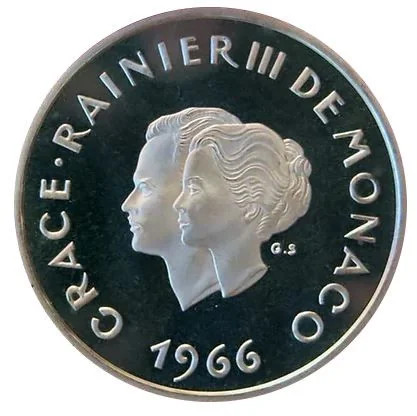
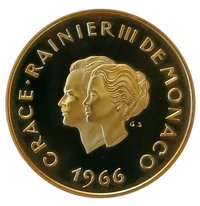
Grace and Rainier III of Monaco, left-facing, with date below.
Inscription:
GRACE • RAINIER III DE MONACO
G.S
1966
G.S
1966
Translation:
Grace Rainier III of Monaco
G.S
1966
G.S
1966
Script: Latin
Language: French
Engraver: Georges Simon
Reverse
Description:
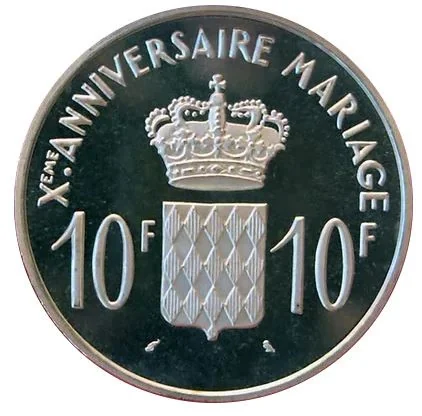
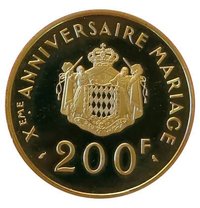
Monaco's royal coat of arms.
Inscription:
X EME ANNIVERSAIRE MARIAGE
10 F 10 F
10 F 10 F
Translation:
Tenth Wedding Anniversary
10 Francs 10 Francs
10 Francs 10 Francs
Script: Latin
Language: French
Engraver: Georges Simon
Edge
Reeded
Categories
| Symbols> Coat of Arms |
| Marriage |
Mints
| Name | Mark |
|---|---|
| Monnaie de Paris | — |
Mintings
| Year | Mint Mark | Mintage | Quality | Collection |
|---|---|---|---|---|
| 1966 | — | 1,000 | Proof | |
| 1966 | — | 24,000 |
Historical background
In 1966, Monaco's currency situation was intrinsically linked to its special relationship with France, governed by the 1918 and 1951 Franco-Monegasque treaties. While the Principality issued its own coinage, the French franc (FRF) served as the official legal tender and the bedrock of its monetary system. The Monegasque franc, minted by the French Monnaie de Paris, was pegged at absolute parity (1:1) with the French franc and was freely interchangeable. This arrangement meant Monaco had no independent monetary policy; its currency was effectively a local variant of the French franc, circulating alongside French banknotes and coins.
The year 1966 fell within a period of relative monetary stability under the Bretton Woods system, but it was also a time of increasing European economic integration. Domestically, Monaco was experiencing significant economic growth driven by tourism, real estate, and the establishment of businesses attracted by favorable tax conditions. This prosperity increased the demand for and circulation of currency, but all liquidity was fundamentally supplied by the French central banking system. The Banque de France managed the money supply and acted as the lender of last resort, with Monegasque commercial banks operating under French regulatory oversight.
Therefore, the background of Monaco's 1966 currency situation is one of complete dependency and stability through treaty obligation. There was no "currency crisis" or independent monetary debate within the Principality that year. Instead, its monetary framework was a key component of its political and economic symbiosis with France, ensuring stability but ceding sovereignty over currency issuance and control. This arrangement would remain fundamentally unchanged until the advent of the euro, which Monaco later adopted through a renewed agreement with France.
The year 1966 fell within a period of relative monetary stability under the Bretton Woods system, but it was also a time of increasing European economic integration. Domestically, Monaco was experiencing significant economic growth driven by tourism, real estate, and the establishment of businesses attracted by favorable tax conditions. This prosperity increased the demand for and circulation of currency, but all liquidity was fundamentally supplied by the French central banking system. The Banque de France managed the money supply and acted as the lender of last resort, with Monegasque commercial banks operating under French regulatory oversight.
Therefore, the background of Monaco's 1966 currency situation is one of complete dependency and stability through treaty obligation. There was no "currency crisis" or independent monetary debate within the Principality that year. Instead, its monetary framework was a key component of its political and economic symbiosis with France, ensuring stability but ceding sovereignty over currency issuance and control. This arrangement would remain fundamentally unchanged until the advent of the euro, which Monaco later adopted through a renewed agreement with France.
🌟 Limited