

20 euro cents – Greece
Add to wishlist
Greece
Context
Years: 2007–2025
Issuer: Greece
Period:
(since 1974)
Currency:
(since 2002)
Total mintage: 213,238,300
Material
Diameter: 22.25 mm
Weight: 5.74 g
Thickness: 2.14 mm
Shape: Spanish flower
Magnetic: No
Technique: Milled
Alignment: Medal alignment
flip
References
KM: #
Numista: #6350
Value
Exchange value: 0.20 EUR
Inflation-adjusted value: 0.27 EUR
Obverse
Description:
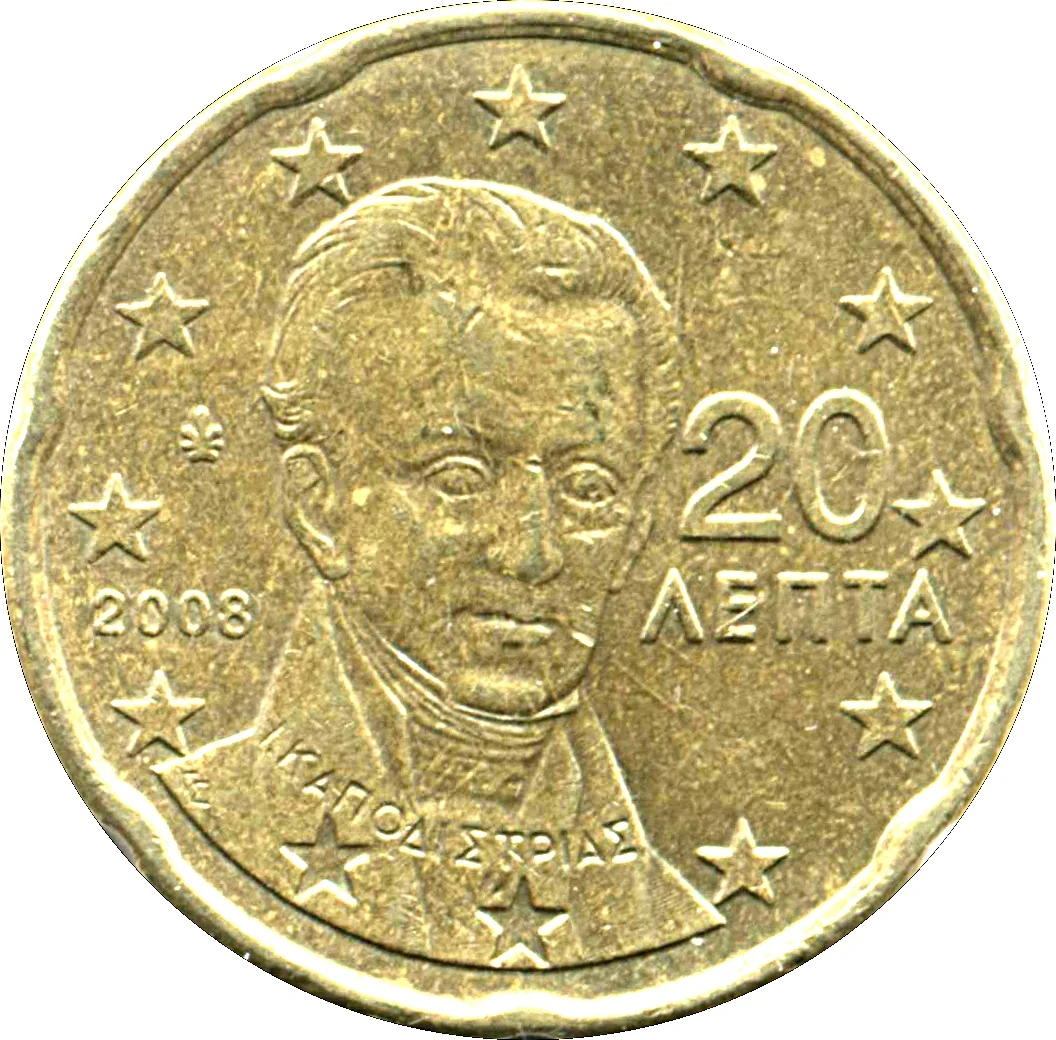
A portrait of Ioannis Capodistrias (1776–1831), first Governor of Greece, is accompanied by his name "Ι. Καποδίστριας," the face value, and the twelve European stars.
Inscription:
20
2008 ΛΕΠΤΑ
Ι. ΚΑΠΟΔΙΣΤΡΙΑΣ
ΓΣ
2008 ΛΕΠΤΑ
Ι. ΚΑΠΟΔΙΣΤΡΙΑΣ
ΓΣ
Translation:
20
2008 LEPTA
I. KAPODISTRIAS
GS
2008 LEPTA
I. KAPODISTRIAS
GS
Script: Greek
Language: Greek
Engravers: Maria Andonatou, Geórgios Stamatópoulos
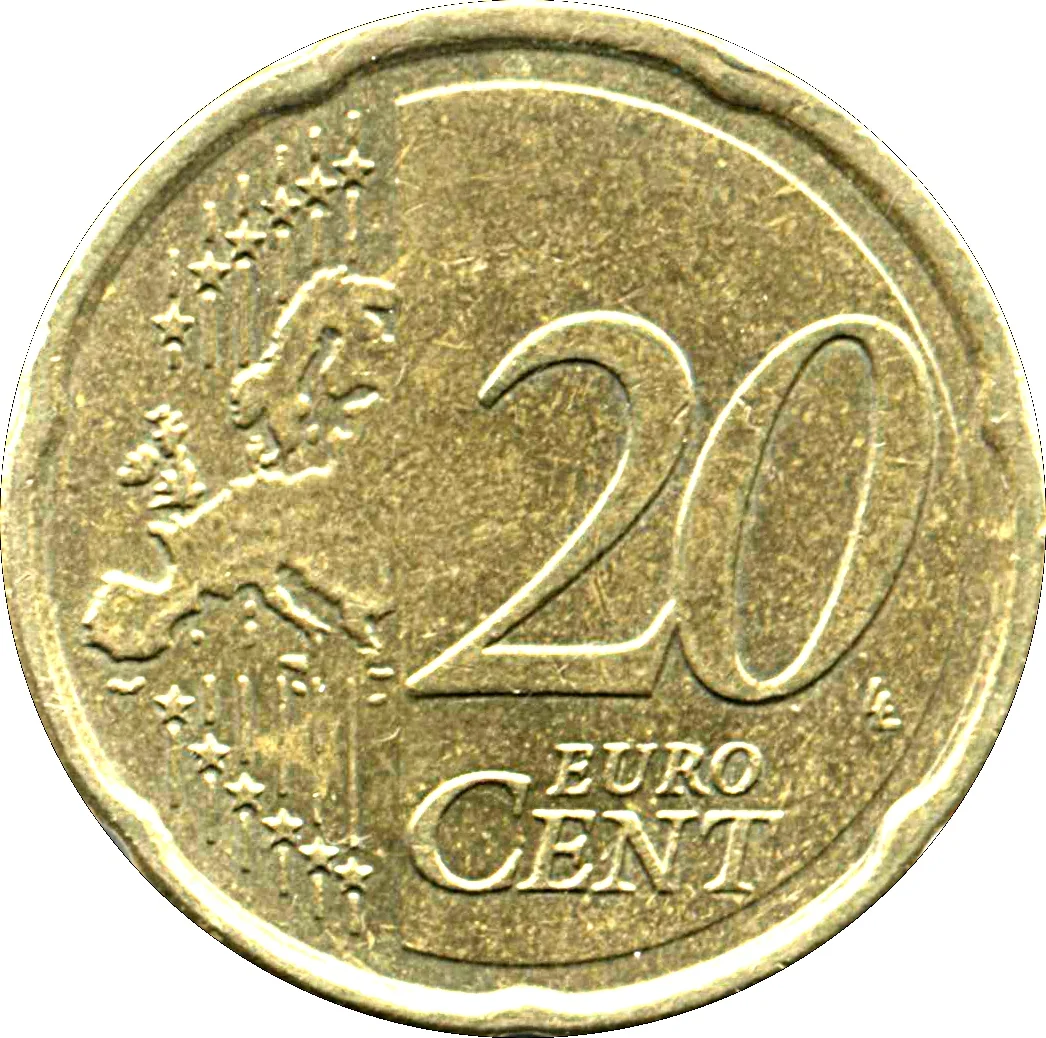
Reverse
Edge
Smooth with seven indentations ("Spanish flower")
Categories
| Map |
| Person> Politician |
Mints
| Name | Mark |
|---|---|
| National Mint of the Bank of Greece | — |
Mintings
| Year | Mint Mark | Mintage | Quality | Collection |
|---|---|---|---|---|
| 2007 | — | 25,000 | BU | |
| 2007 | — | 980,100 | ||
| 2008 | — | 25,000 | BU | |
| 2008 | — | 20,025,000 | ||
| 2009 | — | 23,975,000 | ||
| 2009 | — | 25,000 | BU | |
| 2010 | — | 11,975,000 | ||
| 2010 | — | 25,000 | BU | |
| 2011 | — | 965,000 | ||
| 2011 | — | 35,000 | BU | |
| 2011 | — | 2,500 | Proof | |
| 2012 | — | 30,000 | BU | |
| 2012 | — | 2,500 | Proof | |
| 2013 | — | 20,000 | BU | |
| 2013 | — | 4,000 | Proof | |
| 2014 | — | 13,000 | BU | |
| 2014 | — | 2,500 | Proof | |
| 2015 | — | 2,000 | Proof | |
| 2015 | — | 15,000 | BU | |
| 2016 | — | 15,000 | BU | |
| 2016 | — | 2,000 | Proof | |
| 2017 | — | 15,000 | BU | |
| 2017 | — | 1,200 | Proof | |
| 2018 | — | 15,000 | BU | |
| 2018 | — | 2,000 | Proof | |
| 2019 | — | 12,000,000 | ||
| 2019 | — | 10,000 | BU | |
| 2019 | — | 1,500 | Proof | |
| 2020 | — | 32,000,000 | ||
| 2020 | — | 10,000 | BU | |
| 2021 | — | 8,000,000 | ||
| 2021 | — | 10,000 | BU | |
| 2022 | — | 5,992,500 | ||
| 2022 | — | 7,500 | BU | |
| 2023 | — | 38,992,500 | ||
| 2023 | — | 7,500 | BU | |
| 2024 | — | 13,000,000 | ||
| 2024 | — | 5,000 | BU | |
| 2025 | — | 45,000,000 | ||
| 2025 | — | 5,000 | BU |
Historical background
In 2007, Greece appeared to be a stable member of the Eurozone, having adopted the euro as its currency in 2001. The country was benefiting from the low interest rates and economic credibility that came with membership in the single currency, which fueled a period of significant economic growth and rising living standards. This environment led to increased government spending, a credit boom, and a surge in imports, masking underlying structural weaknesses in the economy, such as low competitiveness, a large public sector, and persistent tax evasion.
However, this prosperity was built on fragile foundations. Crucially, Greece had been running consistently high budget deficits for years, in violation of the Eurozone's Stability and Growth Pact, which mandated deficits below 3% of GDP. Through the use of complex financial instruments, the Greek government, with assistance from investment banks, had managed to obscure the true scale of its fiscal shortfall from European Union statistics authorities. While the global financial crisis had not yet fully erupted in 2007, the Greek economy was already characterized by a massive public debt burden (over 100% of GDP) and a dangerously large current account deficit, indicating the nation was living far beyond its means.
Therefore, the currency situation in 2007 was one of calm before the storm. The euro provided a shield against currency speculation and immediate balance-of-payments crises, but it also removed key policy tools like devaluation and independent monetary policy. This left Greece unable to address its growing imbalances on its own, locking it into a high-cost structure within a monetary union. The inherent contradictions of its economic model within the Eurozone framework were severe, setting the stage for the sovereign debt crisis that would erupt just two years later when the global financial turmoil exposed these hidden frailties.
However, this prosperity was built on fragile foundations. Crucially, Greece had been running consistently high budget deficits for years, in violation of the Eurozone's Stability and Growth Pact, which mandated deficits below 3% of GDP. Through the use of complex financial instruments, the Greek government, with assistance from investment banks, had managed to obscure the true scale of its fiscal shortfall from European Union statistics authorities. While the global financial crisis had not yet fully erupted in 2007, the Greek economy was already characterized by a massive public debt burden (over 100% of GDP) and a dangerously large current account deficit, indicating the nation was living far beyond its means.
Therefore, the currency situation in 2007 was one of calm before the storm. The euro provided a shield against currency speculation and immediate balance-of-payments crises, but it also removed key policy tools like devaluation and independent monetary policy. This left Greece unable to address its growing imbalances on its own, locking it into a high-cost structure within a monetary union. The inherent contradictions of its economic model within the Eurozone framework were severe, setting the stage for the sovereign debt crisis that would erupt just two years later when the global financial turmoil exposed these hidden frailties.
Series: 2007 Greece circulation coins
🌱 Very Common