

50 euro cents – Ireland
Add to wishlist
Ireland
Context
Material
Diameter: 24.25 mm
Weight: 7.8 g
Thickness: 2.38 mm
Shape: Round
Standard: Silver quarter ounce
Magnetic: No
Technique: Milled
Alignment: Medal alignment
flip
References
KM: #
Numista: #6332
Value
Exchange value: 0.50 EUR
Inflation-adjusted value: 0.68 EUR
Obverse
Description:
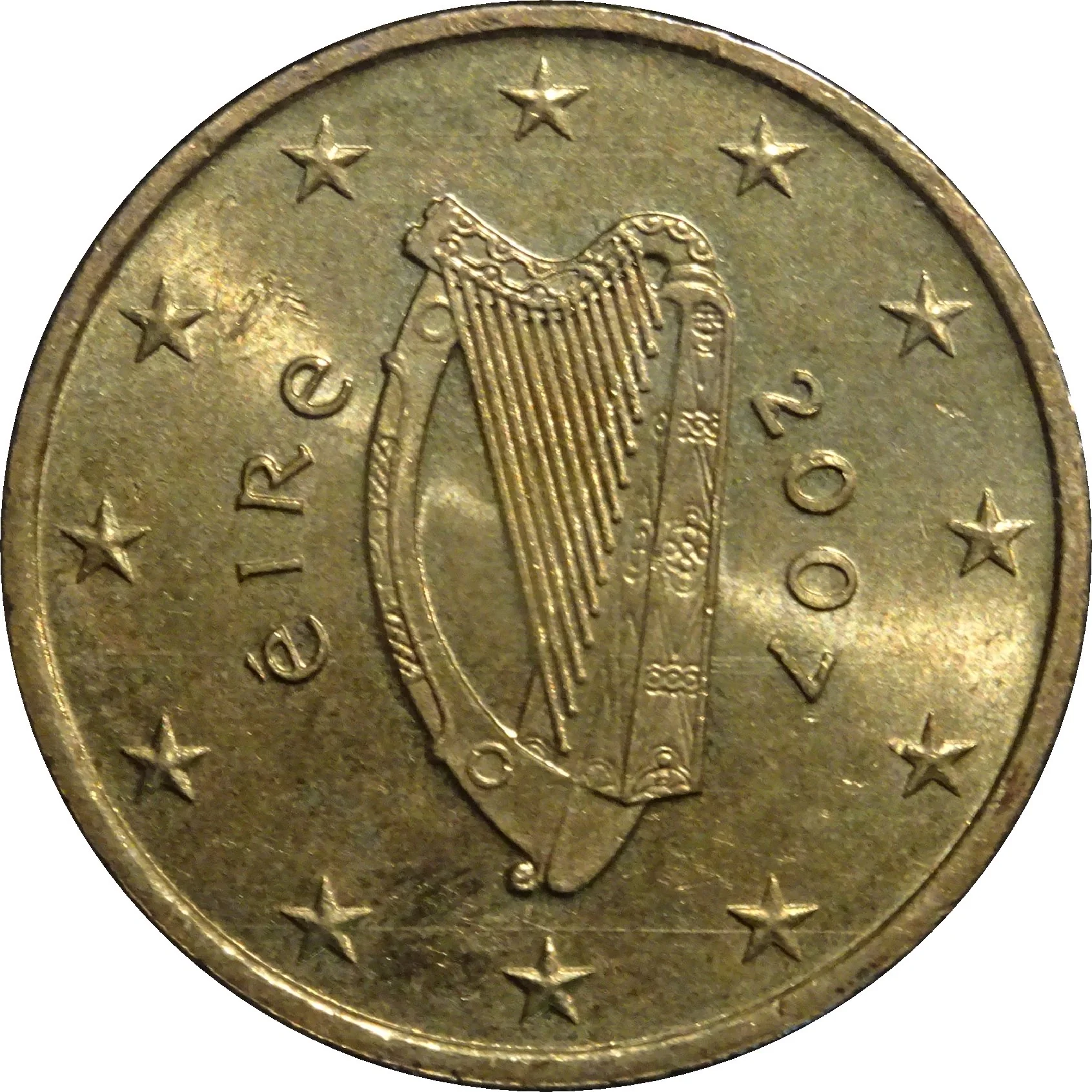
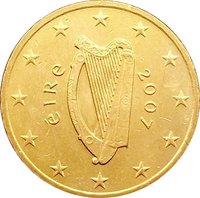
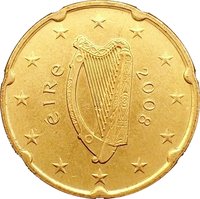
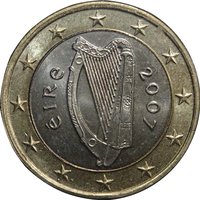
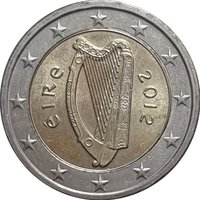
Ireland's Celtic harp, flanked by the country name and date, encircled by the 12 European stars.
Inscription:
éire 2007
Translation:
Ireland 2007
Script: Latin
Language: Irish
Engraver: Jarlath Hayes
Reverse
Edge
Indented
Categories
| Map |
Mints
| Name | Mark |
|---|---|
| Irish Mint | — |
| Mint of Finland | — |
| Monnaie de Paris | — |
| Münze Österreich | — |
| Royal Dutch Mint | — |
| Royal Mint | — |
Mintings
| Year | Mint Mark | Mintage | Quality | Collection |
|---|---|---|---|---|
| 2007 | — | 8,610,000 | ||
| 2007 | — | 10,000 | Proof | |
| 2008 | — | 1,190,000 | ||
| 2009 | — | 2,900,000 | ||
| 2009 | — | 5,000 | Proof | |
| 2010 | — | 1,140,000 | ||
| 2011 | — | 1,060,000 | ||
| 2012 | — | 990,000 | ||
| 2012 | — | 5,000 | Proof | |
| 2013 | — | 960,000 | ||
| 2014 | — | 1,067,000 | ||
| 2015 | — | 1,000 | Proof | |
| 2015 | — | 1,115,000 | ||
| 2016 | — | 25,000 | ||
| 2016 | — | 4,000 | Proof | |
| 2017 | — | 9,260 | ||
| 2018 | — | 79,990 | ||
| 2019 | — | 8,000 | BU | |
| 2019 | — | 1,000 | Proof | |
| 2020 | — | 85,100 | ||
| 2020 | — | 10,000 | In sets | |
| 2021 | — | 6,000 | In sets | |
| 2022 | — | 9,000 | In sets | |
| 2023 | — | 1,000 | Proof | |
| 2023 | — | 6,000 | ||
| 2024 | — | 6,000 | ||
| 2025 | — | 6,000 |
Historical background
In 2007, Ireland's currency situation was defined by its membership in the Eurozone. Having adopted the euro in 1999 (with notes and coins introduced in 2002), the country had fully replaced the Irish pound (the punt) and ceded control of its monetary policy to the European Central Bank (ECB). This meant that interest rates, money supply, and exchange rate policy were set in Frankfurt for the entire currency bloc, not tailored to Ireland's specific economic conditions. For much of the early 2000s, this arrangement was seen as beneficial, providing stability and low interest rates that fueled economic growth.
However, by 2007, the euro's "one-size-fits-all" monetary policy was becoming problematic for Ireland. The ECB's historically low interest rates, designed for slower-growing continental economies, had been a key accelerant for Ireland's concurrent property bubble. With rates too low for its overheating economy, credit expanded wildly, inflating asset prices and construction activity to unsustainable levels. While the currency itself was stable and strong internationally, the domestic economy was becoming dangerously imbalanced, with soaring private debt and a loss of competitiveness due to high inflation.
The year 2007 marked the peak of this boom and the beginning of a dramatic reversal. In the latter half of the year, global financial turbulence from the emerging US subprime crisis began to restrict the flow of credit internationally. This exposed the fragility of Ireland's over-extended banking system and property market. While the euro provided a shield against a traditional currency crisis or speculative attack, it also meant Ireland had no devaluation tool to regain competitiveness. The nation was therefore heading towards a severe domestic economic correction—a property crash and banking collapse—while remaining strapped into a shared currency that offered stability but limited autonomous crisis-fighting tools.
However, by 2007, the euro's "one-size-fits-all" monetary policy was becoming problematic for Ireland. The ECB's historically low interest rates, designed for slower-growing continental economies, had been a key accelerant for Ireland's concurrent property bubble. With rates too low for its overheating economy, credit expanded wildly, inflating asset prices and construction activity to unsustainable levels. While the currency itself was stable and strong internationally, the domestic economy was becoming dangerously imbalanced, with soaring private debt and a loss of competitiveness due to high inflation.
The year 2007 marked the peak of this boom and the beginning of a dramatic reversal. In the latter half of the year, global financial turbulence from the emerging US subprime crisis began to restrict the flow of credit internationally. This exposed the fragility of Ireland's over-extended banking system and property market. While the euro provided a shield against a traditional currency crisis or speculative attack, it also meant Ireland had no devaluation tool to regain competitiveness. The nation was therefore heading towards a severe domestic economic correction—a property crash and banking collapse—while remaining strapped into a shared currency that offered stability but limited autonomous crisis-fighting tools.
Series: 2007 Ireland circulation coins
🌱 Very Common