Logo Title
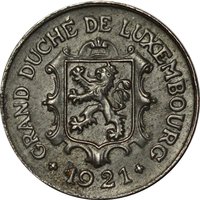
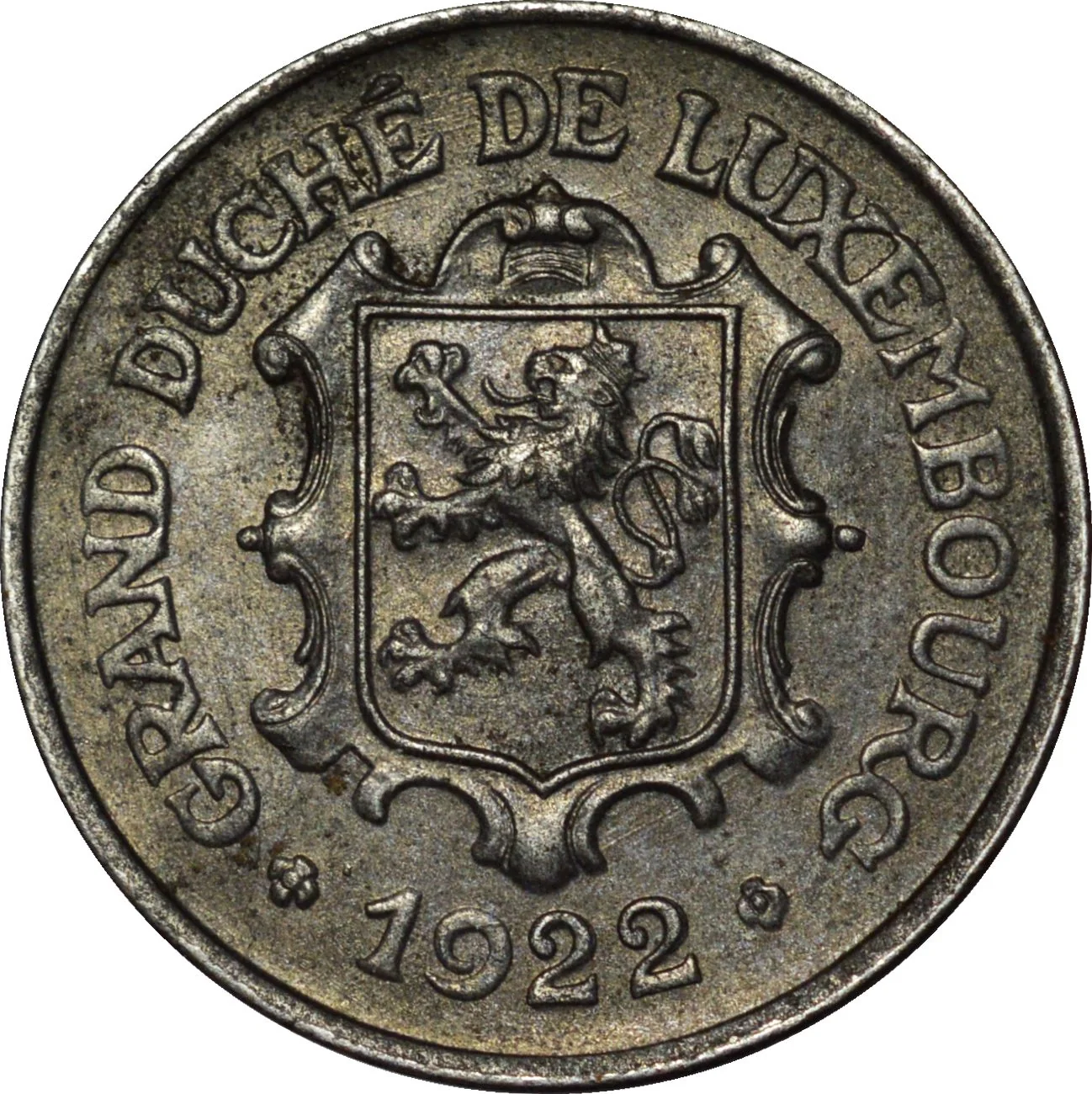
obverse
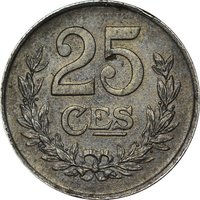
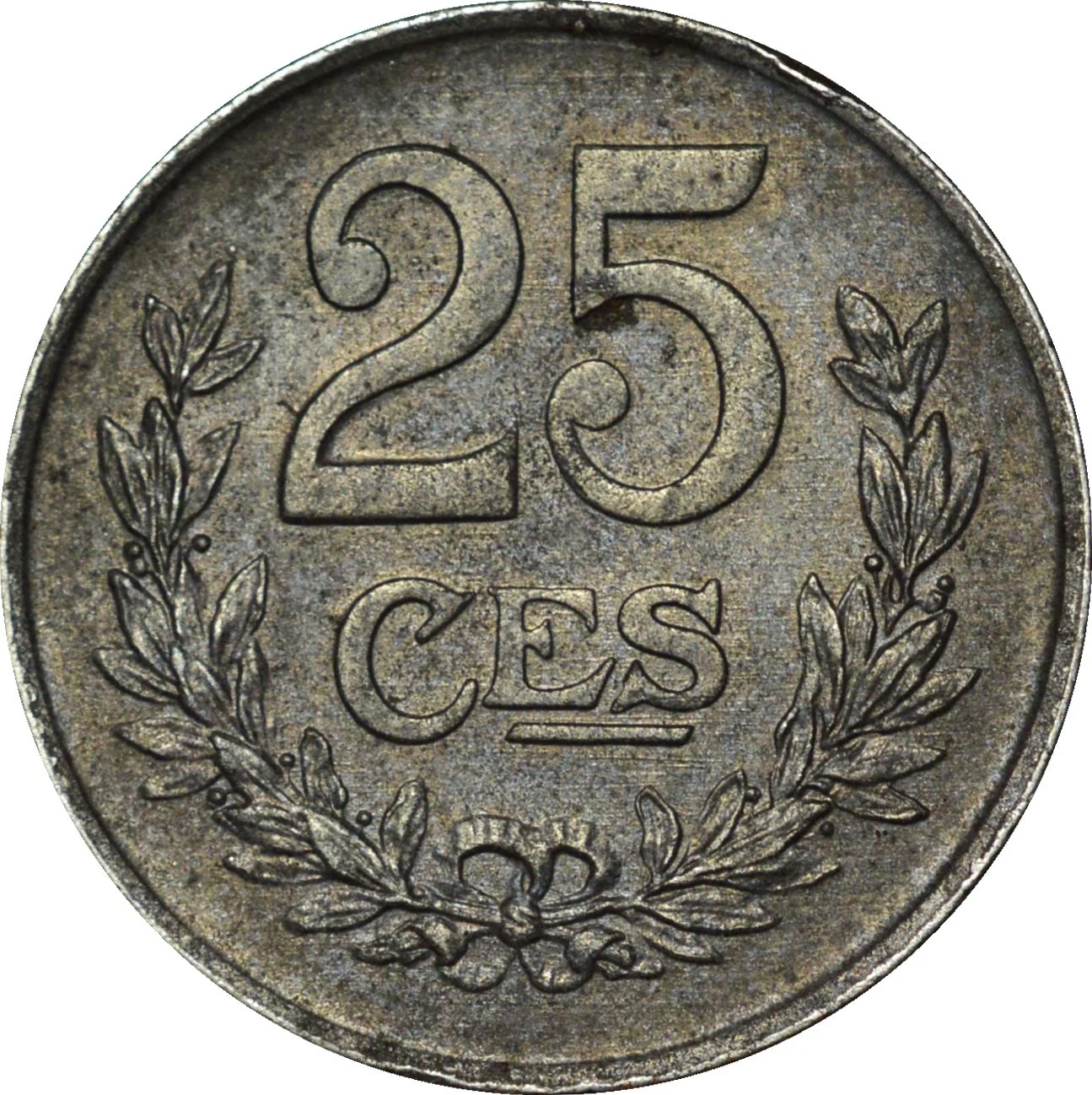
reverse
smy77 CC BY-NC-SA

25 Centimes – Grand Duchy of Luxembourg

Luxembourg
Context
Years: 1919–1922
Country: Luxembourg Country flag
Ruler: Charlotte
Currency:
(1854—2001)
Demonetization: 31 July 1928
Total mintage: 2,204,000
Material
Diameter: 23 mm
Weight: 4.2 g
Thickness: 1.5 mm
Shape: Round
Composition: Iron
Technique: Milled
Alignment: Medal alignment
Obverse
OBVERSE ↑
flip
Reverse
REVERSE ↑
References
KM: #Click to copy to clipboard32
Numista: #6315
Value
Exchange value: 0.25 LUF

Obverse

Description:
Luxembourgish shield with a left-rampant forked-tail lion on a plain field, encircled by the legend and mint year between rosettes, above the exergue.
Inscription:
GRAND DUCHÉ DE LUXEMBOURG

+ 1922 +
Translation:
Grand Duchy of Luxembourg

+ 1922 +
Script: Latin
Language: French
Engraver: Roessler

Reverse

Description:
Face value
within an oak crown
Inscription:
25 CES
Script: Latin
Engraver: Roessler

Edge

Plain

Mintings

YearMint MarkMintageQualityCollection
1919804,000
1920800,000
1922600,000

Historical background

In 1919, the Grand Duchy of Luxembourg faced a complex and precarious currency situation, a direct legacy of the First World War. During the German occupation (1914-1918), the German Reichsmark had been imposed as legal tender, supplanting the pre-war Luxembourg franc, which had been pegged to and circulated alongside the Belgian franc. Following the Armistice, Luxembourg was flooded with now-worthless German paper marks, creating a monetary crisis and severe inflation. The urgent task for the government was to swiftly establish a stable and sovereign currency system to facilitate economic recovery and assert national independence.

The solution was enacted with the Law of 26 August 1919, which created the Luxembourg franc as the sole legal tender, severing the forced link to the German currency. However, recognizing deep economic ties, Luxembourg chose to peg its new franc at par with the Belgian franc and entered into a monetary union with Belgium, formalized in the Belgium-Luxembourg Economic Union (BLEU) treaty of 1921. This pragmatic alliance allowed Belgian banknotes and coins to circulate freely in Luxembourg, while distinctive Luxembourg franc coins were also minted. The Luxembourgish state did not initially issue its own banknotes, relying instead on Belgian notes.

Thus, by the end of 1919, Luxembourg had successfully navigated its post-war monetary chaos by demonetizing the German mark and launching a national currency. The foundation was laid for a system of shared, but not fully surrendered, monetary sovereignty with Belgium. This arrangement provided immediate stability and defined Luxembourg's currency framework for decades, balancing the need for economic integration with a key neighbour against the symbolic and practical requirements of national identity.
🌱 Common