

5 pfennigs – Germany
Add to wishlist
Germany
Context
Years: 1940–1941
Issuer: Germany
Period:
(1933—1945)
Currency:
(1924—1948)
Demonetized: Yes
Total mintage: 41,902,214
Material
Diameter: 19.2 mm
Weight: 2.5 g
Thickness: 1.6 mm
Shape: Round with a round hole
Composition: Zinc
Magnetic: No
Technique: Milled
Alignment: Medal alignment
flip
References
KM: #
Numista: #6312
Obverse
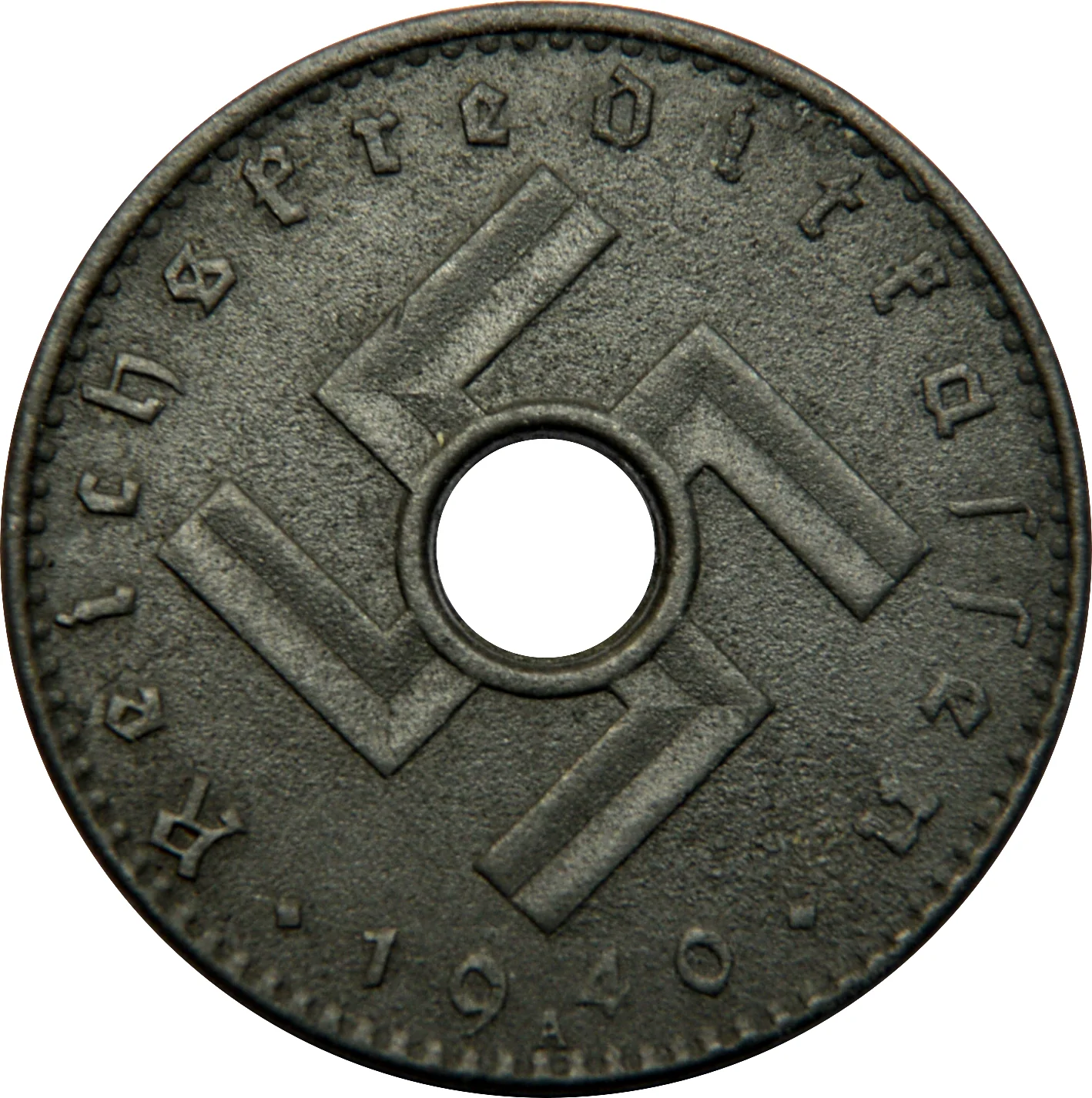
Description:
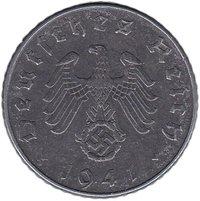
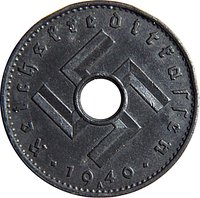
Swastika pierced by a central hole.
Inscription:
Reichskreditkassen 19 A 40
Engraver: Hans Herbert Schweitzer
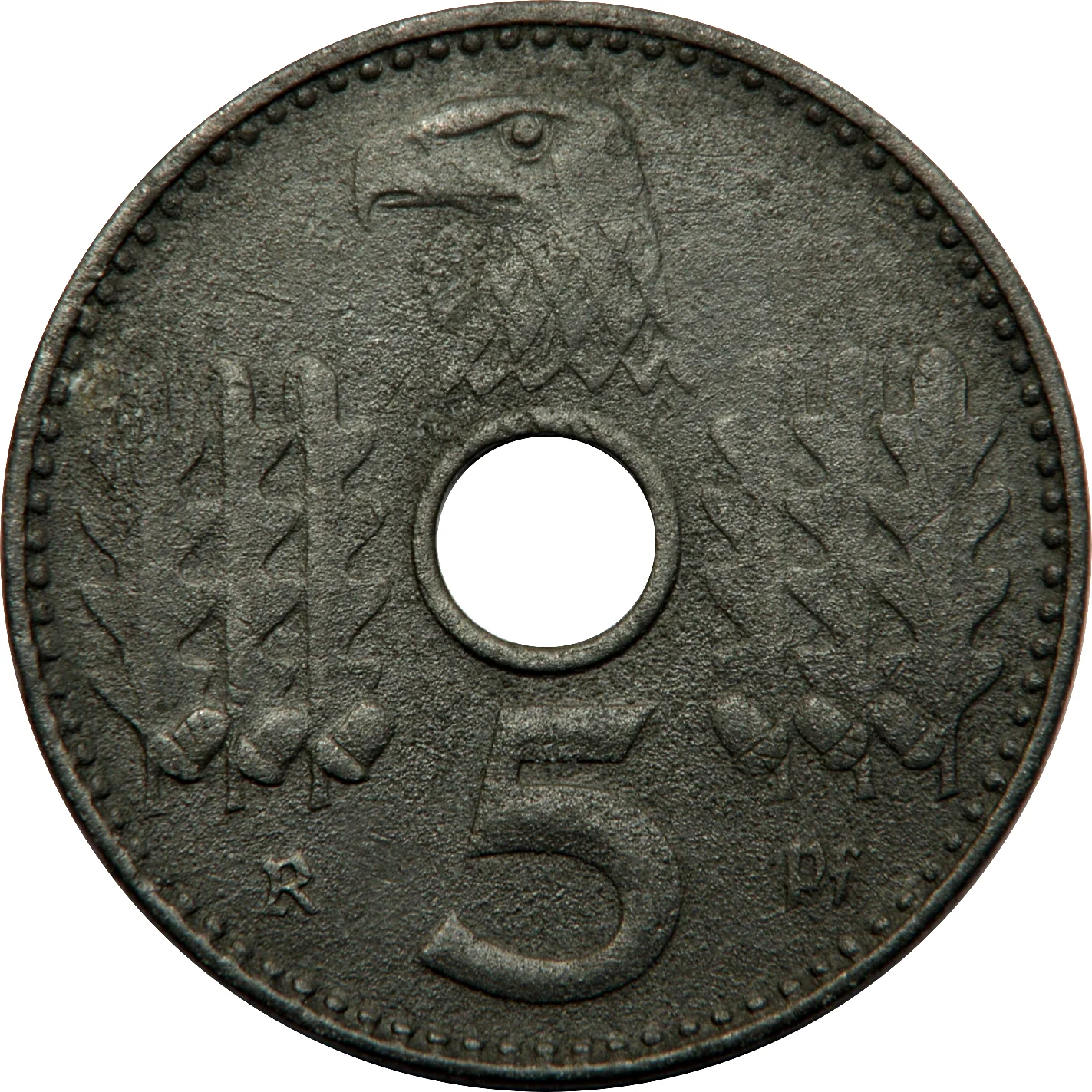
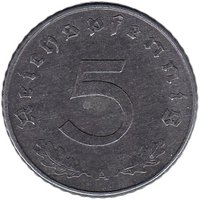
Reverse
Edge
Plain
Mints
| Name | Mark |
|---|---|
| Berlin | A |
| Münze Österreich | B |
| Munich | D |
| Muldenhütten | E |
| Staatliche Münze Baden-Württemberg | F |
| Staatliche Münze Baden-Württemberg | G |
| Hamburgische Münze | J |
Mintings
Historical background
By 1940, Germany's currency situation was characterized by strict state control and hidden inflationary pressures, all subordinated to the Nazi regime's war economy. The Reichsmark remained the official currency, but its stability was an artificial construct maintained by draconian regulations. Price and wage freezes had been instituted in 1936, and severe penalties for hoarding or dealing in foreign exchange created a facade of normalcy. However, the fundamental basis of sound finance had been abandoned; since 1934, the Reichsbank had been directly financing the state's massive deficit, primarily driven by rearmament and then war preparations, through a system of secret "Mefo bills" and other instruments that effectively printed money.
This financial architecture was designed not for economic health but to extract maximum resources for total war without triggering immediate public panic. The regime funded its aggression through exploitation, plundering the reserves of annexed Austria and Czechoslovakia in 1938-39 and imposing crushing occupation costs on conquered territories. Within Germany, citizens faced a growing gap between stable prices and abundant money, leading to a suppressed inflation where goods became scarce despite cash holdings. The government managed this through extensive rationing of food, clothing, and consumer goods, which began in 1939, channeling raw materials and labor almost exclusively into military production.
Consequently, the German economy in 1940 operated on a dual system: a controlled, rationed official economy using Reichsmarks and a burgeoning black market where real values emerged. The currency's external value was meaningless, as international trade was conducted through bilateral clearing agreements that avoided foreign exchange. The entire financial system was a house of cards, sustained by continuous military victory and plunder. The real cost was being accumulated as a vast monetary overhang—a mountain of Reichsmark savings with nothing to purchase—which would become a devastating problem after the war's conclusion.
This financial architecture was designed not for economic health but to extract maximum resources for total war without triggering immediate public panic. The regime funded its aggression through exploitation, plundering the reserves of annexed Austria and Czechoslovakia in 1938-39 and imposing crushing occupation costs on conquered territories. Within Germany, citizens faced a growing gap between stable prices and abundant money, leading to a suppressed inflation where goods became scarce despite cash holdings. The government managed this through extensive rationing of food, clothing, and consumer goods, which began in 1939, channeling raw materials and labor almost exclusively into military production.
Consequently, the German economy in 1940 operated on a dual system: a controlled, rationed official economy using Reichsmarks and a burgeoning black market where real values emerged. The currency's external value was meaningless, as international trade was conducted through bilateral clearing agreements that avoided foreign exchange. The entire financial system was a house of cards, sustained by continuous military victory and plunder. The real cost was being accumulated as a vast monetary overhang—a mountain of Reichsmark savings with nothing to purchase—which would become a devastating problem after the war's conclusion.
Series: 1940 Germany circulation coins

🌱 Fairly Common