

1 shu – Japan
Add to wishlist
Japan
Material
Weight: 1.88 g
Silver Weight:: 1.65 g
Thickness: 1.5 mm
Shape: Irregular rectangular
Composition: 88% Silver
Magnetic: No
Techniques: Hammered, Countermarked
Alignment: Medal alignment
flip
References
Numista: #63042
Value
Bullion value: $4.19
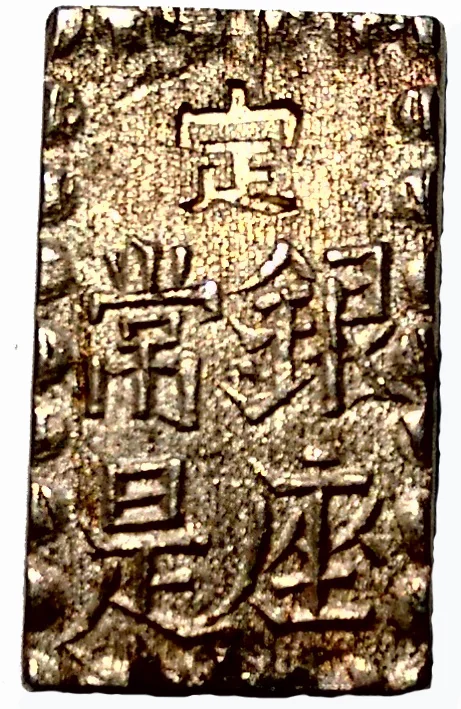
Obverse
Description:
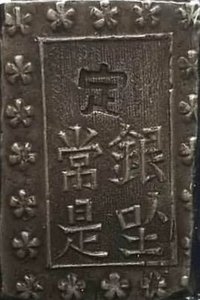
Incuse stamp with mint name and official.
Inscription:
定
常銀
是座
常銀
是座
Translation:
Fixed Standard Silver;
This is the seat.
This is the seat.
Language: Classical Chinese
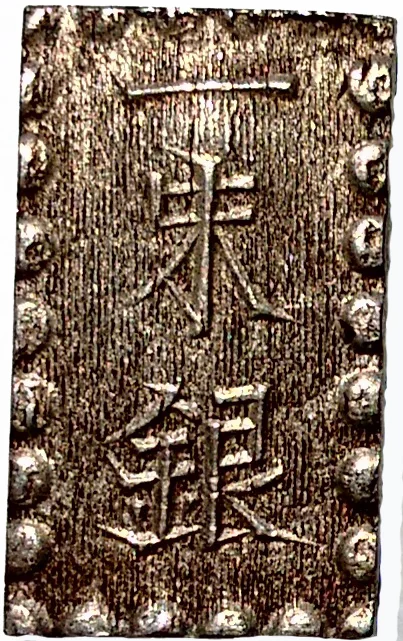
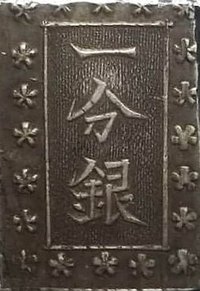
Reverse
Edge
Vertical reeding on short sidesslanted reeding on long sides
Mints
| Name | Mark |
|---|---|
| Ginza, Edo | — |
Mintings
| Year | Mint Mark | Mintage | Quality | Collection |
|---|---|---|---|---|
| — | — | — |
Historical background
In 1868, Japan stood at a pivotal moment with the Meiji Restoration, which formally ended the Tokugawa shogunate and restored imperial rule. This political revolution occurred amidst a profound monetary crisis. The currency system was a chaotic patchwork, a legacy of over 250 years of decentralized feudal rule. The shogunate, hundreds of individual domains (han), and even private merchants all issued their own forms of currency, including gold, silver, and copper coins, as well as paper notes (hansatsu). These currencies had no fixed exchange rate, varied wildly in quality and value, and were often only accepted within their domain of issue, crippling national trade and economic unity.
The situation was exacerbated by the shogunate's severe financial difficulties in its final years. To cover deficits, it had heavily debased its coinage, reducing the gold and silver content and leading to rampant inflation, loss of public trust, and counterfeiting. Furthermore, the unequal treaties forced upon Japan by Western powers, which fixed exchange rates unfavorable to Japan, led to a massive outflow of gold, as international arbitrageurs exploited the difference between Japan's internal gold-to-silver ratio and the global standard. This gold drain depleted the new government's already scarce specie reserves.
Recognizing that a stable, unified currency was essential for modern statehood, industrialization, and renegotiating treaties, the Meiji government made monetary reform an immediate priority. In 1868, it began the process of centralizing control, prohibiting domains from issuing new notes and moving to abolish the hansatsu system. This laid the groundwork for the comprehensive Currency Act of 1871, which established the yen as the new decimal-based national unit, adopted the gold standard, and gave the state a monopoly on minting. Thus, the currency situation in 1868 was one of severe disorder, serving as the direct catalyst for the creation of Japan's modern financial system.
The situation was exacerbated by the shogunate's severe financial difficulties in its final years. To cover deficits, it had heavily debased its coinage, reducing the gold and silver content and leading to rampant inflation, loss of public trust, and counterfeiting. Furthermore, the unequal treaties forced upon Japan by Western powers, which fixed exchange rates unfavorable to Japan, led to a massive outflow of gold, as international arbitrageurs exploited the difference between Japan's internal gold-to-silver ratio and the global standard. This gold drain depleted the new government's already scarce specie reserves.
Recognizing that a stable, unified currency was essential for modern statehood, industrialization, and renegotiating treaties, the Meiji government made monetary reform an immediate priority. In 1868, it began the process of centralizing control, prohibiting domains from issuing new notes and moving to abolish the hansatsu system. This laid the groundwork for the comprehensive Currency Act of 1871, which established the yen as the new decimal-based national unit, adopted the gold standard, and gave the state a monopoly on minting. Thus, the currency situation in 1868 was one of severe disorder, serving as the direct catalyst for the creation of Japan's modern financial system.
🌟 Limited