

2 hryvni – Ukraine
Add to wishlist
Ukraine
Context
Year: 2014
Issuer: Ukraine
Issuing organization: National Bank of Ukraine
Period:
(since 1991)
Currency:
(since 1996)
Total mintage: 20,000
Material
Diameter: 31 mm
Weight: 12.8 g
Thickness: 2 mm
Shape: Round
Composition: Nickel brass
Magnetic: No
Technique: Milled
Alignment: Medal alignment
flip
References
KM: #
Numista: #62821
Value
Exchange value: 2 UAH
Obverse
Description:
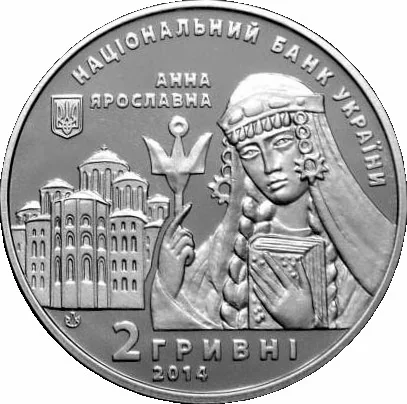
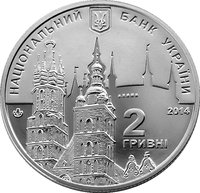
The obverse features Saint Sophia's Cathedral with Princess Anna Yaroslavna before it. Above is "Національний банк України" and her name; below are the coin's denomination (2 ГРИВНІ), year (2014), mint mark, and Ukraine's Small Coat of Arms.
Inscription:
НАЦІОНАЛЬНИЙ БАНК УКРАЇНИ
АННА ЯРОСЛАВНА
2014
ДВІ ГРИВНІ
АННА ЯРОСЛАВНА
2014
ДВІ ГРИВНІ
Translation:
NATIONAL BANK OF UKRAINE
ANNA YAROSLAVNA
2014
TWO HRYVNIAS
ANNA YAROSLAVNA
2014
TWO HRYVNIAS
Script: Cyrillic
Language: Ukrainian
Engraver: Volodymyr Atamanchuk
Reverse
Description:
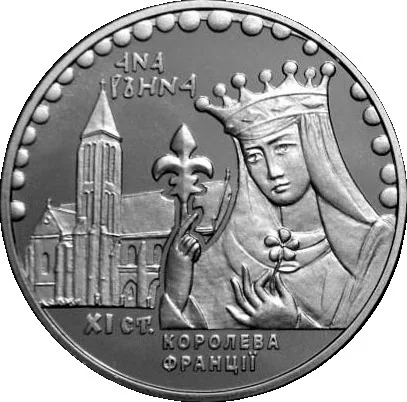
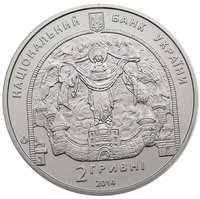
Anna, stylized as France's queen, stands before St. Vincent Abbey.
Inscription:
ХІ ст.
КОРОЛЕВА ФРАНЦІЇ.
КОРОЛЕВА ФРАНЦІЇ.
Translation:
Queen of France.
Script: Cyrillic
Language: Ukrainian
Engraver: Volodymyr Atamanchuk
Edge
Reeded
Categories
| Building> Religious building |
| Person> Monarch |
Mints
| Name | Mark |
|---|---|
| National Bank of Ukraine Banknote Printing and Minting Works | — |
Mintings
| Year | Mint Mark | Mintage | Quality | Collection |
|---|---|---|---|---|
| 2014 | — | 20,000 | Special Uncirculated |
Historical background
In 2014, Ukraine's currency, the hryvnia (UAH), faced a severe crisis triggered by profound political and economic shocks. The Euromaidan revolution, the annexation of Crimea by Russia, and the outbreak of war in the Donbas region shattered investor confidence and crippled key industrial regions. This led to massive capital flight, a collapse in foreign exchange reserves, and a sharp contraction in GDP. The National Bank of Ukraine (NBU) was forced to abandon its managed peg to the U.S. dollar in February 2014, leading to a controlled float that could not prevent a steep devaluation.
The situation deteriorated rapidly throughout the year, with the hryvnia losing nearly 50% of its value against the dollar by December. The NBU implemented strict capital controls, raised its key policy rate to 30%, and intervened heavily in the forex market in a desperate attempt to stabilize the currency. However, these measures were overwhelmed by the twin pressures of a collapsing economy—with exports hit and energy imports still costly—and a loss of monetary sovereignty in conflict-affected areas. Inflation soared into double digits, eroding purchasing power.
By the end of 2014, the currency crisis had become intertwined with a broader economic emergency, pushing the state to the brink of default. The interim government sought urgent international assistance, culminating in a $17 billion standby agreement with the International Monetary Fund (IMF) in April 2014, which was later expanded. This program demanded tough structural reforms and fiscal austerity in exchange for financial support, setting the stage for a painful but necessary stabilization effort in the years to follow.
The situation deteriorated rapidly throughout the year, with the hryvnia losing nearly 50% of its value against the dollar by December. The NBU implemented strict capital controls, raised its key policy rate to 30%, and intervened heavily in the forex market in a desperate attempt to stabilize the currency. However, these measures were overwhelmed by the twin pressures of a collapsing economy—with exports hit and energy imports still costly—and a loss of monetary sovereignty in conflict-affected areas. Inflation soared into double digits, eroding purchasing power.
By the end of 2014, the currency crisis had become intertwined with a broader economic emergency, pushing the state to the brink of default. The interim government sought urgent international assistance, culminating in a $17 billion standby agreement with the International Monetary Fund (IMF) in April 2014, which was later expanded. This program demanded tough structural reforms and fiscal austerity in exchange for financial support, setting the stage for a painful but necessary stabilization effort in the years to follow.
⭐ Somewhat Rare