

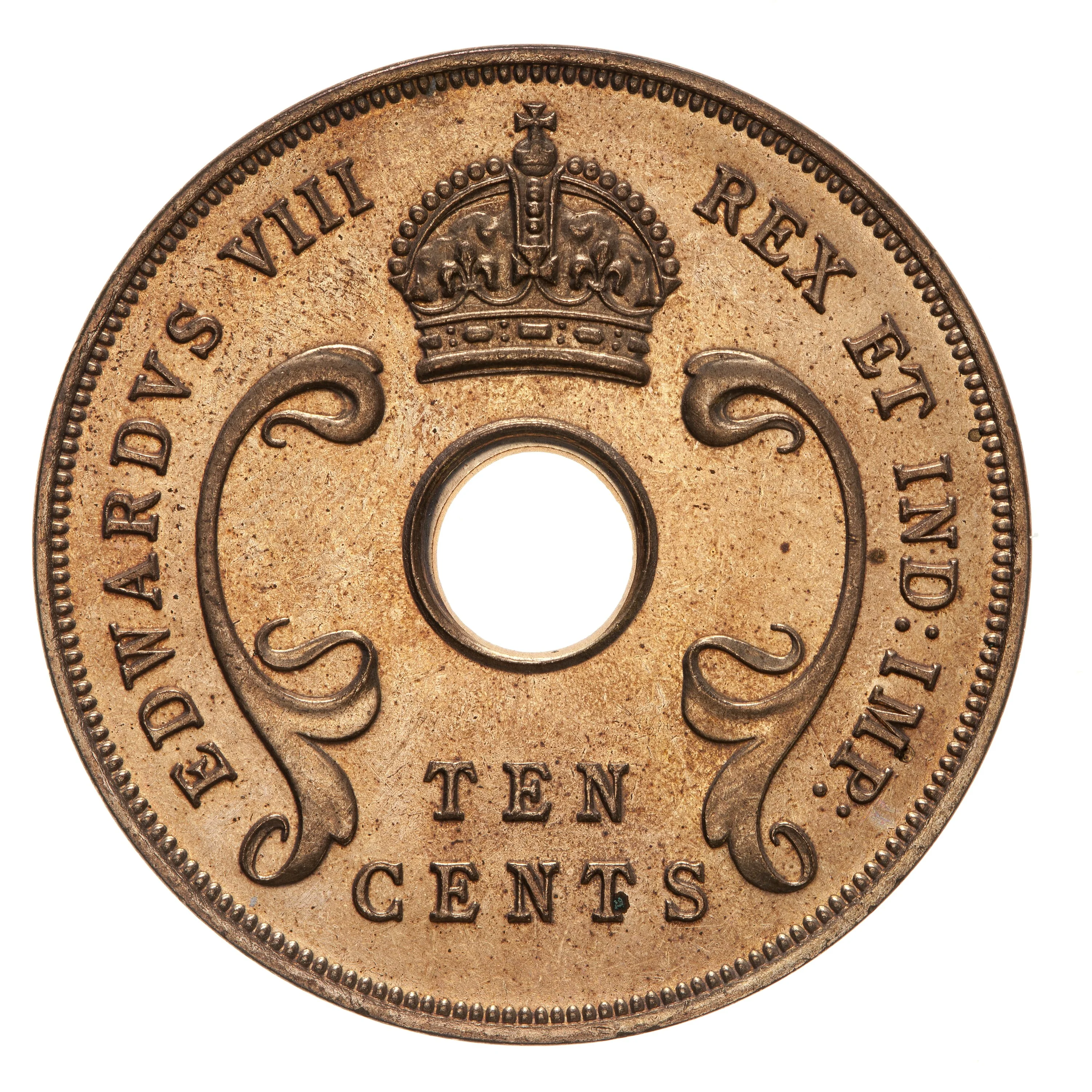
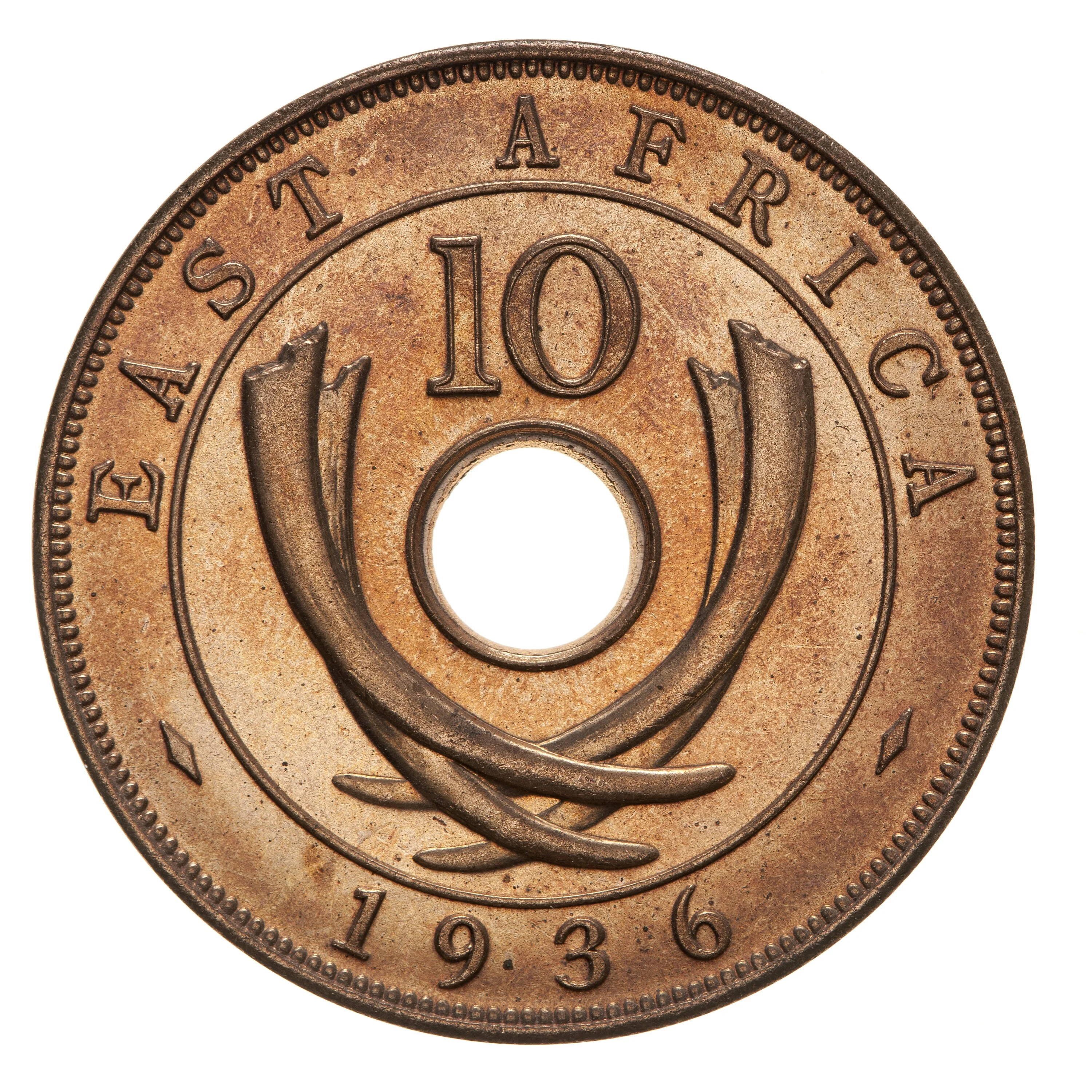
10 Cents – East Africa
Context
Year: 1936
Issuer: East Africa
Ruler: Edward VIII
Currency:
(1921—1967)
Demonetized: Yes
Total mintage: 10,472,000
Material
Diameter: 30.6 mm
Weight: 11.34 g
Thickness: 1.8 mm
Shape: Round with a round hole
Composition: Bronze
Magnetic: No
Technique: Milled
Alignment: Medal alignment
flip
References
KM: #Click to copy to clipboard24
Numista: #6229
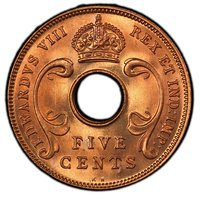
Obverse
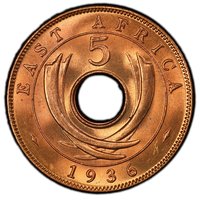
Reverse
Edge
Plain
Mints
| Name | Mark |
|---|---|
| Royal Mint (Tower Hill) | — |
| Heaton and Sons / The Mint Birmingham | H |
| Kings Norton Metal Company | KN |
Mintings
Historical background
In 1936, the currency landscape of East Africa was dominated by colonial monetary systems, firmly integrated into the British Empire's financial orbit. The region was primarily served by the East African shilling, issued by the East African Currency Board (EACB) established in 1919. This board-operated currency, pegged at par to the British shilling and ultimately to the gold standard through sterling, was legal tender in the British-controlled territories of Kenya, Uganda, Tanganyika (a League of Nations mandate under British administration), and Zanzibar. The system was designed for stability and to facilitate trade with the metropole, effectively making East Africa a sterling area subsidiary.
Alongside the East African shilling, other colonial currencies circulated in neighbouring regions, reflecting the continent's partition. The Belgian Congo used the Congolese franc, tied to the Belgian franc, while Italian-occupied Ethiopia (following the 1935-36 invasion) saw the forced introduction of the Italian East African lira. In the Horn, the Maria Theresa thaler still persisted in some remote trade, a relic of an earlier pre-colonial mercantile era. Notably, the Indian rupee, which had previously circulated widely due to trade and labour migration, had been officially replaced by the EACB shilling, though some historical influences remained.
The overall monetary policy for British East Africa was conservative and externally dictated from London, with the Currency Board required to hold full sterling reserves against the shillings in circulation. This ensured convertibility but limited local economic autonomy, as money supply was directly tied to export earnings and sterling reserves rather than regional developmental needs. The year 1936 thus represents a period of imposed monetary stability under colonial administration, with currencies serving the primary functions of resource extraction and imperial trade, laying a unified but externally dependent financial foundation for the future nations of the region.
Alongside the East African shilling, other colonial currencies circulated in neighbouring regions, reflecting the continent's partition. The Belgian Congo used the Congolese franc, tied to the Belgian franc, while Italian-occupied Ethiopia (following the 1935-36 invasion) saw the forced introduction of the Italian East African lira. In the Horn, the Maria Theresa thaler still persisted in some remote trade, a relic of an earlier pre-colonial mercantile era. Notably, the Indian rupee, which had previously circulated widely due to trade and labour migration, had been officially replaced by the EACB shilling, though some historical influences remained.
The overall monetary policy for British East Africa was conservative and externally dictated from London, with the Currency Board required to hold full sterling reserves against the shillings in circulation. This ensured convertibility but limited local economic autonomy, as money supply was directly tied to export earnings and sterling reserves rather than regional developmental needs. The year 1936 thus represents a period of imposed monetary stability under colonial administration, with currencies serving the primary functions of resource extraction and imperial trade, laying a unified but externally dependent financial foundation for the future nations of the region.

🌱 Common