

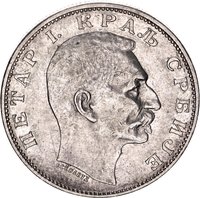
Obverse
Description:
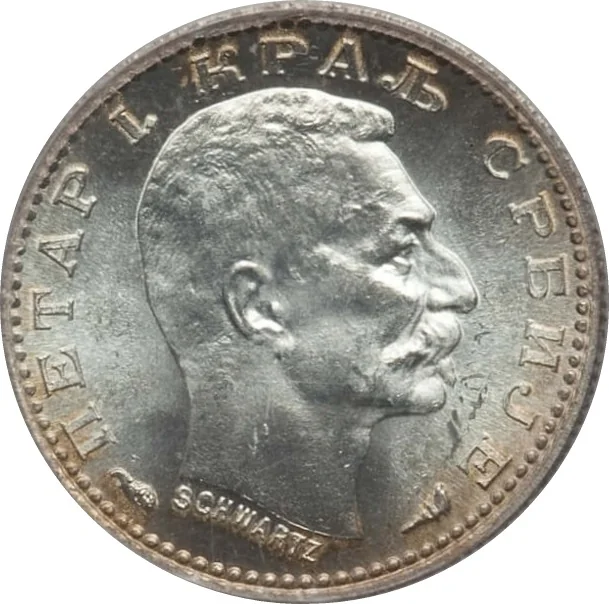
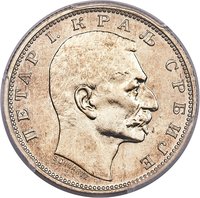
Portrait of Petar I facing right.
Inscription:
ПЕТАР I. КРАЉ СРБИЈЕ
SCHWARTZ
SCHWARTZ
Translation:
PETER I. KING OF SERBIA
SCHWARTZ
SCHWARTZ
Script: Cyrillic
Engraver: Stefan Schwartz
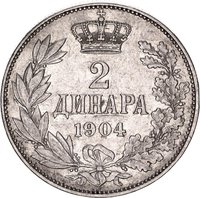
Reverse
Edge
Reeded
Mints
| Name | Mark |
|---|---|
| Gorham Manufacturing Company | — |
| Monnaie de Paris | — |
Mintings
| Year | Mint Mark | Mintage | Quality | Collection |
|---|---|---|---|---|
| 1904 | — | 1,400,031 | ||
| 1904 | — | — | Proof | |
| 1912 | — | 800,000 | ||
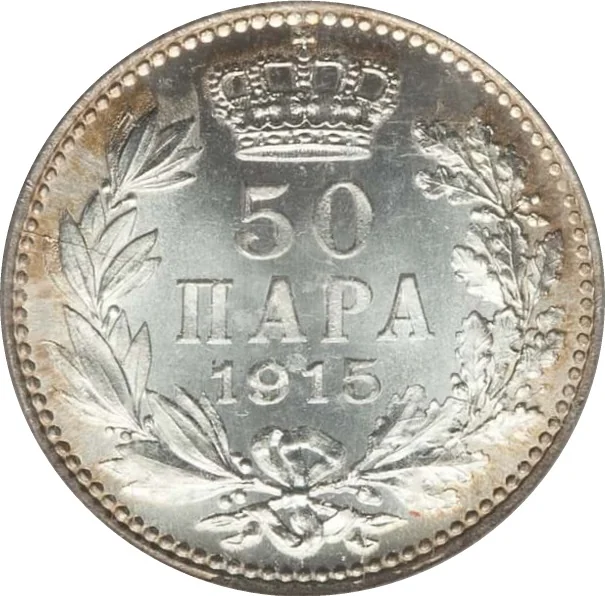
| 1915 | — | 12,137,928 |
Historical background
In 1904, Serbia's currency situation was defined by its use of the Serbian dinar, which operated within the framework of the Latin Monetary Union. The country had officially adopted the LMU's bimetallic standard (gold and silver) in 1878, pegging the dinar to the French franc at a fixed rate of 1 dinar = 1 franc. This alignment was a strategic political and economic choice, integrating Serbia with Western European financial systems and facilitating trade and foreign investment, particularly from France and Austria-Hungary.
However, this formal peg belied underlying strains. Serbia's economy was still largely agrarian and carried significant foreign debt from military modernization and railway construction. The state's finances were often precarious, relying heavily on loans. Consequently, while the dinar maintained its official parity, the actual gold and silver reserves backing the currency were not always robust, leading to occasional concerns about stability and convertibility among foreign creditors and traders.
The year 1904 itself fell within a period of relative monetary calm before the major economic dislocations of the Balkan Wars and World War I. The system's stability was largely propped up by continued foreign borrowing. Nevertheless, the underlying dependency on foreign capital highlighted the dinar's vulnerability. The currency's true test would come in the following decade, when the pressures of war would ultimately force Serbia off the gold standard and lead to significant inflation, exposing the fragility masked by the pre-war LMU arrangement.
However, this formal peg belied underlying strains. Serbia's economy was still largely agrarian and carried significant foreign debt from military modernization and railway construction. The state's finances were often precarious, relying heavily on loans. Consequently, while the dinar maintained its official parity, the actual gold and silver reserves backing the currency were not always robust, leading to occasional concerns about stability and convertibility among foreign creditors and traders.
The year 1904 itself fell within a period of relative monetary calm before the major economic dislocations of the Balkan Wars and World War I. The system's stability was largely propped up by continued foreign borrowing. Nevertheless, the underlying dependency on foreign capital highlighted the dinar's vulnerability. The currency's true test would come in the following decade, when the pressures of war would ultimately force Serbia off the gold standard and lead to significant inflation, exposing the fragility masked by the pre-war LMU arrangement.
Series: 1904 Serbia circulation coins
🌱 Common