

¼ Dollar – United States
Circulating commemorative coins
Commemoration: Louisiana State
United States
Context
Year: 2002
Issuer: United States 
Period:
(since 1776)
Currency:
(since 1785)
Subdivision: ¼ Dollar = 25 Cents
Total mintage: 767,288,245
Material

References
KM: #Click to copy to clipboard333
Numista: #621
Value
Exchange value: ¼ USD = $0.25
Inflation-adjusted value: 0.45 USD
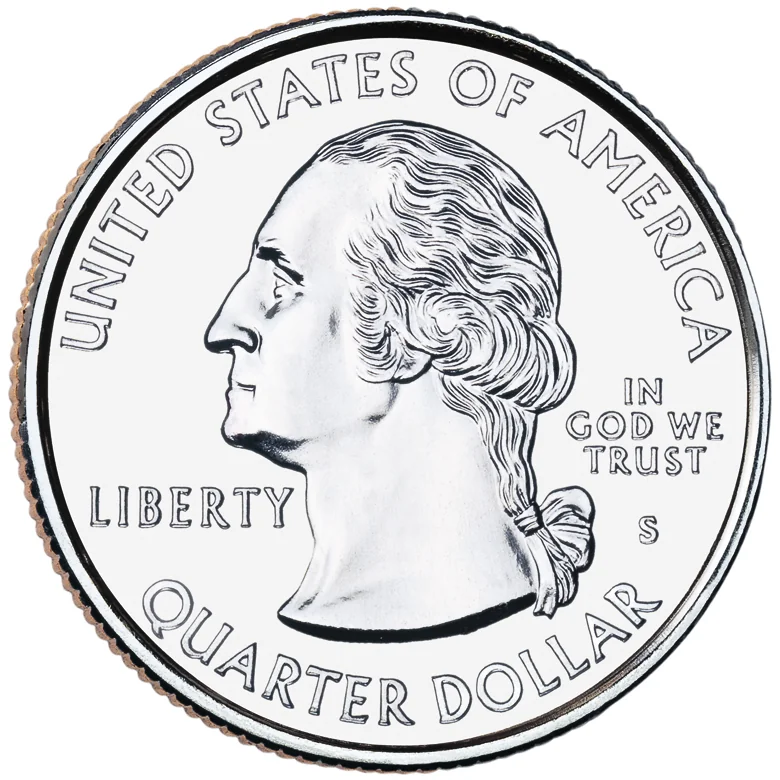
Obverse
Description:
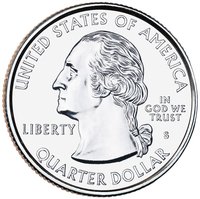
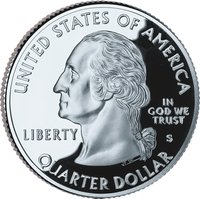
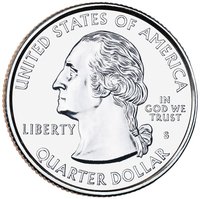
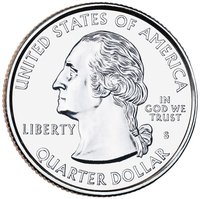
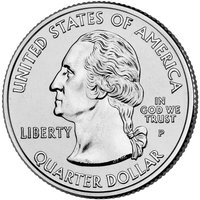
Left-profile portrait of George Washington with "IN GOD WE TRUST" and "LIBERTY"; surrounded by face value, "UNITED STATES OF AMERICA", and engravers' initials on the neck.
Inscription:
UNITED STATES OF AMERICA
IN
GOD WE
TRUST
LIBERTY S
JF wc
QUARTER DOLLAR
IN
GOD WE
TRUST
LIBERTY S
JF wc
QUARTER DOLLAR
Script: Latin
Engravers: John Flanagan, William Cousins
Reverse
Description:
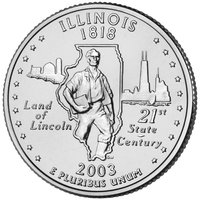
Louisiana's state bird (a pelican), a trumpet with musical notes, and the outline of the Louisiana Purchase territory, with the engraver's initials below.
Inscription:
LOUISIANA
1812
LOUISIANA
PURCHASE
JM
2002
E PLURIBUS UNUM
1812
LOUISIANA
PURCHASE
JM
2002
E PLURIBUS UNUM
Translation:
LOUISIANA
1812
LOUISIANA
PURCHASE
JM
2002
OUT OF MANY, ONE
1812
LOUISIANA
PURCHASE
JM
2002
OUT OF MANY, ONE
Script: Latin
Engraver: John Mercanti
Edge
Reeded
Mints
| Name | Mark |
|---|---|
| United States Mint of Denver | D |
| United States Mint of Philadelphia | P |
| United States Mint of San Francisco | S |
Historical background
In 2002, the United States was navigating the economic aftermath of the September 11th attacks and the bursting of the dot-com bubble, which had officially pushed the economy into a recession in 2001. Against this backdrop, the U.S. dollar remained the world's dominant reserve currency, but it began a period of significant depreciation against major rivals, particularly the euro. This decline, which would become a multi-year trend, was driven by concerns over growing U.S. budget deficits, a widening current account deficit, and a shift in Federal Reserve policy toward historically low interest rates to stimulate recovery, making dollar-denominated assets less attractive to foreign investors.
Domestically, the currency was in a state of tangible transition. The new, more colorful and secure Series 2004 banknotes (starting with the $20 bill) were in the final stages of design and planning, with the Treasury aiming to combat advanced counterfeiting. Meanwhile, the public was still adapting to the recently introduced golden-colored Sacagawea dollar coin, a 2000 release that continued to see limited circulation despite government promotion. The focus on security was paramount, as technological advances in printing and scanning posed an increasing threat to the integrity of the older greenback designs.
Internationally, the dollar's weakness was a double-edged sword. It helped U.S. exporters by making their goods cheaper abroad, providing a needed boost to the manufacturing sector. However, it also raised concerns about the long-term stability of the global financial system, which relied heavily on the dollar. Notably, this period saw the euro, freshly introduced as physical currency in January 2002, steadily gain strength and credibility, beginning its ascent as a potential challenger to dollar hegemony, though it remained a distant second in global usage.
Domestically, the currency was in a state of tangible transition. The new, more colorful and secure Series 2004 banknotes (starting with the $20 bill) were in the final stages of design and planning, with the Treasury aiming to combat advanced counterfeiting. Meanwhile, the public was still adapting to the recently introduced golden-colored Sacagawea dollar coin, a 2000 release that continued to see limited circulation despite government promotion. The focus on security was paramount, as technological advances in printing and scanning posed an increasing threat to the integrity of the older greenback designs.
Internationally, the dollar's weakness was a double-edged sword. It helped U.S. exporters by making their goods cheaper abroad, providing a needed boost to the manufacturing sector. However, it also raised concerns about the long-term stability of the global financial system, which relied heavily on the dollar. Notably, this period saw the euro, freshly introduced as physical currency in January 2002, steadily gain strength and credibility, beginning its ascent as a potential challenger to dollar hegemony, though it remained a distant second in global usage.

🌱 Very Common