

50 Euro Cents – Austria
Austria
Context
Years: 2002–2007
Issuer: Austria 
Period:
(since 1945)
Currency:
(since 2002)
Total mintage: 191,315,000
Material
Diameter: 24.25 mm
Weight: 7.8 g
Thickness: 2.38 mm
Shape: Round
Standard: Silver quarter ounce
Magnetic: No
Technique: Milled
Alignment: Medal alignment
flip
References
KM: #Click to copy to clipboard3087
Numista: #62
Value
Exchange value: 0.50 EUR = $0.59
Inflation-adjusted value: 0.90 EUR
Obverse
Description:
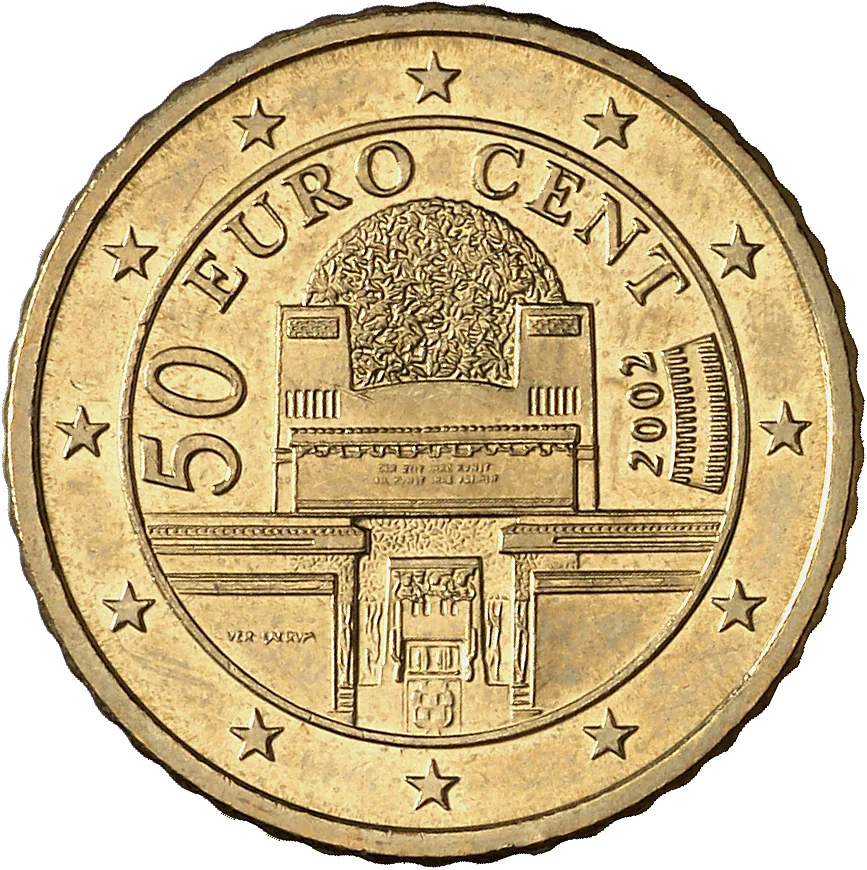
Vienna’s Secession building, marking Austria’s art nouveau dawn and a new era, is encircled by the face value, heraldic flag markings, and Europe’s twelve stars.
Inscription:
50 EURO CENT
DER ZEIT IHRE KVNST
DER KVNST IHRE FREIHEIT
VER SACRUM
2003
DER ZEIT IHRE KVNST
DER KVNST IHRE FREIHEIT
VER SACRUM
2003
Translation:
THE AGE ITS ART
THE ART ITS FREEDOM
SACRED SPRING
2003
THE ART ITS FREEDOM
SACRED SPRING
2003
Script: Latin
Engraver: Josef Kaiser
Reverse
Edge
Indented
Mints
| Name | Mark |
|---|---|
| Münze Österreich | — |
Mintings
| Year | Mint Mark | Mintage | Quality | Collection |
|---|---|---|---|---|
| 2002 | — | 169,100,000 | ||
| 2002 | — | 100,000 | BU | |
| 2002 | — | 10,000 | Proof | |
| 2003 | — | 25,000 | Proof | |
| 2003 | — | 9,100,000 | ||
| 2003 | — | 125,000 | BU | |
| 2004 | — | 3,100,000 | ||
| 2004 | — | 100,000 | BU | |
| 2004 | — | 20,000 | Proof | |
| 2005 | — | 3,100,000 | ||
| 2005 | — | 100,000 | BU | |
| 2005 | — | 20,000 | Proof | |
| 2006 | — | 3,200,000 | ||
| 2006 | — | 100,000 | BU | |
| 2006 | — | 20,000 | Proof | |
| 2007 | — | 3,000,000 | ||
| 2007 | — | 75,000 | BU | |
| 2007 | — | 20,000 | Proof |
Historical background
In 2002, Austria was in the final year of its national currency, the Austrian schilling, as it prepared for the full introduction of euro banknotes and coins. Having been a founding member of the European Union's Economic and Monetary Union (EMU) in 1999, the country had already adopted the euro as its official accounting currency for electronic payments and financial markets. This period was characterized by a "dual circulation" phase, where prices were displayed in both schillings and euros to familiarize the public with the new currency and ensure a transparent conversion at the fixed irrevocable rate of 1 euro = 13.7603 Austrian schillings.
The transition was a major logistical and public relations undertaking. The Austrian National Bank (OeNB), alongside businesses and government agencies, engaged in extensive public information campaigns to build trust and ease the population's adaptation. A key focus was combating price inflation fears by emphasizing the fixed conversion rate and encouraging vigilance against unjustified price rounding. Throughout the year, banks and businesses were preparing their systems, and the population was receiving "starter kits" of euro coins ahead of the physical switch.
The year culminated on 1 January 2002, when euro cash was successfully introduced. The schilling immediately lost its status as legal tender, though it remained exchangeable for euros at the OeNB indefinitely. The 2002 transition in Austria is widely viewed as a smooth and well-executed process, marking the country's full integration into the Eurozone and a definitive step in its post-war European identity, leaving the schilling as a symbol of its 20th-century economic history.
The transition was a major logistical and public relations undertaking. The Austrian National Bank (OeNB), alongside businesses and government agencies, engaged in extensive public information campaigns to build trust and ease the population's adaptation. A key focus was combating price inflation fears by emphasizing the fixed conversion rate and encouraging vigilance against unjustified price rounding. Throughout the year, banks and businesses were preparing their systems, and the population was receiving "starter kits" of euro coins ahead of the physical switch.
The year culminated on 1 January 2002, when euro cash was successfully introduced. The schilling immediately lost its status as legal tender, though it remained exchangeable for euros at the OeNB indefinitely. The 2002 transition in Austria is widely viewed as a smooth and well-executed process, marking the country's full integration into the Eurozone and a definitive step in its post-war European identity, leaving the schilling as a symbol of its 20th-century economic history.
Series: 2002 Austria circulation coins

🌱 Very Common