

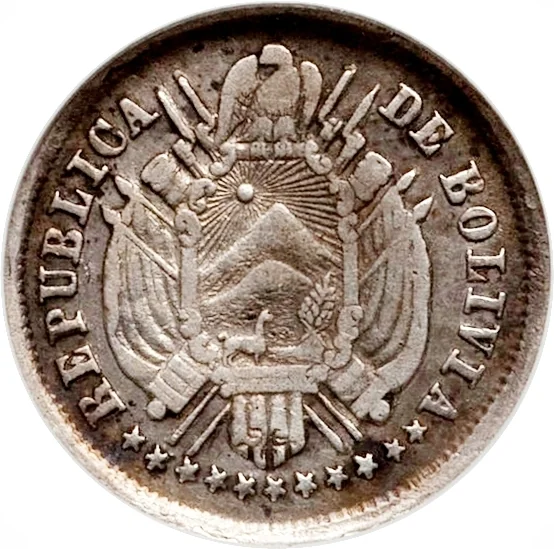
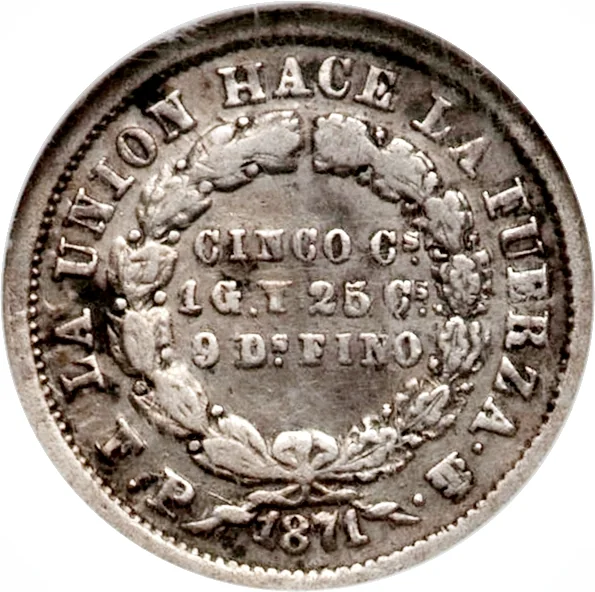
5 centavos – Bolivia
Add to wishlist
Bolivia
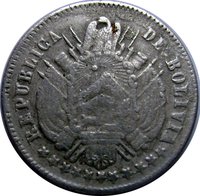
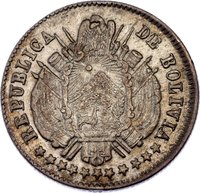
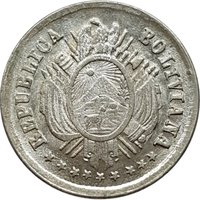
Obverse
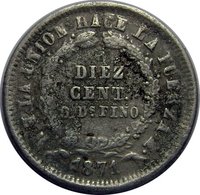
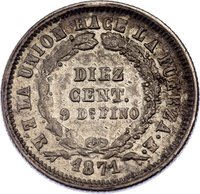
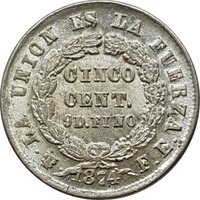
Reverse
Edge
Mints
| Name | Mark |
|---|---|
| Potosi | PTS |
Mintings
| Year | Mint Mark | Mintage | Quality | Collection |
|---|---|---|---|---|
| 1871 | ER | — | ||
| 1871 | FP | — | ||
| 1872 | ER | — | ||
| 1872 | FE | — |
Historical background
In 1871, Bolivia’s currency situation was characterized by profound instability and fragmentation, a direct legacy of the economic devastation following the War of the Pacific (1879-1883) and earlier internal conflicts. However, a critical clarification is necessary: the year 1871 predates the War of the Pacific. The significant monetary turmoil of the early 1870s was instead rooted in the chaotic period following the overthrow of President Mariano Melgarejo in 1871. His corrupt regime (1864-1871) had plundered the national treasury and massively increased the public debt, leaving the state fiscally crippled. The country operated with a limited silver coinage, but the real economic lifeblood was the Peruvian silver sol, which circulated widely due to Bolivia's own weak mint output and integrated regional trade.
The primary currency in circulation was the Boliviano, a silver coin theoretically pegged to the French franc under the Latin Monetary Union standard, but its supply was insufficient. To fill the void, a confusing array of foreign coins, primarily from Peru, Chile, and Argentina, circulated at fluctuating values. More damagingly, successive governments, desperate for revenue, had authorized the issue of billetes fiscales (fiscal notes), a form of inconvertible paper money. By 1871, these notes were severely depreciated, creating a dual-system of "hard" silver and "soft" paper that eroded public trust and hampered commerce.
Therefore, the background for 1871 is one of transition and inherited weakness. The collapse of the Melgarejo regime opened a period of political uncertainty that would further complicate monetary policy. The new government faced the immediate challenges of a depleted treasury, a heavy debt burden, and a disordered currency system reliant on foreign coin and discredited paper. This fragile financial foundation would prove disastrously inadequate just a few years later with the outbreak of the War of the Pacific, which would trigger complete monetary collapse and a long period of currency chaos.
The primary currency in circulation was the Boliviano, a silver coin theoretically pegged to the French franc under the Latin Monetary Union standard, but its supply was insufficient. To fill the void, a confusing array of foreign coins, primarily from Peru, Chile, and Argentina, circulated at fluctuating values. More damagingly, successive governments, desperate for revenue, had authorized the issue of billetes fiscales (fiscal notes), a form of inconvertible paper money. By 1871, these notes were severely depreciated, creating a dual-system of "hard" silver and "soft" paper that eroded public trust and hampered commerce.
Therefore, the background for 1871 is one of transition and inherited weakness. The collapse of the Melgarejo regime opened a period of political uncertainty that would further complicate monetary policy. The new government faced the immediate challenges of a depleted treasury, a heavy debt burden, and a disordered currency system reliant on foreign coin and discredited paper. This fragile financial foundation would prove disastrously inadequate just a few years later with the outbreak of the War of the Pacific, which would trigger complete monetary collapse and a long period of currency chaos.
💎 Very Rare