


5 leva – Bulgaria
Add to wishlist
Non-circulating coins
Commemoration: Palm Sunday
Bulgaria
Context
Material
Diameter: 34.2 mm
Weight: 15 g
Shape: Round
Composition: Copper-nickel
Alignment: Medal alignment
flip

References
KM: #
Numista: #61090
Value
Exchange value: 5 BGN
Obverse
Description:
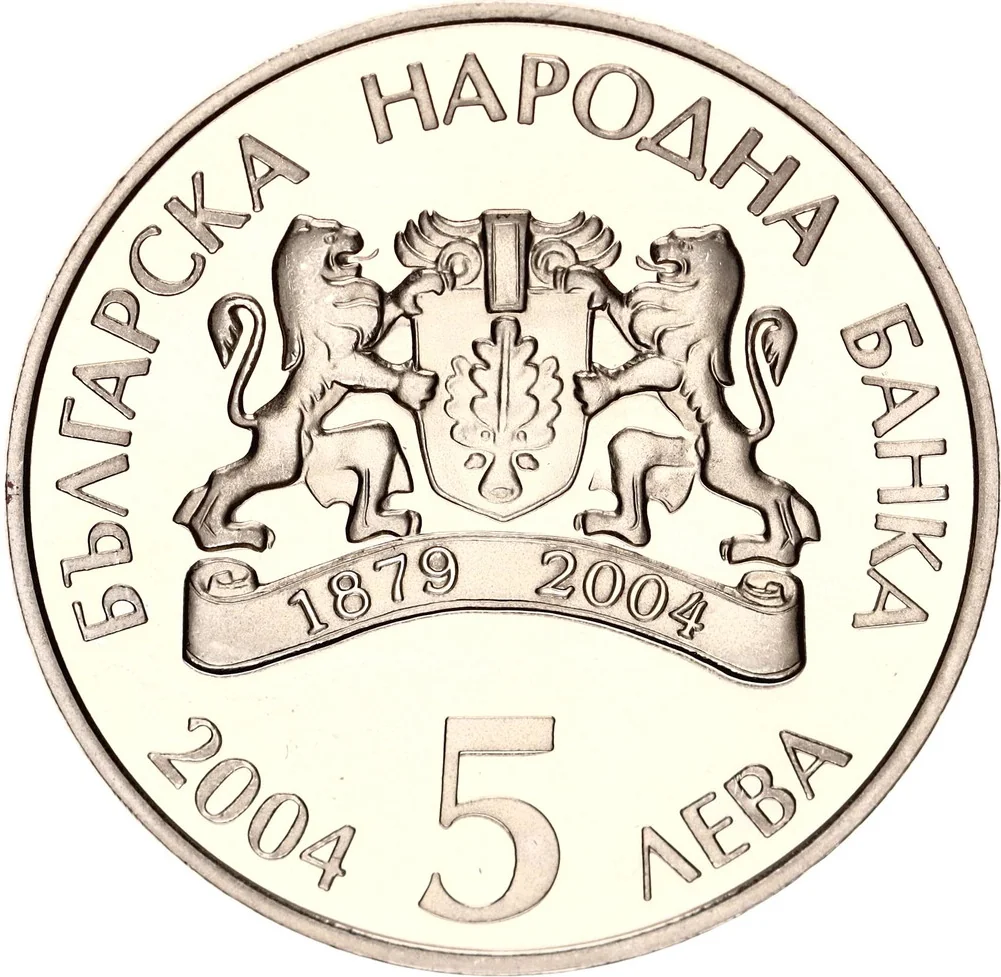
The obverse displays the Bulgarian National Bank logo with '1879' and '2004' on its ribbon. Around the edge are the denomination '5 ЛЕВА', the issue year '2004', and 'БЪЛГАРСКА НАРОДНА БАНКА'.
Inscription:
БЪЛГАРСКА НАРОДНА БАНКА
2004 5 ЛЕВА
2004 5 ЛЕВА
Translation:
BULGARIAN NATIONAL BANK
2004 5 LEVA
2004 5 LEVA
Script: Cyrillic
Language: Bulgarian
Engravers: Bogomil Nikolov, Ekaterina Dimitrova
Reverse
Description:
The reverse shows colored flowers in a square pattern, with a vertical willow twig crossing the word 'ЦВЕТНИЦА' like a cross.
Inscription:
ЦВЕТНИЦА
Translation:
The Flower Garden
Script: Cyrillic
Language: Russian
Engravers: Bogomil Nikolov, Ekaterina Dimitrova
Edge
Plain
Categories
| Symbols> Coat of Arms |
| Plants> Flower |
Mints
| Name | Mark |
|---|---|
| Bulgarian Mint | — |
Mintings
| Year | Mint Mark | Mintage | Quality | Collection |
|---|---|---|---|---|
| 2004 | — | 10,000 |
Historical background
In 2004, Bulgaria was in a critical and stable phase of its post-communist monetary history, operating under a Currency Board Arrangement (CBA) established in July 1997. This strict regime was implemented following a severe financial and hyperinflation crisis, and it pegged the Bulgarian lev (BGN) firmly to the German Deutsche Mark, and subsequently to the euro after its introduction, at a rate of 1.95583 leva for one euro. The CBA mandated that every lev in circulation be fully backed by foreign reserves, severely restricting the central bank's ability to conduct independent monetary policy or act as a lender of last resort. This discipline had successfully restored monetary stability, tamed inflation, and built significant foreign exchange reserves.
The year 2004 was significant as Bulgaria was actively progressing toward its strategic goal of European Union accession, which it achieved on January 1, 2007. A key requirement for eventual Eurozone membership was participation in the EU's Exchange Rate Mechanism II (ERM II), which the currency board was seen as a de facto precursor to. The government, led by Prime Minister Simeon Saxe-Coburg-Gotha, maintained a firm commitment to the currency board, viewing it as the cornerstone of economic credibility. This stability, coupled with structural reforms, supported strong GDP growth and increasing foreign direct investment during this period.
However, the rigid system also presented challenges. The currency board limited tools for adjusting to economic shocks, placing the entire burden of adjustment on fiscal policy and domestic prices and wages. Furthermore, while the peg ensured stability, it meant Bulgaria had no control over its interest rates, which were effectively set by the European Central Bank. In 2004, the economy also faced pressures from a growing current account deficit, fueled by strong domestic demand and imports, which raised concerns about long-term sustainability under the fixed exchange rate. Nevertheless, the consensus in 2004 was that the benefits of the currency board in ensuring stability and guiding the path to the EU far outweighed these risks.
The year 2004 was significant as Bulgaria was actively progressing toward its strategic goal of European Union accession, which it achieved on January 1, 2007. A key requirement for eventual Eurozone membership was participation in the EU's Exchange Rate Mechanism II (ERM II), which the currency board was seen as a de facto precursor to. The government, led by Prime Minister Simeon Saxe-Coburg-Gotha, maintained a firm commitment to the currency board, viewing it as the cornerstone of economic credibility. This stability, coupled with structural reforms, supported strong GDP growth and increasing foreign direct investment during this period.
However, the rigid system also presented challenges. The currency board limited tools for adjusting to economic shocks, placing the entire burden of adjustment on fiscal policy and domestic prices and wages. Furthermore, while the peg ensured stability, it meant Bulgaria had no control over its interest rates, which were effectively set by the European Central Bank. In 2004, the economy also faced pressures from a growing current account deficit, fueled by strong domestic demand and imports, which raised concerns about long-term sustainability under the fixed exchange rate. Nevertheless, the consensus in 2004 was that the benefits of the currency board in ensuring stability and guiding the path to the EU far outweighed these risks.

💎 Extremely Rare