

5 Pyas – Myanmar
Circulating commemorative coins
Commemoration: F.A.O.
Myanmar
Context

Material
Diameter: 18 mm
Weight: 2.8 g
Shape: Round
Composition: Aluminium bronze
Magnetic: No
Technique: Milled
Alignment: Medal alignment
flip
References
KM: #Click to copy to clipboard51
Numista: #6103
Value
Exchange value: 0.05 MMK
Obverse
Description:
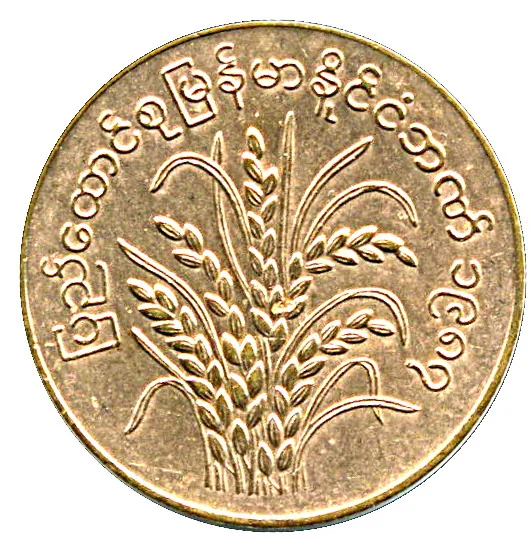
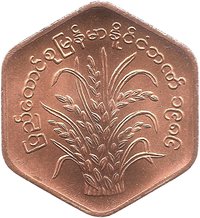
Rice plant, dated.
Inscription:
ပြည်ထောင်စုမြန်မာနိုင်ငံဘဏ် ၁၉၈၇
Translation:
Union of Myanmar Bank 1987
Language: Burmese
Reverse
Description:
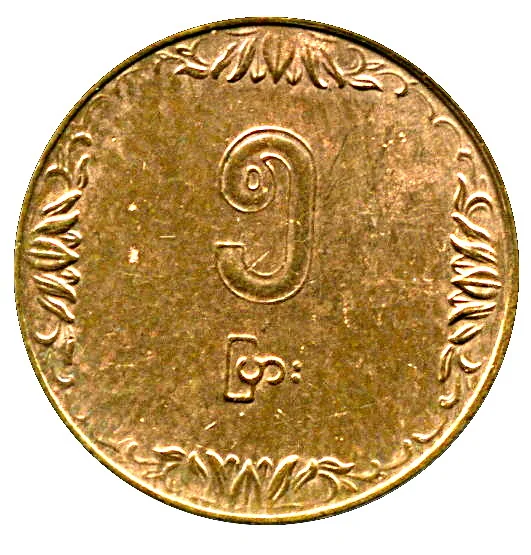
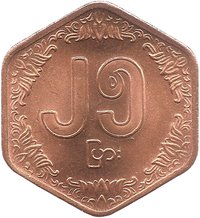
Central square's border defines its denomination.
Inscription:
၅
ပြား
ပြား
Translation:
5 Pyas
Language: Burmese
Edge
Plain
Categories
| Organization> FAO |
Mintings
| Year | Mint Mark | Mintage | Quality | Collection |
|---|---|---|---|---|
| 1987 | — | — |
Historical background
In September 1987, the military government of Myanmar, then known as Burma and led by General Ne Win, enacted a sudden and devastating demonetization policy. Without warning, it declared that 25-, 35-, and 75-kyat banknotes—which represented a majority of the currency in circulation—were no longer legal tender. The stated rationale was to combat black marketeering and cripple the economic power of ethnic minority insurgent groups, but the move was also steeped in Ne Win's personal superstition, as he considered the number nine to be auspicious and the demonetized notes' denominations were not divisible by nine.
The immediate consequences were catastrophic for the general populace. Ordinary citizens, who had no means to exchange the now-worthless paper, saw their life savings wiped out overnight. The demonetization primarily targeted the middle and lower classes, as wealthier elites often held assets in gold, foreign currency, or land. The policy triggered widespread economic paralysis, wiping out liquidity, halting trade, and fueling acute public anger and despair. It was a primary catalyst for the severe economic hardship that set the stage for the mass pro-democracy protests of 1988.
This drastic measure was the second such shock in five years, following a 1985 demonetization, and it shattered any remaining public trust in the state and its currency. The economic devastation directly contributed to the social unrest that culminated in the nationwide 8888 Uprising in August 1988. Thus, the 1987 currency crisis is remembered not merely as a failed economic policy, but as a pivotal political event that exposed the regime's recklessness and deepened the profound crisis of legitimacy that continues to shape Myanmar's modern history.
The immediate consequences were catastrophic for the general populace. Ordinary citizens, who had no means to exchange the now-worthless paper, saw their life savings wiped out overnight. The demonetization primarily targeted the middle and lower classes, as wealthier elites often held assets in gold, foreign currency, or land. The policy triggered widespread economic paralysis, wiping out liquidity, halting trade, and fueling acute public anger and despair. It was a primary catalyst for the severe economic hardship that set the stage for the mass pro-democracy protests of 1988.
This drastic measure was the second such shock in five years, following a 1985 demonetization, and it shattered any remaining public trust in the state and its currency. The economic devastation directly contributed to the social unrest that culminated in the nationwide 8888 Uprising in August 1988. Thus, the 1987 currency crisis is remembered not merely as a failed economic policy, but as a pivotal political event that exposed the regime's recklessness and deepened the profound crisis of legitimacy that continues to shape Myanmar's modern history.
🌱 Common