

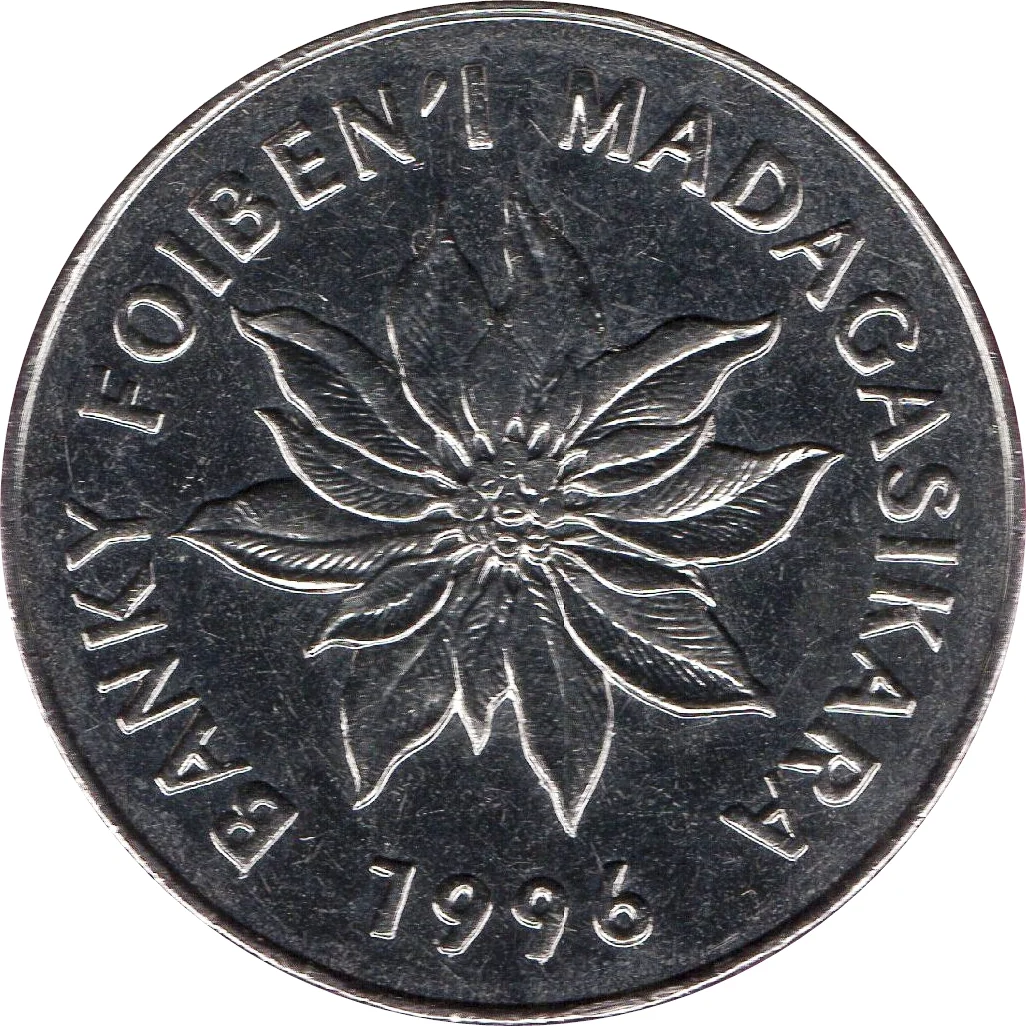
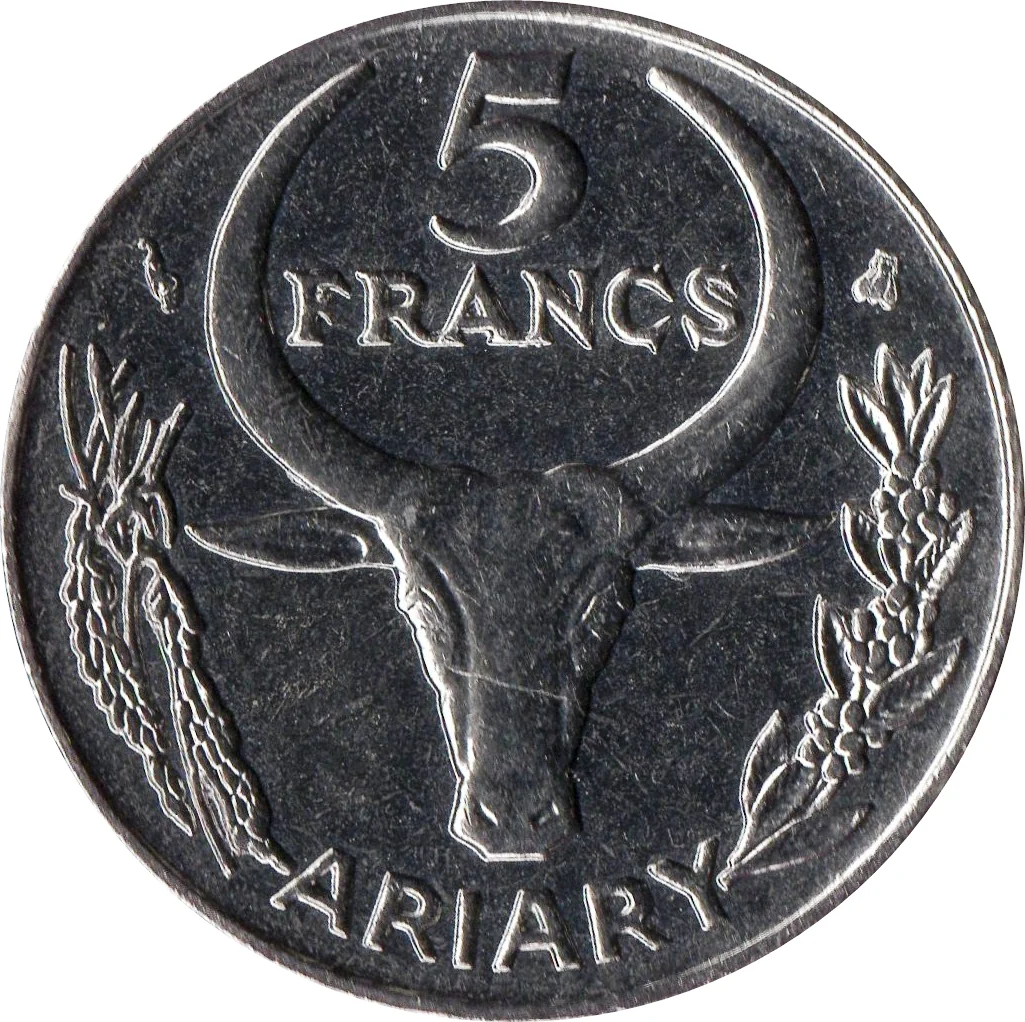
5 francs – Madagascar
Add to wishlist
Madagascar
Context
Year: 1996
Issuer: Madagascar
Period:
(1992—2010)
Currency:
(1963—2004)
Subdivision: 5 francs = 1 Ariary
Material
Diameter: 22 mm
Weight: 5 g
Thickness: 2 mm
Shape: Round
Composition: Stainless steel
Technique: Milled
Alignment: Coin alignment
flip
References
KM: #
Numista: #6093
Value
Exchange value: 1 MGF
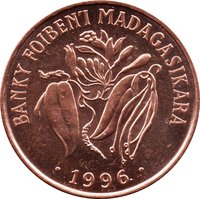
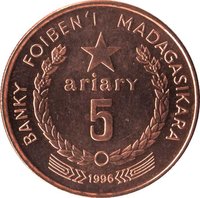
Obverse
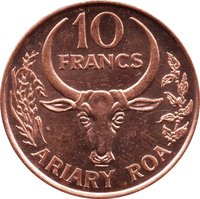
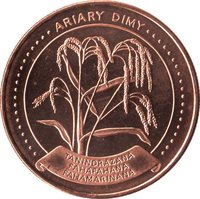
Reverse
Edge
Plain
Mints
| Name | Mark |
|---|---|
| Monnaie de Paris | — |
Mintings
| Year | Mint Mark | Mintage | Quality | Collection |
|---|---|---|---|---|
| 1996 | — | — |
Historical background
In 1996, Madagascar's currency situation was characterized by the ongoing use of the Malagasy franc (FMG), which operated under a managed float regime supervised by the Central Bank of the Republic of Madagascar. This period followed a major economic liberalization and structural adjustment program initiated in the late 1980s under the guidance of the International Monetary Fund (IMF) and World Bank. A key reform had been the unification of the exchange rate in 1994, eliminating the previous complex system of multiple official and parallel rates, which helped to reduce distortions and fostered a more transparent foreign exchange market.
The economy in the mid-1990s was still grappling with the legacy of prolonged political instability and economic contraction, though reforms were beginning to show tentative signs of stabilization. Inflation, a persistent challenge, remained high but was on a downward trajectory from the hyperinflationary peaks of the early 1990s, partly contained by tighter monetary policy. The value of the FMG was generally depreciating against major currencies like the French franc and the US dollar, reflecting both underlying economic vulnerabilities and the adjustment to a market-determined rate. This depreciation increased the local cost of imports and servicing foreign debt, creating ongoing pressure on prices and living standards.
Overall, the currency situation in 1996 reflected a transitional phase where the institutional framework for a market-based system was in place, but the benefits of sustained macroeconomic stability and growth were not yet fully realized. The government's commitment to its reform program was crucial for maintaining donor support and accessing external financing, which in turn helped to build foreign exchange reserves and provide a buffer for the national currency. However, the fragility of the economic recovery meant that the Malagasy franc remained susceptible to both domestic fiscal pressures and external shocks.
The economy in the mid-1990s was still grappling with the legacy of prolonged political instability and economic contraction, though reforms were beginning to show tentative signs of stabilization. Inflation, a persistent challenge, remained high but was on a downward trajectory from the hyperinflationary peaks of the early 1990s, partly contained by tighter monetary policy. The value of the FMG was generally depreciating against major currencies like the French franc and the US dollar, reflecting both underlying economic vulnerabilities and the adjustment to a market-determined rate. This depreciation increased the local cost of imports and servicing foreign debt, creating ongoing pressure on prices and living standards.
Overall, the currency situation in 1996 reflected a transitional phase where the institutional framework for a market-based system was in place, but the benefits of sustained macroeconomic stability and growth were not yet fully realized. The government's commitment to its reform program was crucial for maintaining donor support and accessing external financing, which in turn helped to build foreign exchange reserves and provide a buffer for the national currency. However, the fragility of the economic recovery meant that the Malagasy franc remained susceptible to both domestic fiscal pressures and external shocks.
🌱 Common