

10 kreuzers – Teutonic Order
Add to wishlist
Non-circulating coins
Commemoration: Death of Grand Master Max Franz
Germany
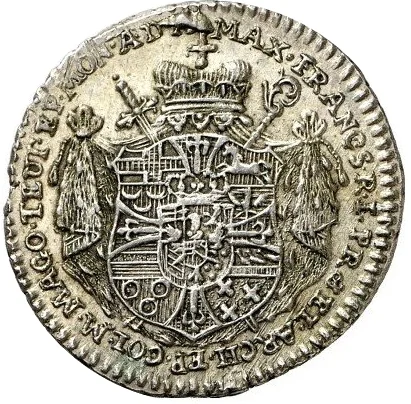
Obverse
Description:
Coat of arms on a coat beneath a Kurhut, with nine lines of text.
Inscription:
MAX.FRANCS.R.I.PR&EL.ARCH.EP.COI.M.MAOO.TEUT.EP.MON.A.D.A
Translation:
MAXIMILIAN FRANCIS, HOLY ROMAN EMPEROR, PRINCE AND ARCHDUKE OF AUSTRIA, BISHOP OF COLOGNE, MASTER OF THE GERMAN ORDER, BISHOP OF MÜNSTER, ADMINISTRATOR OF THE DIOCESE OF AUGSBURG.
Script: Latin
Language: Latin
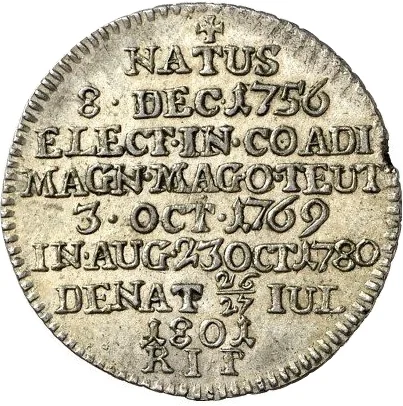
Reverse
Description:
Inscription below cross.
Inscription:
NATUS // 8.DEC.1756 // ELECT.IN.COADI // MAGN.MAGO.TEUT // 3.OCT.1769 // IN.AUG.23OCT1780 // DENAT 26/27 IUL // 1801 // RIP
Script: Latin
Edge
Mintings
| Year | Mint Mark | Mintage | Quality | Collection |
|---|---|---|---|---|
| 1801 | — | — |
Historical background
In 1801, the currency situation within the territories of the Teutonic Order was one of profound complexity and transition, reflecting the Order's diminished political and economic power. The state itself, a relic of the medieval crusading era, was by this time a minor Prussian principality, consisting largely of scattered territories around the Baltic, including its core territory of East Prussia. The monetary system was not unified; it operated within the broader economic sphere of the Polish-Lithuanian Commonwealth and the Kingdom of Prussia, with a multitude of foreign and domestic coins in circulation. These included Prussian thalers and groschen, Polish złotys and groszes, and even older Swedish and Dutch coins, leading to a chaotic exchange environment that hampered trade and administration.
This monetary disarray was exacerbated by the Order's chronic financial weakness. Having never fully recovered from the secularization of its Prussian holdings in 1525, the Teutonic Order by 1801 was a financially strained entity, reliant on income from its remaining German bailiwicks. The production of its own coinage was minimal and sporadic, often limited to small-change copper pfennigs or commemorative issues struck in Mergentheim, the seat of the Grand Master. Consequently, the Order lacked the authority and resources to impose a standard currency, leaving commerce dependent on the fluctuating values of neighboring states' currencies and the subjective assessments of local money changers.
The year 1801 placed this fragile system under imminent threat. The geopolitical landscape was being reshaped by the Napoleonic Wars and the secularizations occurring across the Holy Roman Empire. Just two years prior, in 1799, the Order had lost its possessions on the left bank of the Rhine to France. The Reichsdeputationshauptschluss of 1803, which would formally secularize the Order's remaining German properties and effectively dissolve its statehood, was already being negotiated. Therefore, the currency situation of 1801 was not merely chaotic but ultimately ephemeral, representing the final, unstable monetary practices of a sovereign entity on the brink of political extinction.
This monetary disarray was exacerbated by the Order's chronic financial weakness. Having never fully recovered from the secularization of its Prussian holdings in 1525, the Teutonic Order by 1801 was a financially strained entity, reliant on income from its remaining German bailiwicks. The production of its own coinage was minimal and sporadic, often limited to small-change copper pfennigs or commemorative issues struck in Mergentheim, the seat of the Grand Master. Consequently, the Order lacked the authority and resources to impose a standard currency, leaving commerce dependent on the fluctuating values of neighboring states' currencies and the subjective assessments of local money changers.
The year 1801 placed this fragile system under imminent threat. The geopolitical landscape was being reshaped by the Napoleonic Wars and the secularizations occurring across the Holy Roman Empire. Just two years prior, in 1799, the Order had lost its possessions on the left bank of the Rhine to France. The Reichsdeputationshauptschluss of 1803, which would formally secularize the Order's remaining German properties and effectively dissolve its statehood, was already being negotiated. Therefore, the currency situation of 1801 was not merely chaotic but ultimately ephemeral, representing the final, unstable monetary practices of a sovereign entity on the brink of political extinction.
✨ Legendary