

1 Groschen – Teutonic Order
Non-circulating coins
Commemoration: Death of Franz Ludwig von Pfalz-Neuburg
Germany
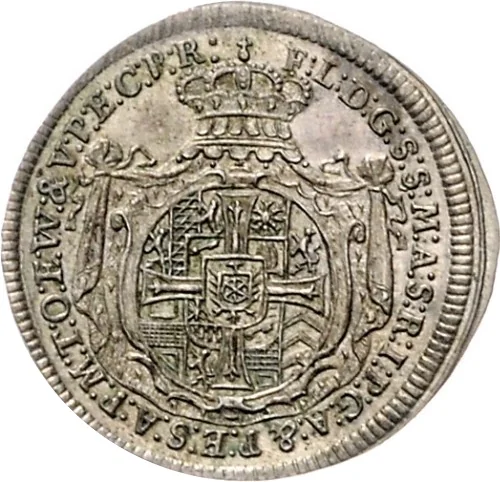
Obverse
Description:
Crowned, mantled oval heraldic arms.
Script: Latin
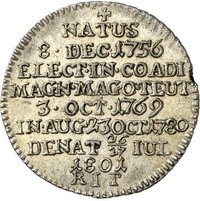
Reverse
Description:
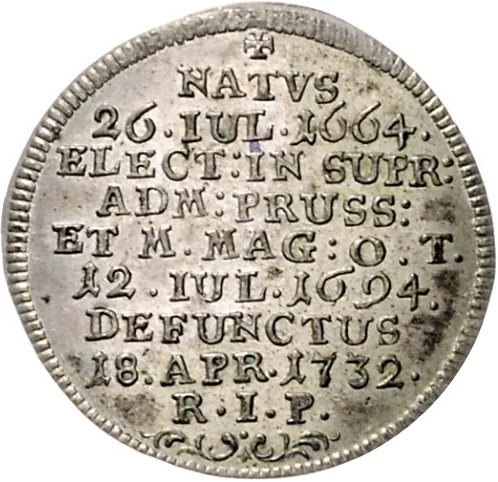
Dated 9-line inscriptions.
Script: Latin
Edge
Mintings
| Year | Mint Mark | Mintage | Quality | Collection |
|---|---|---|---|---|
| 1732 | — | — |
Historical background
In 1732, the currency situation within the Teutonic Order State (centered in the Duchy of Prussia) was characterized by a complex and often unstable monetary dualism. The state officially operated on a bimetallic system based on the Reichsthaler (a large silver coin) and the Groschen (a smaller silver coin), with 90 Groschen theoretically equaling one Reichsthaler. However, the Order's mints, most notably in Königsberg, also produced a flood of lower-quality subsidiary coinage, such as copper Schillinge and Dreipölker, to facilitate small, everyday transactions. This created a persistent tension between high-value "good money" used for large trade and state finance, and depreciating "bad money" used by the common populace.
The system was under significant strain due to decades of monetary manipulation. The Order, frequently in need of revenue, had engaged in repeated debasements—reducing the precious metal content in coins while maintaining their face value. This practice, alongside the influx of foreign coins like Polish ducats and Dutch rijksdaalders circulating in the region, led to chronic inflation, confusion in exchange rates, and a loss of public trust. Gresham's law was in effect, as people hoarded older, higher-silver coins and passed on the newer, inferior ones, further exacerbating the circulation of poor-quality currency.
Ultimately, this fragile monetary environment reflected the broader political and economic weakness of the Teutonic Order itself. By 1732, the Order was a shadow of its medieval power, with its Grand Master acting as a vassal to the Polish Crown. The chaotic currency was symptomatic of an administration struggling to manage its finances and assert economic sovereignty. This instability would persist until the state's dissolution in 1795, with its monetary system remaining a patchwork of official rates and market-driven realities until the end.
The system was under significant strain due to decades of monetary manipulation. The Order, frequently in need of revenue, had engaged in repeated debasements—reducing the precious metal content in coins while maintaining their face value. This practice, alongside the influx of foreign coins like Polish ducats and Dutch rijksdaalders circulating in the region, led to chronic inflation, confusion in exchange rates, and a loss of public trust. Gresham's law was in effect, as people hoarded older, higher-silver coins and passed on the newer, inferior ones, further exacerbating the circulation of poor-quality currency.
Ultimately, this fragile monetary environment reflected the broader political and economic weakness of the Teutonic Order itself. By 1732, the Order was a shadow of its medieval power, with its Grand Master acting as a vassal to the Polish Crown. The chaotic currency was symptomatic of an administration struggling to manage its finances and assert economic sovereignty. This instability would persist until the state's dissolution in 1795, with its monetary system remaining a patchwork of official rates and market-driven realities until the end.
✨ Legendary