

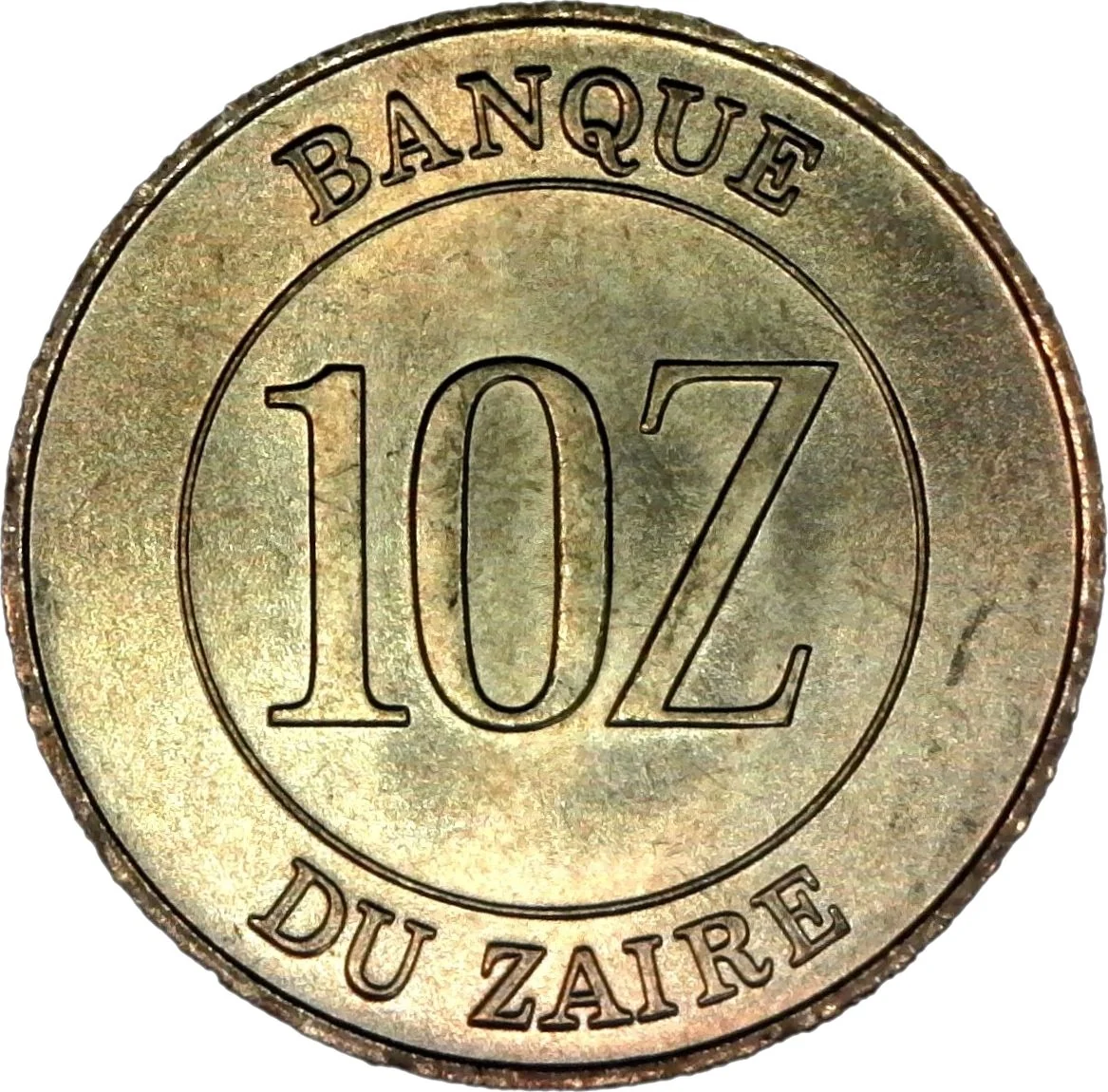
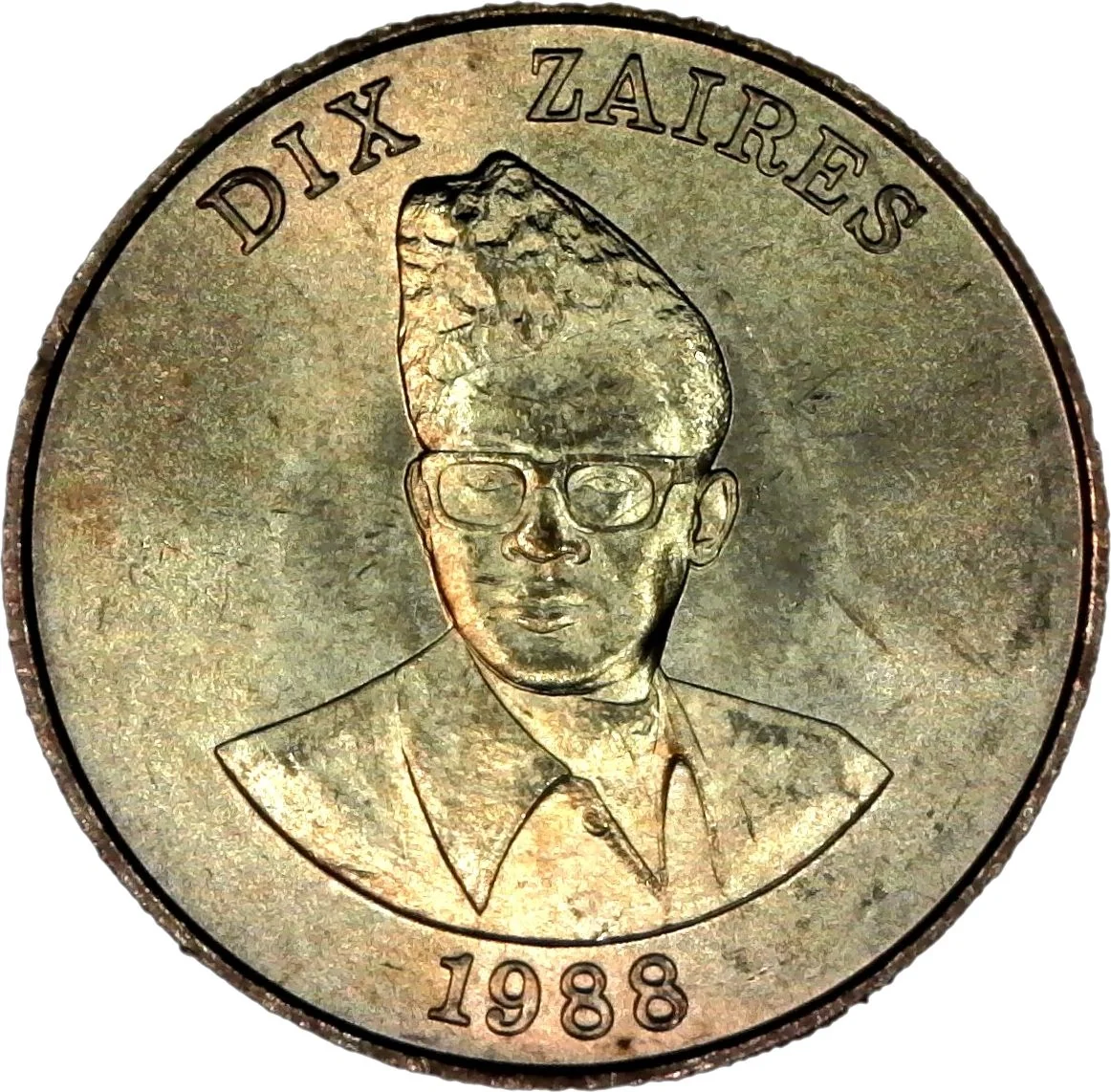
10 zaires – Zaire
Add to wishlist
Democratic Republic of the Congo
Context
Year: 1988
Country: Democratic Republic of the Congo
Issuer: Zaire
Issuing organization: Bank of Zaire
Period:
(1971—1997)
Currency:
(1967—1993)
Demonetized: Yes
Material
References
KM: #
Numista: #6079
Value
Exchange value: 10 ZRZ
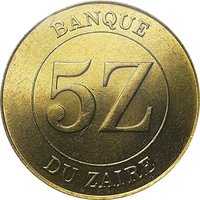
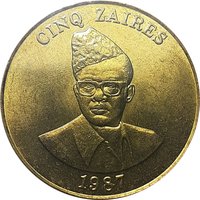
Obverse
Reverse
Edge
Plain
Mints
| Name | Mark |
|---|---|
| Royal Mint | — |
Mintings
| Year | Mint Mark | Mintage | Quality | Collection |
|---|---|---|---|---|
| 1988 | — | — |
Historical background
In 1988, the currency situation in Zaire (now the Democratic Republic of the Congo) was characterized by severe instability and hyperinflation, a direct consequence of decades of economic mismanagement under President Mobutu Sese Seko. The national currency, the zaire, was in a state of freefall, having lost virtually all credibility both domestically and internationally. This was driven by a combination of rampant corruption, the systematic plundering of state resources, and the government's persistent reliance on printing money to finance massive budget deficits, all within a context of collapsing productive capacity and export revenues.
The official exchange rate, set by the central bank, was wildly divorced from reality, giving rise to a vast and thriving parallel black market for foreign currency, particularly US dollars. In this dual system, the black market rate was many times higher than the official rate, crippling formal import-export businesses while enriching a small connected elite who had access to dollars at the preferential official rate. This environment fostered widespread economic distortion, crippling shortages of basic goods, and a rapid dollarization of the economy, as citizens and businesses sought any means to escape the rapidly depreciating zaire.
Ultimately, the currency crisis of 1988 was a glaring symptom of a failing state. The government's attempts at piecemeal reforms, including a currency redenomination in 1987 that created the "nouveau zaire," had failed to address the fundamental political and economic pathologies. By the end of the decade, the monetary system was in chaos, contributing profoundly to the deepening social unrest and economic collapse that would culminate in Mobutu's overthrow in 1997. The situation underscored that without a radical shift in governance, any technical monetary adjustments were doomed to fail.
The official exchange rate, set by the central bank, was wildly divorced from reality, giving rise to a vast and thriving parallel black market for foreign currency, particularly US dollars. In this dual system, the black market rate was many times higher than the official rate, crippling formal import-export businesses while enriching a small connected elite who had access to dollars at the preferential official rate. This environment fostered widespread economic distortion, crippling shortages of basic goods, and a rapid dollarization of the economy, as citizens and businesses sought any means to escape the rapidly depreciating zaire.
Ultimately, the currency crisis of 1988 was a glaring symptom of a failing state. The government's attempts at piecemeal reforms, including a currency redenomination in 1987 that created the "nouveau zaire," had failed to address the fundamental political and economic pathologies. By the end of the decade, the monetary system was in chaos, contributing profoundly to the deepening social unrest and economic collapse that would culminate in Mobutu's overthrow in 1997. The situation underscored that without a radical shift in governance, any technical monetary adjustments were doomed to fail.
🌱 Very Common