

1 Mark – German Democratic Republic
Germany
Context
Years: 1956–1963
Country: Germany 
Issuer: German Democratic Republic 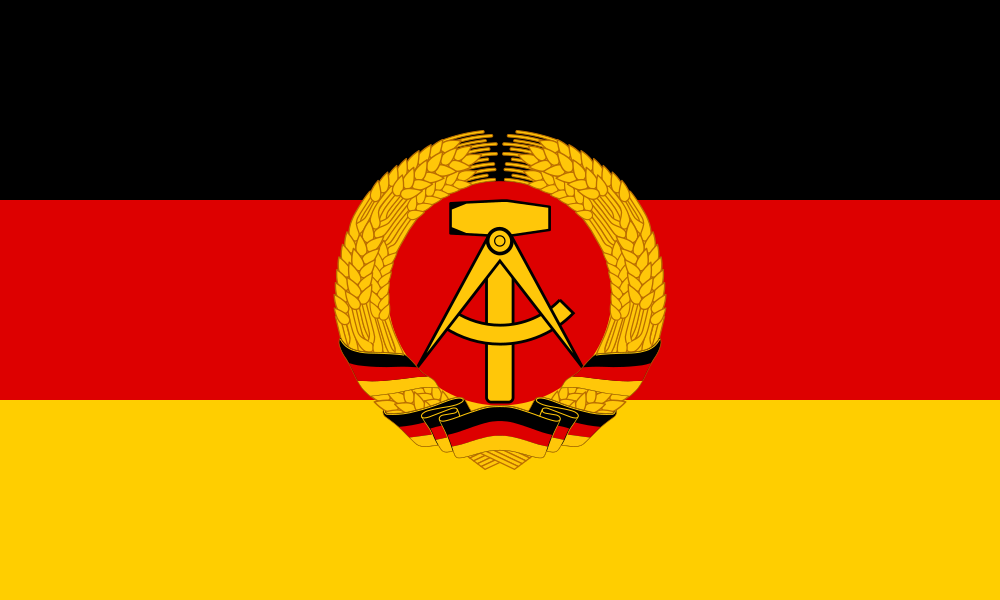
Period:
(1949—1990)
Currency:
(1948—1990)
Demonetization: 30 June 1990
Total mintage: 189,938,387
Material
References
KM: #Click to copy to clipboard13
Numista: #6076
Value
Exchange value: 1 DDM
Inflation-adjusted value: 6.12 DDM
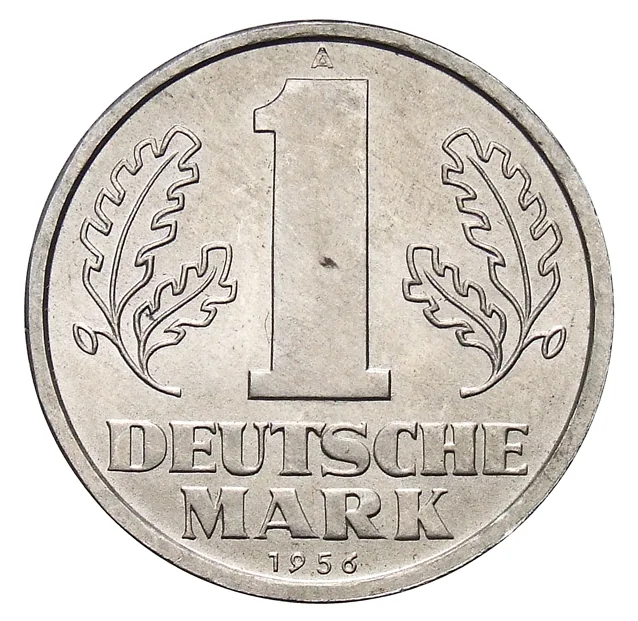
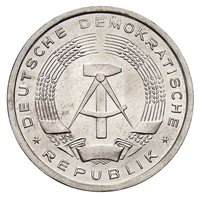
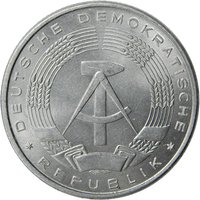
Obverse
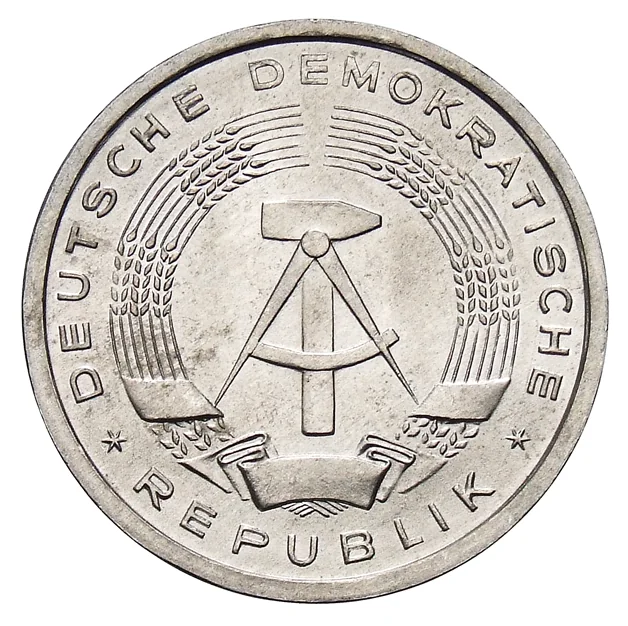
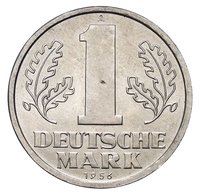
Reverse
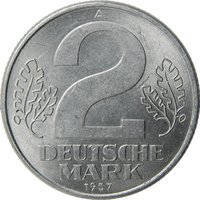
Description:
Oak leaves flank value, mintmark above.
Inscription:
A
1
DEUTSCHE
MARK
1963
1
DEUTSCHE
MARK
1963
Script: Latin
Engraver: Rudi Högner
Edge
Smooth with imprints (13 small 6-rays stars).
Mints
| Name | Mark |
|---|---|
| Berlin | A |
Historical background
In 1956, the currency situation in the German Democratic Republic (GDR) was characterized by a fragile duality and the lingering aftermath of a major reform. The official currency, the East German Mark (Mark der Deutschen Notenbank, or MDN), was not a freely convertible currency but a tool of the state-planned economy. Its value was administratively set and it functioned primarily within the closed economic sphere of the Eastern Bloc, with severe restrictions on taking it out of the country. This stood in stark contrast to the powerful West German Deutsche Mark (DM), which was becoming a symbol of the "Economic Miracle" across the border.
The system was still stabilizing from the pivotal Currency Reform of 1948, which had fundamentally split the monetary unity of post-war Germany. While West Germany introduced the Deutsche Mark that June, the Soviet Zone (later the GDR) followed days later with the Ostmark, creating two separate monetary zones. By 1956, a critical feature was the existence of a premium exchange rate for the West German DM within the GDR. Through government-sanctioned channels like the Genex gift service or the Intershop stores (established in 1955), GDR citizens with access to hard Western currency could purchase coveted Western goods, effectively creating a two-tier economy where the DM held vastly more purchasing power than the ostensible official exchange rate.
This currency divide mirrored and exacerbated the growing socio-economic divide between the two Germanys. For the GDR government, controlling the currency was essential for enforcing its economic plan, preventing capital flight, and maintaining political stability. However, the palpable attraction of the DM undermined confidence in the East Mark and highlighted the GDR's relative economic weakness. The situation in 1956 thus laid bare the ongoing struggle of the SED regime to legitimize its currency and, by extension, its state, in the face of a powerful Western counterpart that exerted a constant pull on the population's aspirations.
The system was still stabilizing from the pivotal Currency Reform of 1948, which had fundamentally split the monetary unity of post-war Germany. While West Germany introduced the Deutsche Mark that June, the Soviet Zone (later the GDR) followed days later with the Ostmark, creating two separate monetary zones. By 1956, a critical feature was the existence of a premium exchange rate for the West German DM within the GDR. Through government-sanctioned channels like the Genex gift service or the Intershop stores (established in 1955), GDR citizens with access to hard Western currency could purchase coveted Western goods, effectively creating a two-tier economy where the DM held vastly more purchasing power than the ostensible official exchange rate.
This currency divide mirrored and exacerbated the growing socio-economic divide between the two Germanys. For the GDR government, controlling the currency was essential for enforcing its economic plan, preventing capital flight, and maintaining political stability. However, the palpable attraction of the DM undermined confidence in the East Mark and highlighted the GDR's relative economic weakness. The situation in 1956 thus laid bare the ongoing struggle of the SED regime to legitimize its currency and, by extension, its state, in the face of a powerful Western counterpart that exerted a constant pull on the population's aspirations.
🌱 Very Common