

2 Paisa – Nepal
Nepal

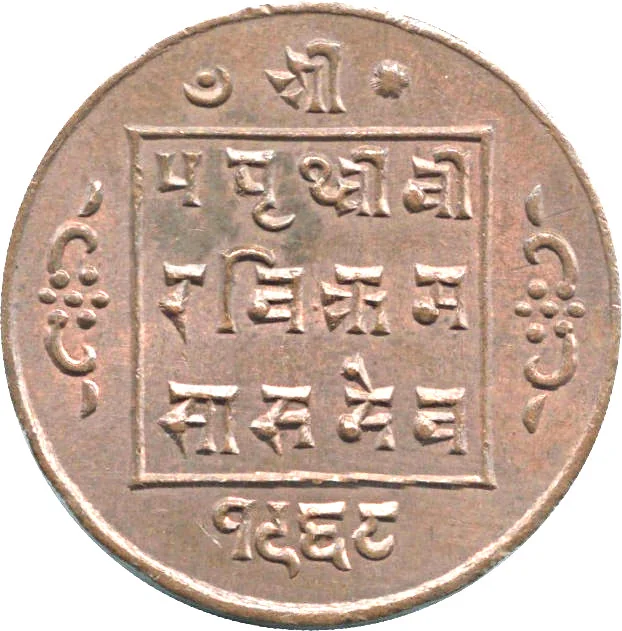
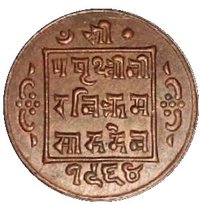
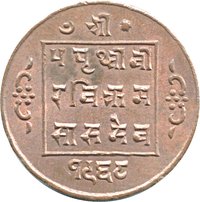
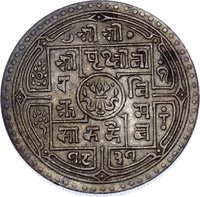
Obverse
Description:
Legend in square, date below.
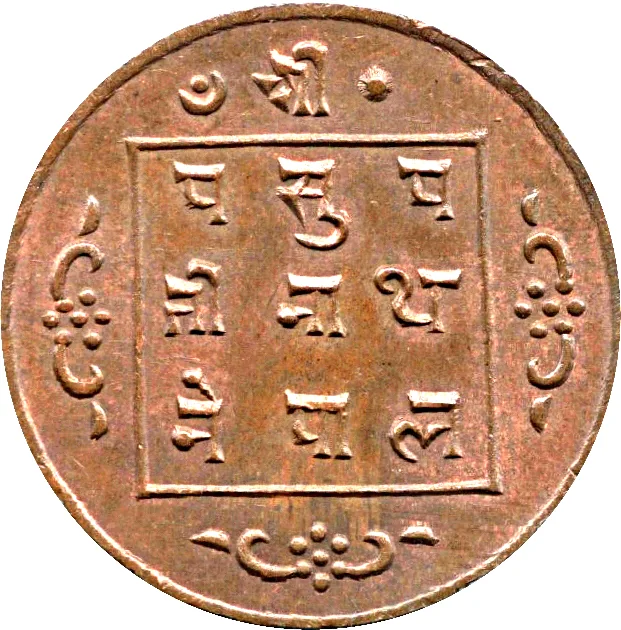
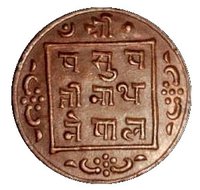
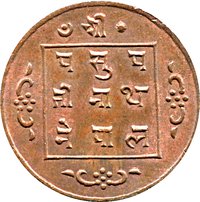
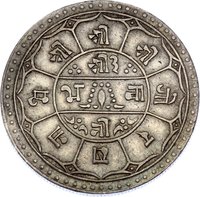
Reverse
Description:
Legend in square.
Edge
Plain
Mintings
| Year | Mint Mark | Mintage | Quality | Collection |
|---|---|---|---|---|
| 1907 | — | — | ||
| 1911 | — | — | ||
| 1911 | — | — | Proof |
Historical background
In 1907, Nepal's currency situation was characterized by a complex and fragmented system, heavily influenced by its political and economic ties to British India. The dominant circulating medium was the Mohar, a silver coin minted by the Shah dynasty. However, the system was not decimalized; one Mohar was subdivided into 128 dams, and further into 512 paisas, creating cumbersome calculations. Alongside these, older Kali Mohars (black mohars, debased silver) and various copper coins circulated, while in the Tarai plains bordering India, Indian Rupees were widely used and often preferred for larger transactions due to their stability and wider acceptance in regional trade.
This monetary landscape was directly shaped by the 1908 Tripartite Agreement (signed in December 1907 according to the Nepali calendar year 1964). This pivotal treaty between Nepal, British India, and the United Kingdom standardized the exchange rate, fixing the Nepali Mohar to the Indian Rupee at a rate of 1.5 Mohars = 1 Indian Rupee. The agreement was crucial for Nepal, as it stabilized cross-border trade and formalized the economic dependency on British India. It also mandated that Nepal's silver coinage be minted from Indian-minted silver, further cementing the rupee's influence.
Despite this formalization, the system remained inefficient for daily use. The public continued to grapple with the non-decimal denominations, and the concurrent circulation of Nepali and Indian coins created a dual-currency economy. The year 1907 thus represents a transitional point—a moment just before the implementation of the Tripartite Agreement's terms, which provided external stability but did not yet address the internal need for a modern, unified decimal currency system. That reform would come decades later with the introduction of the Nepali Rupee in 1932.
This monetary landscape was directly shaped by the 1908 Tripartite Agreement (signed in December 1907 according to the Nepali calendar year 1964). This pivotal treaty between Nepal, British India, and the United Kingdom standardized the exchange rate, fixing the Nepali Mohar to the Indian Rupee at a rate of 1.5 Mohars = 1 Indian Rupee. The agreement was crucial for Nepal, as it stabilized cross-border trade and formalized the economic dependency on British India. It also mandated that Nepal's silver coinage be minted from Indian-minted silver, further cementing the rupee's influence.
Despite this formalization, the system remained inefficient for daily use. The public continued to grapple with the non-decimal denominations, and the concurrent circulation of Nepali and Indian coins created a dual-currency economy. The year 1907 thus represents a transitional point—a moment just before the implementation of the Tripartite Agreement's terms, which provided external stability but did not yet address the internal need for a modern, unified decimal currency system. That reform would come decades later with the introduction of the Nepali Rupee in 1932.
Series: 1907 Nepal circulation coins
💎 Extremely Rare