

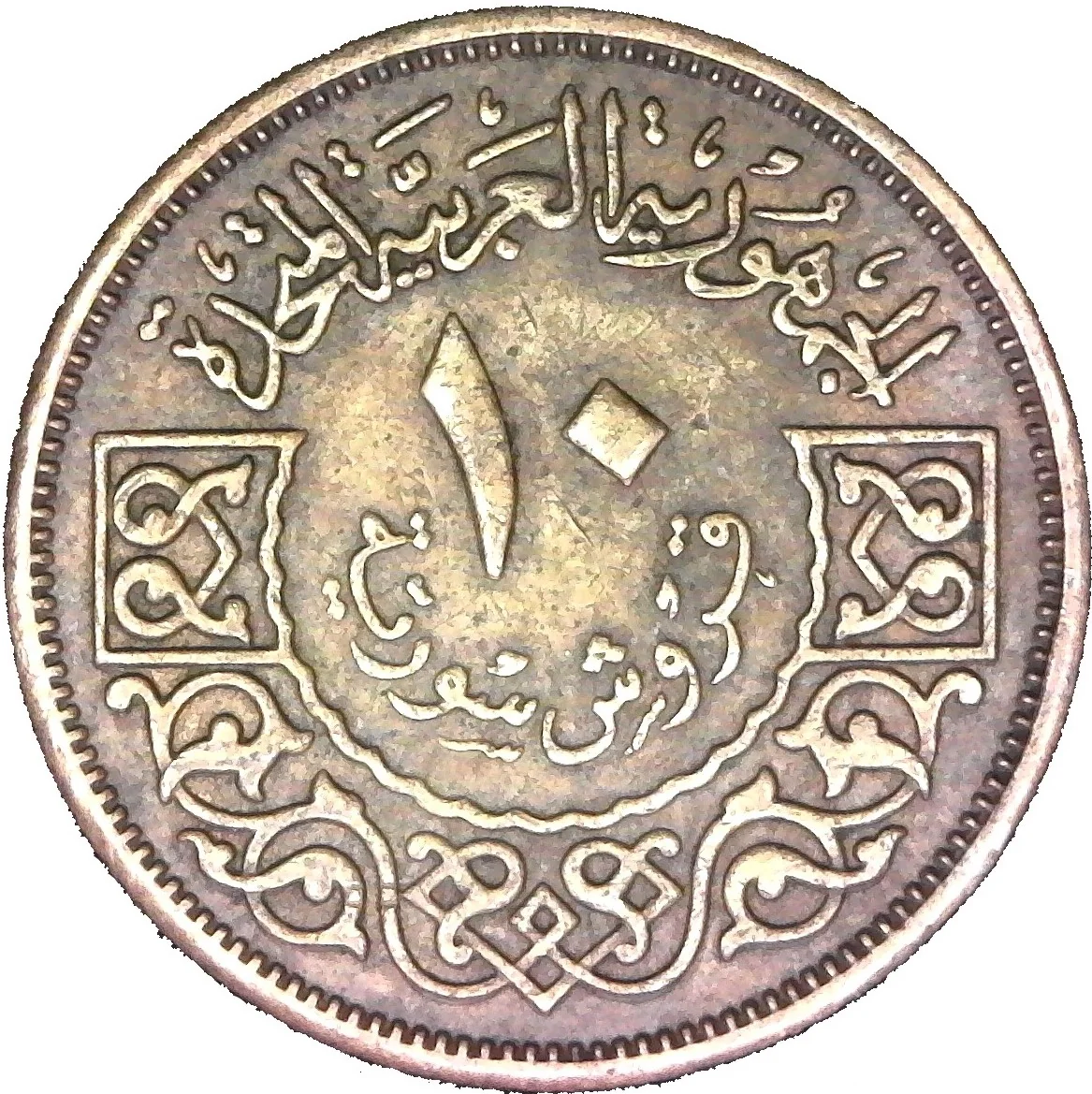
10 piastres – Syria
Add to wishlist
Syria
Context
Year: 1960
Islamic (Hijri) Year:: 1380
Issuer: Syria
Period:
(1958—1961)
Currency:
(since 1919)
Demonetized: Yes
Total mintage: 2,800,000
Material
References
KM: #
Numista: #6016
Value
Exchange value: 0.10 SYP
Obverse
Description:
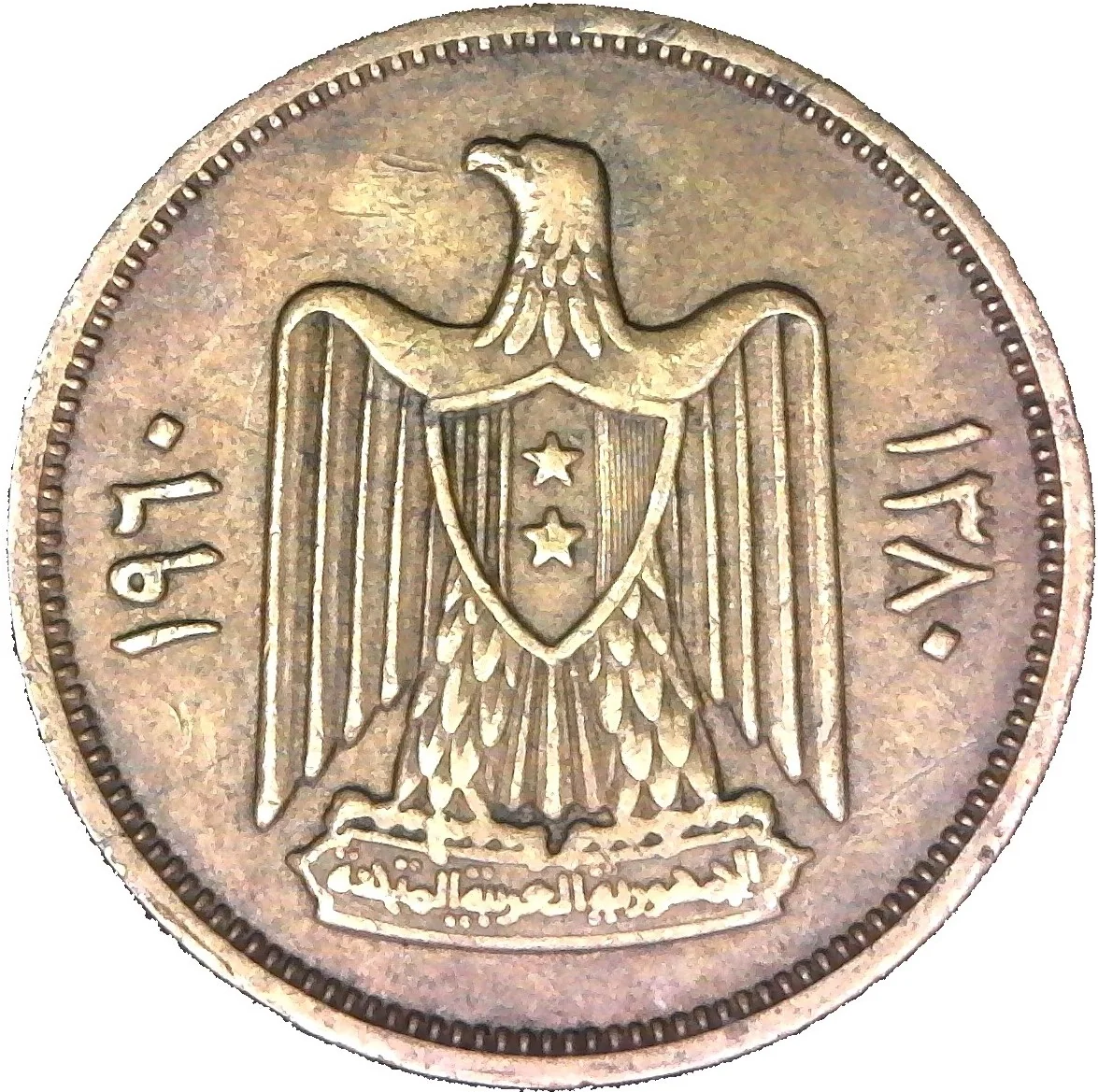
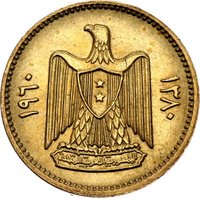
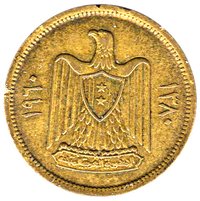
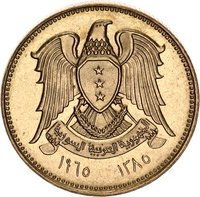
United Arab Republic coat of arms (1958-1961): A left-facing Saladin eagle with outspread wings holds a scroll. On its chest is a shield trisected vertically, with two stars in the center. Arabic dates flank the shield.
Inscription:
١٣٨٠ ١٩٦٠
الجمهورية العربية المتحدة
الجمهورية العربية المتحدة
Translation:
United Arab Republic
1380 1960
1380 1960
Script: Arabic
Language: Arabic
Reverse
Edge
Reeded
Categories
| Animal> Bird> Eagle |
| Symbols> Coat of Arms |
Mints
| Name | Mark |
|---|---|
| Egyptian Mint Authority | — |
Mintings
| Year | Mint Mark | Mintage | Quality | Collection |
|---|---|---|---|---|
| 1960 | — | 2,800,000 |
Historical background
In 1960, Syria's currency situation was defined by its recent political union with Egypt, forming the United Arab Republic (UAR) in 1958. As part of this merger, Syria abandoned its national currency, the Syrian pound, and adopted the Egyptian pound as the common legal tender. This move was politically symbolic, intended to solidify economic integration, but it placed Syria's monetary policy under the control of the central bank in Cairo, effectively ceding a key instrument of national sovereignty.
The arrangement quickly proved economically problematic for Syria. The Egyptian pound was overvalued, which hurt Syrian agricultural exports—the backbone of its economy—by making them more expensive on the world market. Furthermore, monetary decisions made in Cairo often failed to account for Syria's distinct economic conditions, leading to liquidity issues and commercial discontent. The centralized policy also fueled resentment among Syrian business elites and landowners, who felt disadvantaged by the UAR's broader socialist-oriented economic reforms.
Consequently, by 1960, the currency union was a significant point of tension and a practical failure. It became a powerful symbol of the unequal nature of the political merger and contributed to the growing discontent that would lead to Syria's secession from the UAR in 1961. Following the dissolution of the union, Syria swiftly re-established its own central bank and reintroduced the Syrian pound in 1961, seeking to restore its monetary independence and stabilize an economy strained by the preceding experiment in unity.
The arrangement quickly proved economically problematic for Syria. The Egyptian pound was overvalued, which hurt Syrian agricultural exports—the backbone of its economy—by making them more expensive on the world market. Furthermore, monetary decisions made in Cairo often failed to account for Syria's distinct economic conditions, leading to liquidity issues and commercial discontent. The centralized policy also fueled resentment among Syrian business elites and landowners, who felt disadvantaged by the UAR's broader socialist-oriented economic reforms.
Consequently, by 1960, the currency union was a significant point of tension and a practical failure. It became a powerful symbol of the unequal nature of the political merger and contributed to the growing discontent that would lead to Syria's secession from the UAR in 1961. Following the dissolution of the union, Syria swiftly re-established its own central bank and reintroduced the Syrian pound in 1961, seeking to restore its monetary independence and stabilize an economy strained by the preceding experiment in unity.
🌱 Common