

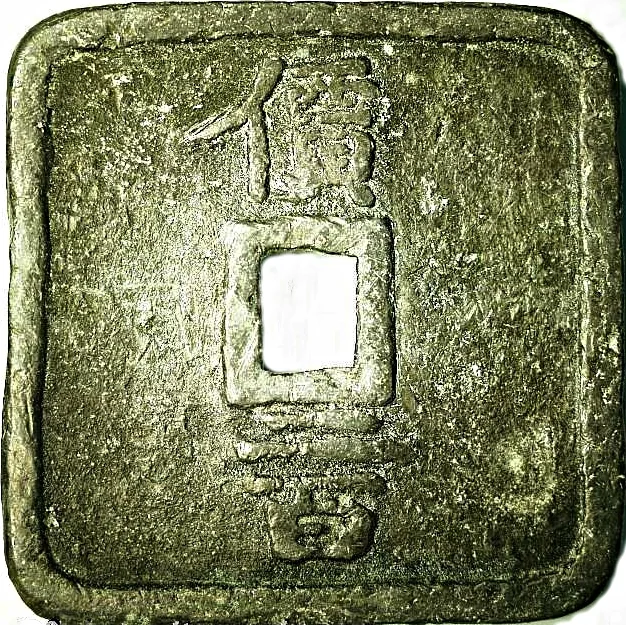
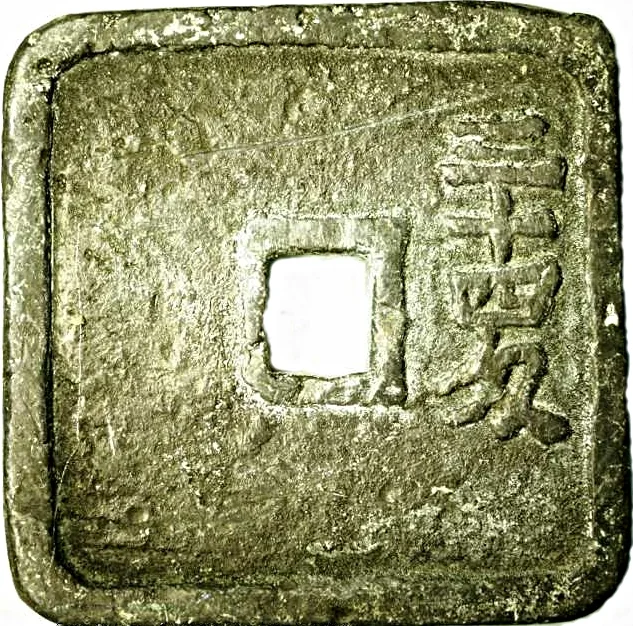
200 mon – Yonezawa Domain
Add to wishlist
Japan
Context
Material
Shape: Square with rounded corners
Composition: Lead
Technique: Cast
Alignment: Medal alignment
flip
References
KM: #
Numista: #59832
Obverse
Description:
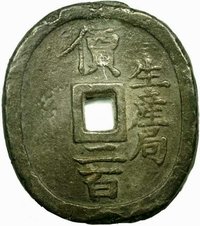
價二百
Inscription:
價
二
百
二
百
Translation:
Value
Two
Hundred
Two
Hundred
Scripts: Chinese (traditional, regular script)
Language: Chinese
Reverse
Description:
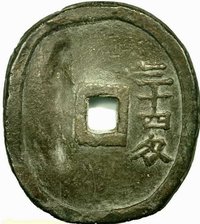
Right of hole: 三十四匁 (34 monme), the coin's weight.
Inscription:
三
十
四
匁
十
四
匁
Translation:
Thirty-four monme.
Scripts: Chinese (traditional, regular script)
Language: Japanese
Edge
Mintings
| Year | Mint Mark | Mintage | Quality | Collection |
|---|---|---|---|---|
| 1866 | — | — |
Historical background
In 1866, the Yonezawa Domain, like many domains in late Tokugawa Japan, faced severe financial strain exacerbated by the complex and often chaotic currency system of the period. The domain's economy was burdened by centuries of sankin-kōtai obligations, poor harvests, and the costly military modernizations demanded by the looming threat of Western powers and domestic unrest. To meet these expenses, Yonezawa, like other domains, had long resorted to issuing its own paper scrip known as hansatsu (domain notes). However, by the mid-1860s, the over-issuance of this scrip had led to significant depreciation and loss of public confidence, creating rampant inflation within its borders.
The situation was critically intertwined with the Bakufu's own monetary crisis. The central shogunate, in a desperate attempt to shore up its finances, had debased the gold and silver coinage, leading to nationwide monetary instability. For Yonezawa, this meant its hansatsu traded at a steep discount against the official—but now debased—coinage of the realm. The domain's scrip also faced competition and confusion from the notes of neighboring domains, which circulated unofficially, and from a proliferation of counterfeit notes. This monetary chaos disrupted trade, eroded the domain's purchasing power for essential goods like rice and weaponry, and placed an immense burden on both the samurai class, living on fixed stipends, and the peasantry.
Consequently, in 1866, the Yonezawa administration, under the reformist leadership of the karō (senior councillor) Chō Kurata, was in the midst of attempting drastic financial reforms. These included austerity measures, promoting local industries like safflower production, and efforts to stabilize the domain's currency. However, these reforms were a race against time, as the domain's monetary weakness directly impaired its ability to prepare for the impending Boshin War (1868–1869). The currency situation in 1866 was thus a acute symptom of Yonezawa's broader fiscal distress, reflecting the collapse of the Tokugawa economic order and the urgent, difficult transition domains faced on the eve of the Meiji Restoration.
The situation was critically intertwined with the Bakufu's own monetary crisis. The central shogunate, in a desperate attempt to shore up its finances, had debased the gold and silver coinage, leading to nationwide monetary instability. For Yonezawa, this meant its hansatsu traded at a steep discount against the official—but now debased—coinage of the realm. The domain's scrip also faced competition and confusion from the notes of neighboring domains, which circulated unofficially, and from a proliferation of counterfeit notes. This monetary chaos disrupted trade, eroded the domain's purchasing power for essential goods like rice and weaponry, and placed an immense burden on both the samurai class, living on fixed stipends, and the peasantry.
Consequently, in 1866, the Yonezawa administration, under the reformist leadership of the karō (senior councillor) Chō Kurata, was in the midst of attempting drastic financial reforms. These included austerity measures, promoting local industries like safflower production, and efforts to stabilize the domain's currency. However, these reforms were a race against time, as the domain's monetary weakness directly impaired its ability to prepare for the impending Boshin War (1868–1869). The currency situation in 1866 was thus a acute symptom of Yonezawa's broader fiscal distress, reflecting the collapse of the Tokugawa economic order and the urgent, difficult transition domains faced on the eve of the Meiji Restoration.
✨ Legendary