

50 para – Yugoslavia
Add to wishlist
Context
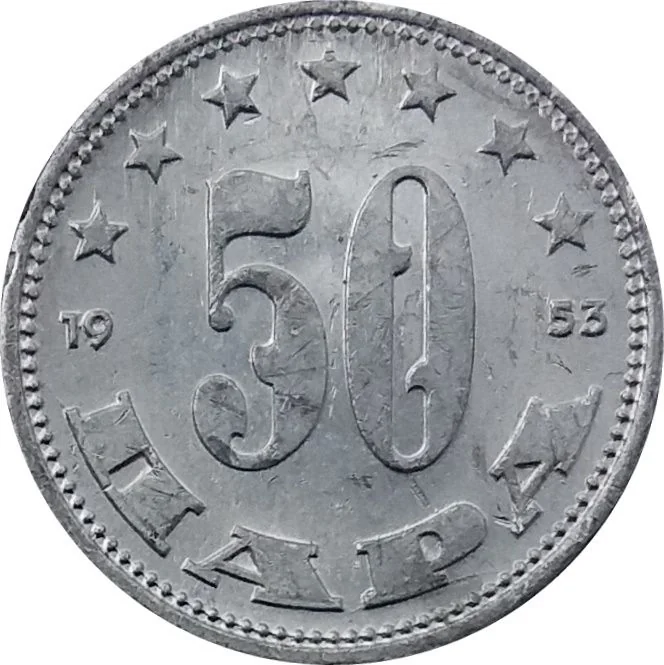
Year: 1953
Issuer: Yugoslavia
Issuing organization: National Bank of Yugoslavia
Period:
(1945—1963)
Currency:
(1944—1965)
Demonetization: 31 May 1968
Total mintage: 60,036,000
Material
References
KM: #
Numista: #5980
Obverse
Description:
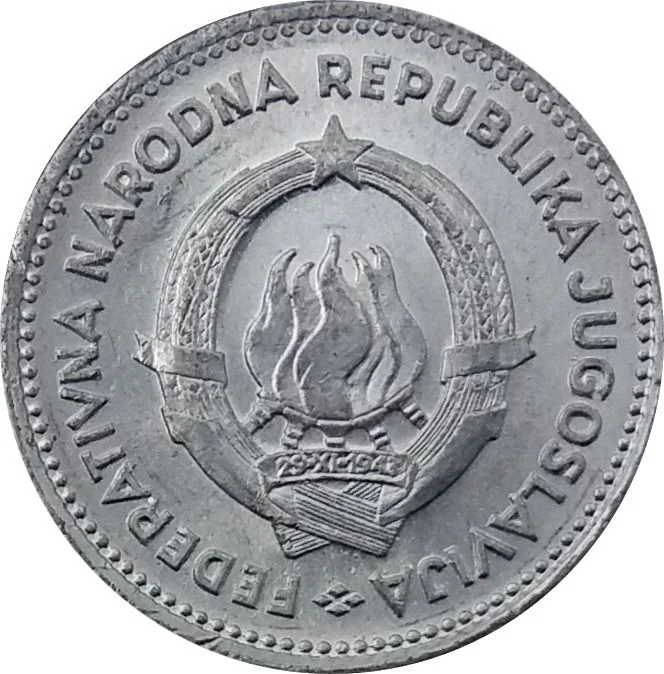
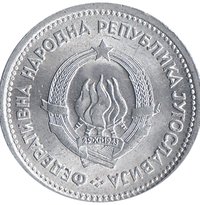
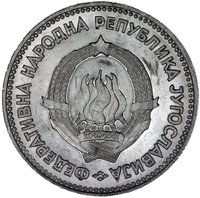
Yugoslavia's emblem (1946-1963) with a circular legend.
Inscription:
FEDERATIVNA NARODNA REPUBLIKA JUGOSLAVIJA
29·XI·1943
29·XI·1943
Translation:
FEDERATIVE PEOPLE'S REPUBLIC OF YUGOSLAVIA
29·XI·1943
29·XI·1943
Language: Serbo-Croatian
Reverse
Edge
Plain
Mints
| Name | Mark |
|---|---|
| Belgrade | — |
Mintings
| Year | Mint Mark | Mintage | Quality | Collection |
|---|---|---|---|---|
| 1953 | — | 60,036,000 |
Historical background
Following the tumultuous post-World War II period, Yugoslavia's currency situation in 1953 was defined by a major monetary reform aimed at stabilizing an economy strained by rapid industrialization, the 1948 break with Stalin's Cominform, and a severe drought. The previous currency, the Yugoslav dinar, had suffered from significant inflation due to wartime destruction, expansive state investment, and the initial costs of establishing a self-managed socialist system independent of both Eastern and Western blocs. By the early 1950s, this inflation eroded public confidence and complicated economic planning, necessitating decisive state intervention.
On January 1, 1953, the government implemented a critical currency reform. This was not a simple redenomination but a complex conversion designed to restrict the money supply and curb inflationary pressures. Old dinars were exchanged for new dinars at varying rates that heavily penalized hoarded cash and speculative capital, while offering more favorable terms for savings in official bank accounts. This discriminatory conversion aimed to soak up excess liquidity, punish the black market, and incentivize the population to use formal banking channels, thereby bringing more financial activity under state oversight.
The 1953 reform was a cornerstone of Yugoslavia's unique economic policy during this period, aligning with the broader shift towards "market socialism" and workers' self-management. While it successfully reset the monetary system and temporarily stabilized prices, underlying structural pressures persisted. The reform underscored the state's attempt to balance socialist control with limited market mechanisms, setting the stage for the country's continued experimentation with its independent economic path throughout the 1950s and 1960s, albeit with recurring cycles of inflation and subsequent stabilizations.
On January 1, 1953, the government implemented a critical currency reform. This was not a simple redenomination but a complex conversion designed to restrict the money supply and curb inflationary pressures. Old dinars were exchanged for new dinars at varying rates that heavily penalized hoarded cash and speculative capital, while offering more favorable terms for savings in official bank accounts. This discriminatory conversion aimed to soak up excess liquidity, punish the black market, and incentivize the population to use formal banking channels, thereby bringing more financial activity under state oversight.
The 1953 reform was a cornerstone of Yugoslavia's unique economic policy during this period, aligning with the broader shift towards "market socialism" and workers' self-management. While it successfully reset the monetary system and temporarily stabilized prices, underlying structural pressures persisted. The reform underscored the state's attempt to balance socialist control with limited market mechanisms, setting the stage for the country's continued experimentation with its independent economic path throughout the 1950s and 1960s, albeit with recurring cycles of inflation and subsequent stabilizations.
🌱 Very Common